Autistic fans help shape comic convention guidance

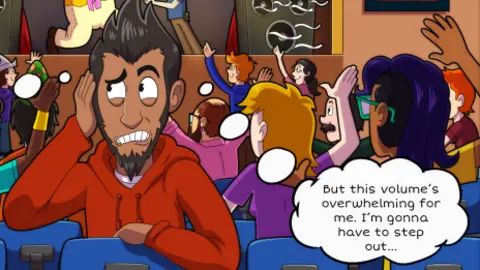 The Collaboration for Comics and Autism/Dekko Comics
Hundreds of autistic people from around the UK have helped shape new guidance on how to make comic festivals and conventions welcoming.
Researchers were taken aback by how many fans took part in an online survey on the issue, as part of the University of Cambridge project.
Prof Jenny Gibson, who expected a few dozen responses, said: "That tells you how many autistic fans there are out there and how much appetite there is for change."
The year-long project identified about 40 potential ways to make the festivals autism-friendly. The guidance has also been turned into a 10-page comic.
Study co-lead Dr Joe Sutliff Sanders said: "At the moment autistic fans are fixing the problems they encounter by themselves.
"We hope the new guidelines will build awareness and encourage change so that they don't have to."
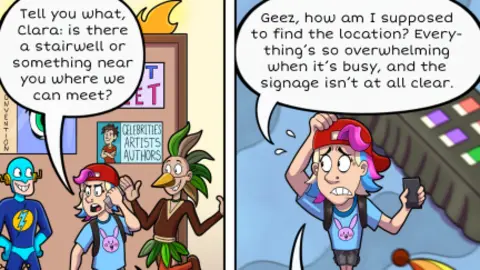 Copyright The Collaboration for Comics and Autism/Dekko Comics
Matt Burke, technical director of the Lakes International Comics Arts Festival in Kendal, Cumbria, said: "Probably the most common problems autistic people experience at festivals and events are things like coping with crowds, noise, and the sheer drain on their social battery."
The former college leader was one of the partners on the Cambridge project.
"Often, [autistic fans] lose confidence at festivals because they don't know what to expect and sometimes they won't go because they don't know [what to expect]," he said.
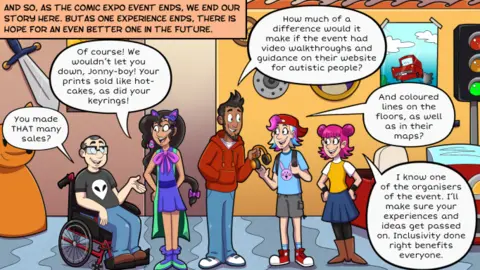 Copyright The Collaboration for Comics and Autism/Dekko Comics
Research suggests about 80% of children with autism spectrum disorder (ASD) enjoy reading comics, compared with about 60% of neurotypical children.
The rate is even higher among those with language disorders, according to the university.
Many participants in the Cambridge study reported a basic lack of awareness of their needs among organisers, inadvertently making these spaces unwelcoming.
Their feedback was explored during two workshops held at the university's Faculty of Education, which included autistic illustrators and artists, comic publishers and neurodiversity advocates.
The recommendations included:
- Creating a "readable" environment for autistic fans, such as using clear and consistent colour coding
- Providing clear information in advance, such as accessible maps and detailed event descriptions
- Designing events for sensory comfort, including offering quiet spaces or access to noise-cancelling/limiting headphone-style ear protectors
- Training volunteers and staff in the basics of supporting autistic visitors
Specialist publisher Dekko Comics created the comic version of the best practice.
Other partners included the Association of Illustrators, the Quentin Blake Centre for Illustration and autistic cartoonists Bex Ollerton and Eliza Fricker.
Follow Cambridgeshire news on BBC Sounds, Facebook, Instagram and X.
