Why Target is under fire over Minnesota ICE raids

 Reuters
Target and other major Minnesota businesses are facing rising discontent from staff, as workers fear the Trump administration's immigration crackdown puts them at risk on the job.
Employees are pushing firms to provide clearer guidance about how to respond if Immigration and Customs Enforcement (ICE) officers arrive at their worksites - and asking them to do more to limit agents' access to stores and parking lots.
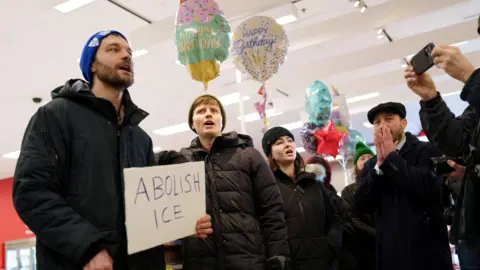
The pressures have been particularly acute at Target, a national name and one of the state's flagship employers, after the detention of two workers inside one of its suburban Minneapolis stores last month.
In the aftermath, more than 300 staff signed an internal letter, seen by the BBC, urging executives to speak up, and take steps to keep ICE officers off Target properties.
Target cashier Sandra Macmillan, 71, said she resigned last month after seeing the videos, which showed masked agents pinning the two employees to the ground in the store's entryway before pushing them into a vehicle, while one shouted: "I'm literally a US citizen".
"I looked online and saw no response from Target," said Macmillan, who had worked for the company in Texas since 2021, calling it "the last straw". "There was no acknowledgement whatsoever."
 Sandra Macmillan
Experts said to what extent firms can restrict access to their properties was a murky legal area.
Target said it had shared resources related to personal safety and ICE protocols with in-store and corporate teams.
Michael Fiddelke, Target's new chief executive who officially took the helm of the retailer this week, told staff in a video message in late January that "the violence and loss of life in our community is incredibly painful".
"We are doing everything we can to manage what's in our control, always keeping the safety of our team and guests our top priority," he said in the video, a transcript of which was reviewed by the BBC.
Still, the company has not publicly responded to the in-store ICE arrests in January, and did not comment on that incident to the BBC.
The tensions at businesses are part of the fallout as US President Donald Trump moves to deliver on his promises of stricter immigration enforcement, a focal point of his winning 2024 election campaign.
He has sent thousands of ICE agents to Minneapolis in recent weeks in an initiative dubbed "Operation Metro Surge", which officials say is aimed at restoring public safety by arresting and deporting undocumented immigrants with criminal records.
The administration's tactics have prompted thousands nationwide to take to the streets in protest. Federal agents shot and killed two US citizens in Minneapolis last month, and migrants with clean records and US citizens have been caught up in the crackdown.
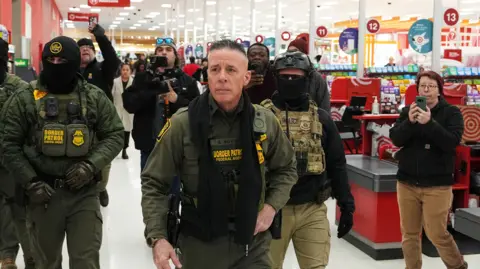
Workplaces have emerged as a key battleground, as officers use them to make detentions.
Anti-ICE activists have responded with protests aimed at businesses, including Target, Home Depot, DR Horton and the Hilton hotel chain. But instances of firms denying service to ICE agents have also drawn swift backlash from the Trump administration.
After a Hilton franchisee near Minneapolis declined to rent rooms to ICE agents, the Department of Homeland Security blasted the firm on social media for impeding law enforcement.
Hilton later cut ties with that franchise. It then temporarily closed other locations in the city, citing security risks.
On Wednesday, the White House said it would start withdrawing some of its ICE agents from Minneapolis, but said that officers have a responsibility to enforce the law.
 AP
APIn the meantime, concerns about safety have pitted employees against bosses.
Late last month, executives at more than 60 Minnesota-based firms, including Target, signed a letter urging "an immediate deescalation of tensions".
But the statement did not mention ICE by name - and did little to quell frustration among employees looking for a stronger pushback.
A Home Depot spokesperson told the BBC that the home improvement retailer "cannot legally interfere with federal enforcement agencies, including preventing them from coming into our stores and parking lots".
Home Depot and Target said they did not coordinate with ICE. DR Horton and Hilton did not respond to requests for comment.
'A line too far'
 ICE Out Now Coalition
The muted response from Target, which is headquartered in Minneapolis and has long been a corporate leader in the state, has drawn particular scrutiny.
It has added to the challenges at the firm, which has struggled to navigate political controversies related to its diversity, equity and inclusion (DEI) practices and LGBTQ merchandise.
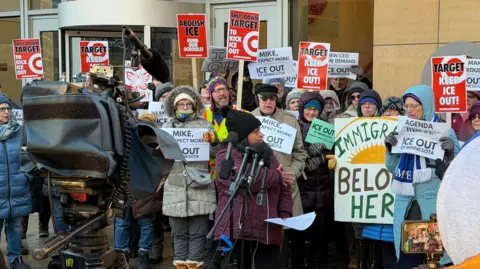
"Target is Minnesota's leading corporate citizen," said Ulla Nilsen, an organiser with the immigrant rights non-profit Unidos Minnesota, which helped organise a rally outside Target's Minneapolis headquarters on Monday.
"As a corporate citizen, are you going to stay silent and allow our democracy to be completely destroyed?"
Five people who worked at Target last month, most of whom spoke to the BBC on condition of anonymity for fear of retaliation, described growing frustration among staff sparked by the ICE response.
One Minnesota-based corporate employee in the marketing division told the BBC he handed in his two-week notice in mid-January, calling Target's handling of the issue "a line too far".
Another staffer, who works at a store in Milwaukee, Wisconsin located in a predominantly Hispanic neighbourhood, said he had not received guidance on what to do if ICE were to be deployed to the area, calling the lack of clarity "discouraging".
But he said he was sceptical of demands that the firm challenge the ICE crackdown more directly.
"With the current administration right now, it seems like ICE kind of has a free-for-all to do whatever they want. And I don't exactly see how Target is going to go against that," he said.
How much can employers do?
At one restaurant, run by a prominent Minneapolis restaurant group, frustration about how executives were handling the issue prompted staff to go on strike for three days in late January, according to Hazel, an employee who asked to be referred to by only her first name.
Last week, the two sides reached an agreement on how to handle ICE, which included posting signs explicitly denying agents access to private areas of the restaurants without a judicial warrant.
But legal experts said companies are in a tough spot when it comes to limiting access.
Access to non-public areas like employee break rooms requires a signed judicial warrant.
But the rules governing "quasi-public" spaces are less clear, which means that in many cases, it is up to employers to make their own assessments, said Jessie Hahn, an attorney at the National Immigration Law Center.
"It's very difficult for employers, because they want to make sure they're addressing their employees' concerns, but also operating within the parameters of the law," Shanon Stevenson, a partner at law firm Fisher Phillips, said.
Activists and worker groups say firms should do more.
Rena Wong, president of the United Food and Commercial Workers Local 663 in Minnesota, said some union members have expressed alarm after workers were seized in parking lots where they work. The union represents grocery store employees at several large chains.
Even workers that are US citizens say they are concerned about being detained because of their race, Wong said. In September, the Supreme Court ruled that it is legal for immigration agents to use race as a factor when deciding who to question about immigration status.
Wong said some chains had adopted policies to limit cooperation with ICE on private property in response. But she added: "The call from employers needs to be stronger, because they are being impacted too, economically."
The Centro de Trabajadores Unidos en Lucha, a Twin Cities worker centre, is campaigning for DR Horton, America's largest home builder, and other large housing developers to speak up.
"These are some of the biggest economic players in the state and nationwide," said executive director Merle Payne, who said ICE agents had visited a DR Horton site in Shakopee, Minnesota at least three times this year.
"They have the power and influence to stand up and demand an end to the raids."
