Private security patrol plans dubbed a 'gimmick'

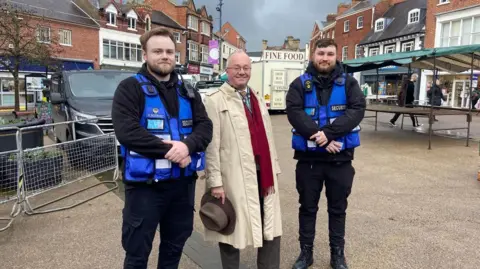 Office of the Leicestershire Police and Crime Commissioner
Plans to deploy private security patrols in towns across Leicestershire and Rutland have been dubbed a "gimmick".
Leicestershire and Rutland's Reform UK police and crime commissioner (PCC) Rupert Matthews said he wanted to recruit "street marshals" from security firms in a bid to prevent crimes like shoplifting and anti-social behaviour.
Matthews said his office would fund an 18-month scheme, costing about £2m, to recruit between 20 and 30 street marshals to work in towns including Coalville and Hinckley.
However, Conservative Leicestershire county councillor for Coalville North Craig Smith branded the move an "astonishing misuse of public money".
"Residents don't want security guards in fancy uniforms wandering around town centres acting as a substitute for real policing," Smith said.
"They want properly trained police officers with the powers to intervene, arrest and prevent crime.
"This is £2m of taxpayers' money being thrown at what can only be described as a gimmick."
Hinckley Liberal Democrat county councillor Michael Mullaney said: "If there's £2m that the PCC has, he should give that to Leicestershire Police for the chief constable to decide how to use in its budget.
"We know there is a shortage of police officers and I think the public would prefer to see more of them in towns."
Matthews said the marshals would not replace regular officers but would be a "visible and uniformed" presence.
The commissioner said they would not have powers to detain suspects but were intended to do a different job to police officers.
Matthews said he wanted the patrols in place by January and that firms bidding for contracts would be vetted with only firms that use staff registered with the government's Security Industry Authority (SIA) considered for tenders.
Melton, Oakham, Uppingham, Market Harborough, Ashby and Loughborough, as well as some larger villages, would also get patrols, according to the PCC.
Matthews said: "The role of the wardens is to prevent crime, rather than respond after it has occurred.
"Preventing crime reduces demand not only on policing but across other public services.
"My responsibilities include commissioning services that improve community safety, and street wardens have already demonstrated their effectiveness in this area.
"Under legislation, PCCs do not have operational control over police officers or staff.
"This is rightly the responsibility of the chief constable, and I fully respect that distinction.
"The public value a visible and reassuring presence in their communities.
"Wardens will become familiar local figures and, importantly, will not be redeployed to support policing in other areas.
"PCCs are due to be abolished in 2028. It would therefore be imprudent to ringfence funding for more police officers - something I am unable to do anyway - given the uncertainty surrounding the future structure of policing.
"The government's plans for potential 'super-force' mergers remain unclear, and police officers cannot be recruited or released at will."
'Evidence-based'
Andy Spence, chairman of the Leicestershire Police Federation, said: "We have concerns about the safety of the public and the security staff.
"We don't believe the PCC should be giving money to private firms and taking money out of the police budget.
"He should use these millions to recruit police officers, PCSOs, or special officers who do have powers of arrest and access to police information systems."
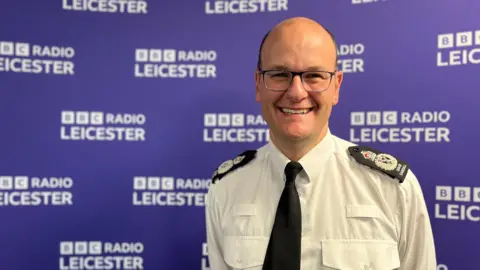
Leicestershire Police's Temporary Chief Constable David Sandall said: "It is important any crime prevention initiative is based on informed and reliable research, is evidence-based and data-led.
"The success of any initiative also requires strong partnership work with partners and communities affected to ensure an effective, sustainable and impactive outcome.
"The police and crime commissioner receives all funding into Leicestershire for policing and crime prevention, and any decision on how this is invested is made by the police and crime commissioner."
Listen to BBC Radio Leicester on Sounds and follow BBC Leicester on Facebook, on X, or on Instagram. Send your story ideas to eastmidsnews@bbc.co.uk or via WhatsApp on 0808 100 2210.
