Breakthrough made with 'problematic plutonium'

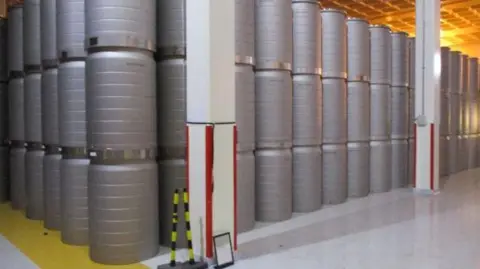 NDA
NDAA portion of "problematic plutonium" has safely been processed into a stable waste form in a UK first, a nuclear disposal group has said.
The UK's Nuclear Decommissioning Authority (NDA) said the can of radioactive residue was the first of 400 to be processed at Sellafield in Cumbria.
The NDA has been tasked by the government to safely dispose of the country's plutonium inventory by locking it in a rock-like ceramic material - a process known as immobilisation.
David Peattie, NDA Group CEO, said processing the first can into a disposable form represented "significant progress", but new technology still needed to be developed for other plutonium forms.
As yet there is nowhere to dispose of the processed residue, with the search continuing for a suitable location for a geological disposal facility (GDF).
In August, it was announced more than £150m would be spent by the government to investigate how best to dispose of the 140 tonnes of radioactive plutonium held at Sellafield.
The site has the world's largest stockpile of the hazardous material.
New technology needed
Sellafield's CEO Euan Hutton said reducing the stockpile would dominate the site's work for decades.
"This achievement means we can deal with some of the more problematic plutonium now, making a start on putting the material beyond reach earlier, and underlines our commitment to deal with the legacy of decades of reprocessing work," he said.
Mr Hutton said the team had "adapted processes to handle material never managed before".
The NDA said immobilisation would address long-term safety and security risks associated with plutonium residue
But the majority of the material was in a more hazardous oxide powder form and could not be processed through existing methods.
This means experts will need need to design new technology to lock it into a stable form for permanent disposal at a GDF.
Update: An earlier version of this story incorrectly stated processed residue could be disposed of in Sellafield's geological disposal facility. This has been corrected to state there is no such facility at the moment and that potential locations are still being sought.
