School pantries mean 'food on table' for families

 BBC
BBCPrimary schools hosting weekly food pantries as part of a council-supported scheme have said the provision puts "food on the table" for families.
North Yorkshire Council launched the programme to provide sustainable and affordable food in 2024, and it has since grown to include five schools.
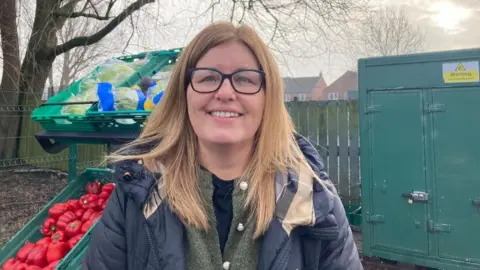
Sarah Dixon, headteacher at Selby's Barwic Parade Community Primary School said its pantry was "an amazing resource" for reducing food waste and supporting families struggling with the cost of living.
"I think people were a little bit apprehensive - what's the catch? But actually the queue gets longer each week, as word spreads that this is for everybody," she said.
"It's such a benefit to have in the community, but I know parents rely on it.
"For our families it means food on the table, food in children's bellies and a really cost-effective way to feed your family."
It's just after 3pm, and true to Dixon's word, a line of people patiently wait by the school gate, bags in hand.
Here, a bag of groceries costs £2, with items such as bread, vegetables and snacks included.
The council supports the school in the initial set-up of the pantry, establishing links between food redistributors such as Fareshare, who are supplied by supermarkets, farmers and other businesses.
"We get all sorts," Dixon said.
"We get really nice fruit and veg in, biscuits - last week we had some really nice rump steak which went down a storm."
The aim is for the school's pantry to then become self-sufficient, with the nominal fee for food covering the cost of buying it from distributors.
Peter Barringer, community outreach manager at Fareshare Yorkshire said the charity supported 380 different projects across the region.
In the past five or six years the charity has seen an increase in schools wanting to be involved in redistributing surplus food, he explained.
"Wherever you get areas of deprivation, or areas of poverty, something like this supports the community, and you're getting good, nutritious food," he said.
"We're able to intercept food that would have otherwise rotted in fields or not be used and make it have a social impact."
According to Fareshare's data, around 270,000 tonnes of edible food can go to waste each year.
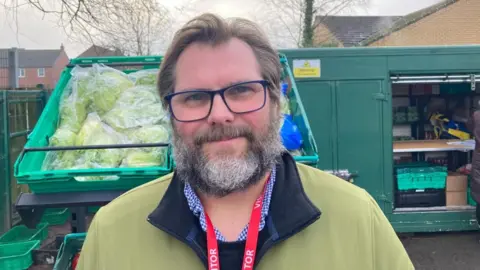
Schools and other groups therefore play an important role in reducing unnecessary food waste, Barringer added, by delivering it directly into the community.
"Across the board, the more schools, the more places that can run projects like this, the more people they're helping.
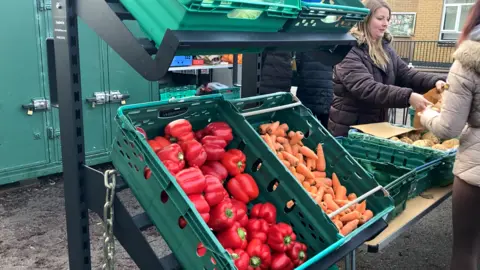
When the school gates are opened a steady stream of parents move along the row of tables, filling up bags from the array of food on offer.
Parent Cheryl Scott said she had been able to pick up "all sorts" of groceries before.
"Because there's a lot of families who don't have a lot, so to know that something like this is available for two pounds, and you can get amazing things, is really good.
"[And] it's nice to know it's not all going to waste."
Frances Tasker, a grandmother of a school pupil, said she found the pantry to be "good value for money" which helped with those on a lower income.
Dixon said the school had been hosting the pantry for "around a year" and felt it had been "really successful" so far.
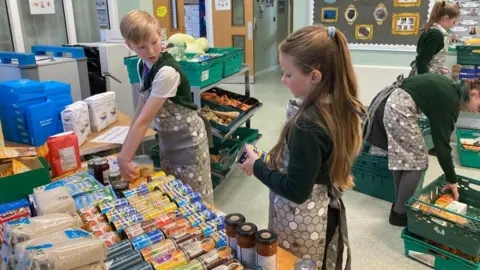
At Malton Primary Academy pupils have a direct involvement in the food pantry, helping to stock shelves and price up the produce.
Julie Peacock, safeguarding lead at the school, said the children fully committed to their job, often convincing parents to take an extra item, or sharing recipe ideas.
Edward, 11, said he enjoyed his role because he liked "helping people in our Malton community" and "doing deals with customers".
Ten-year-old Delilah said she especially liked "making sure everyone was happy", while Emily and Heidi, both 10, loved "meeting new people".
"I just love the smiles on everybody's faces," Emily added.
When parents arrive at the end of the school day, the children spring into action; holding customer's bags, totting up totals and, in Edward's case, upselling a tin or two.
The school works with Ryedale Food Aid, a local charity that provides food and household essentials to causes in the surrounding area, to source the supplies.

"Our parents, families and community have really welcomed it," Peacock added.
"It's just another help, we know it doesn't solve the food problems our families [can] struggle with but it's there - it's open five days a week, so any parent can access it."
Gill Kelly, consultant in public health for children and young people at North Yorkshire Council said the authority was committed to "promoting a healthy lifestyle" from childhood.
"We want our children to have that easy access to good nutrition because we know that it improves behaviour and ability to learn in school," she said.
"The food itself, there is a charge to it, but it does lower food bills substantially.
"So it's a positive impact for household bills and the cost of living, but at the same time then families have such easy access to good, nutritious food."
Listen to highlights from North Yorkshire on BBC Sounds, catch up with the latest episode of Look North.
