The fire-lit WW2 runways that 'saved 10,000 lives'

 BBC
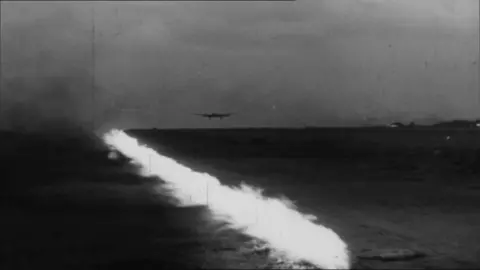
BBCOn foggy nights during World War Two, runways were lit with fire to help guide bombers home.
For thousands of RAF pilots, the system – known as FIDO – meant survival.
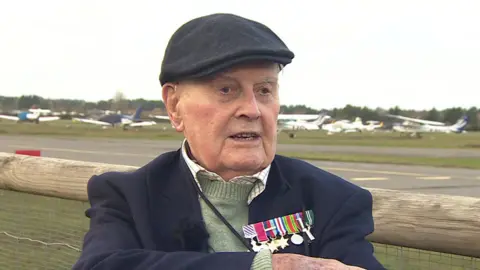
Colin Bell, 104, said it saved his life on three separate occasions – cutting through the darkness to ensure he could land his Mosquito bomber safely.
The veteran visited Blackbushe Airport in Hampshire to share stories and support fundraising for an aircraft's restoration.
 British Pathé
Fog proved such a major hazard to returning pilots that prime minister Winston Churchill ordered the Petroleum Warfare Department to develop a way of dispersing it.
The result was FIDO – which stands for Fog, Intense Dispersal Of – a network of pipes and petrol burners that cleared fog from runways.
It was installed at 15 airfields across the UK, including what was then RAF Blackbushe
"It saved my life three times," said Bell. "And I was incredibly grateful to the boffins that developed it."
He said there was only one option available to pilots landing in fog at airfields without FIDO: flying out to sea and parachuting from the aircraft.
The veteran continued: "There's a great element of luck in one's life, and I've just been incredibly lucky."
He was far from the only pilot whose safety was ensured by FIDO.
Between 1943 and 1945, 2,500 aircraft landed safely in fog thanks to FIDO, saving the lives of 10,000 aircrew, according to the RAF Museum.
It also said FIDO helped to shorten the war by allowing operations to continue when weather conditions might have otherwise halted flying.
 Colin Bell
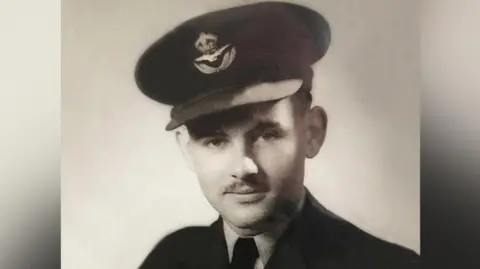
Bell joined the RAF in 1940 and learned to fly in the United States.
He was was one of the RAF's elite pathfinder pilots and flew the famous de Havilland Mosquito twin-engine bomber.
"It was correctly described as the wooden wonder," he said.
"I was in love with it from the time I first flew it, and I'm still in love with it when I think about it."
Bell flew 50 operations over Germany, 13 of which were over Berlin.
He was awarded the Distinguished Flying Cross for his bravery.
But it was another aircraft that formed the focus of Bell's visit to Blackbushe: the 1946 Vickers Viking.
There are only six of its kind remaining in the world and the Blackbushe Heritage Trust is working to restore one as the centrepiece of a new heritage centre.
During his visit, Bell saw the aircraft and said he applauded efforts to return it to its former glory.
He was also able to share the story of another lucky escape that happened on Blackbushe's airfield.
After damaging the undercarriage of his Mosquito, Bell was forced to land on one wheel, an incident he said "put the fear of God" into everyone watching.
You can follow BBC Hampshire & Isle of Wight on Facebook, X (Twitter), or Instagram.
