Wing 'shredded' before fatal paramotor crash, says pilot

 PA Media
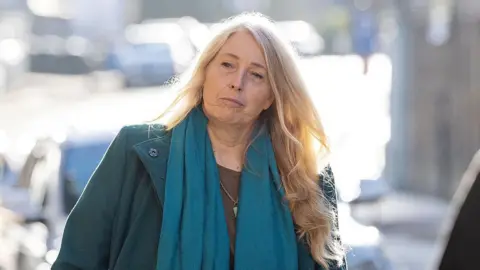
A paramotor pilot believed the wing of her aircraft was "shredded" by the propeller of a fellow flier's machine in a mid-air crash over the Highlands, an inquiry has heard.
Sacha Dench was seriously injured and Devon-based cameraman Dan Burton died when their light aircraft collided near Lochinver in September 2021.
Dench told a fatal accident inquiry (FAI) in Tain she had "pretty much" been flying in a straight line when she felt a "massive vibration".
She said: "I figured my wing had just been shredded and I remember yelling out Dan's name but couldn't do anything. I thought that was his propeller in my wing."
Dench and Burton were attempting a round-Britain challenge to highlight the issue of climate change ahead of the COP26 climate conference in Glasgow when their crash happened.
Climate activist Dench told the inquiry: "I don't remember falling. I remember opening my eyes on the ground."
Asked whether she had been aware of where she and Burton had been in relation to each other at the time of collision, she said "no".
"I didn't know he was anywhere near me," she added.
The inquiry heard extracts from a statement Dench made to the police in May the following year.
She explained she had not been in communication with Burton at the time of the crash.
Her statement read: "I didn't get any response from Dan, but we had not connected via Bluetooth headset at the time.
"You can usually tell (when you are connected) as there is a background noise and he certainly didn't say anything."
 Conservation Without Borders
The inquiry was also shown three videos taken in the minutes before the crash, two of which were recovered from a camera used by Dench and one used by Burton.
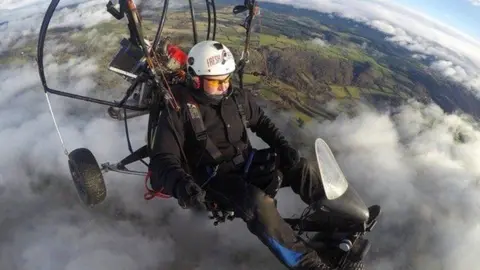
The shots taken by Dench were from what Fiscal Depute Jemma Eadie described as a "selfie angle" and showed her face from below, with her lime green paramotor wing and areas of sky and landscape visible around her.
During both videos, a second paramotor enters shot above her. Dench confirmed it was Burton's aircraft.
The short video clip from Burton's camera showed the top of Dench's wing far below him and visible against a sprawling mountain landscape.
Dench was asked about why in this clip her wing could be seen to rise "sharply" on two occasions.
She replied that there could be "many reasons" for it.
"The air movement could have been upwards, I could have done it to change position," she said.
"It doesn't look like a shocking (change) - it's an ordinary change in altitude."
'Very paranoid'
Earlier Dench told the inquiry that a previous paragliding accident in Wales left her "paranoid" about flying too close to other pilots.
She said: "I was coming into land and another pilot above me caught his knee in my wing and we both landed together.
"I got dragged off the top of the hill, dragged along on my face. I didn't know it at the time but I had broken my arm as well."
Asked what effect the accident had on her, she said she stopped flying in crowded places and had a "very strict rule" of mostly flying alone.
"I essentially was very paranoid about no-one flying close to me," she said.
The inquiry previously heard they had flown together since 2012, including on a conservation project that led Dench to be dubbed the "human swan".
Victoria Andrews, representing the charity Conservation Without Borders, asked Dench why she was happy to fly with Burton despite her earlier accident.
"I trusted him," Dench replied.
"We had flown a lot together, he was very well aware of my style of piloting."
Dench, originally from Australia, also faced a number of questions from her representative, Simon Richards, on how two paramotorists flew together and interacted while in the air.
Asked what an "unsafe" distance between two paramotorists would be, she replied there was "no need to be within 50 metres of another pilot", and that flying to the side of another pilot was safest.
She said you should never fly "directly in front or behind someone", since flying in front of someone generated turbulence, and a pilot could not see what was directly behind them.
Dench confirmed it would therefore be the "duty" of the pilot flying directly behind another paramotorist to ensure they never flew in that position.
She said Burton would sometimes fly directly above or behind her to shoot video or photographs, but "only if we were doing a specific flying protocol".
She went on: "The only time would be if we were in communication and he was specifically telling me where to go.
"Otherwise he would not be anywhere near me."
'Hit head pretty hard'
Richards also asked about communication between the pilots while in the air.
The inquiry previously heard Dench and Burton wore headsets with an "open channel" that automatically connected when they came within about 2,624ft (800m) of each other.
Dench said if either pilot had been out of range for any reason, such as to film a video, there would be an "audible sound" in the headset when they came back into range.
Richards asked: "If you are not in communication with another pilot then your belief would be they are not within range?"
Dench said "yes" and also agreed with Richards' suggestion that if this was the case then a pilot was free to move "up, down, right, left without having to warn" the other pilot.
She was asked by Fiscal Depute Jemma Eadie what gauges and measures she had on board the aircraft for monitoring fuel levels and altitude.
A number of times Dench said she could not remember specific details, and at one point fought back tears as she said: "It was four-and-a-half years ago and I hit my head pretty hard."
The inquiry continues.
