Meet the women protecting India's snow leopards

 Devesh Chopra/BBC
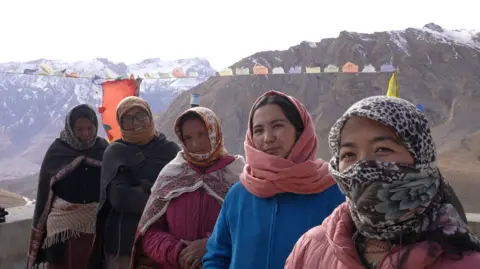
In one of India's coldest and most remote regions, a group of women have taken on an unlikely role: protecting one of Asia's most elusive predators, the snow leopard.
Snow leopards are found in just 12 countries across Central and South Asia. India is home to one of the world's largest populations, with a nationwide survey in 2023 - the first comprehensive count ever carried out in the country - estimating more than 700 animals, .
One of the places they roam is around Kibber village in Himachal Pradesh state's Spiti Valley, a stark, high-altitude cold desert along the Himalayan belt. Here, snow leopards are often called the "ghosts of the mountains", slipping silently across rocky slopes and rarely revealing themselves.
For generations, the animals were seen largely as a threat, for attacking livestock. But attitudes in Kibber and neighbouring villages are beginning to shift, as people increasingly recognise the snow leopard's role as a top predator in the food chain and its importance in maintaining the region's fragile mountain ecosystem.
Nearly a dozen local women are now working alongside the Himachal Pradesh forest department and conservationists to track and protect the species, playing a growing role in conservation efforts.
Locally, the snow leopard is known as Shen and the women call their group "Shenmo". Trained to install and monitor camera traps, they handle devices fitted with unique IDs and memory cards that automatically photograph snow leopards as they pass.
"Earlier, men used to go and install the cameras and we kept wondering why couldn't we do it too," says Lobzang Yangchen, a local coordinator working with a small group supported by the non-profit Nature Conservation Foundation (NCF) in collaboration with the forest department.
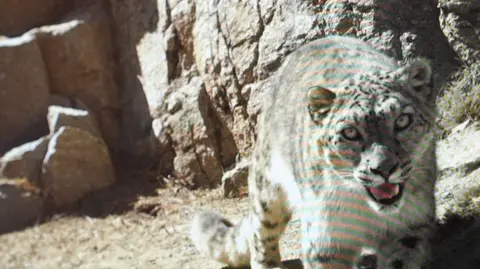
Yangchen was among the women who helped collect data for Himachal Pradesh's snow leopard survey in 2024, which found that the state was home to 83 snow leopards - up from 51 in 2021.
 Spiti Wildlife Division
The survey documented snow leopards and 43 other species using camera traps spread across an area of nearly 26,000sq km (10,000sq miles). Individual leopards were identified by the unique rosette patterns on their fur, a standard technique used for spotted big cats. The findings are now feeding into wider conservation and habitat-management plans.
"Their contribution was critical to identifying individual animals," says Goldy Chhabra, deputy conservator of forests with the Spiti Wildlife Division.
Collecting the data is demanding work. Most of it takes place in winter, when heavy snowfall pushes snow leopards and their prey to lower altitudes, making their routes easier to track.
On survey days, the women wake up early, finish household chores and gather at a base camp before travelling by vehicle as far as the terrain allows. From there, they trek several kilometres to reach camera sites, often at altitudes above 14,000ft (4,300m), where the thin air makes even simple movement exhausting.
The BBC accompanied the group on one such trek in December. After hours of walking in biting cold, the women suddenly stopped on a narrow trail.
Yangchen points to pugmarks in the dust: "This shows the snow leopard has been here recently. These pugmarks are fresh."
 Devesh Chopra/BBC
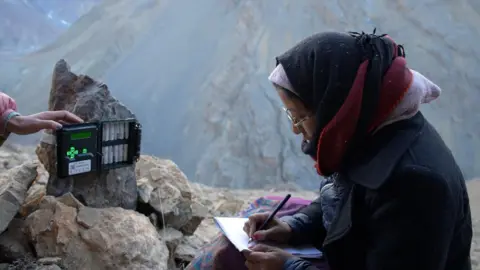
Along with pugmarks, the team looks for other signs, including scrapes and scent‑marking spots, before carefully fixing a camera to a rock along the trail.
One woman then carries out a "walk test", crawling along the path to check whether the camera's height and angle will capture a clear image.
The group then moves on to older sites, retrieving memory cards and replacing batteries installed weeks earlier.
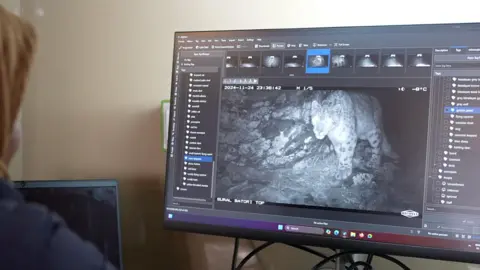
By mid-afternoon, they return to camp to log and analyse the images using specialised software - tools many had never encountered before.
"I studied only until grade five," says Chhering Lanzom. "At first, I was scared to use the computer. But slowly, we learned how to use the keyboard and mouse."
The women joined the camera-trapping programme in 2023. Initially, conservation was not their motivation. But winters in the Spiti Valley are long and quiet, with little agricultural work to fall back on.
"At first, this work on snow leopards didn't interest us," Lobzang says. "We joined because we were curious and we could earn a small income."
The women earn between 500 ($5.46; £4) and 700 rupees a day.
But beyond the money, the work has helped transform how the community views the animal.
 Spiti Wildlife Division
"Earlier, we thought the snow leopard was our enemy," says Dolma Zangmo, a local resident. "Now we think their conservation is important."
Alongside survey work, the women help villagers access government insurance schemes for their livestock and promote the use of predator‑proof corrals - stone or mesh enclosures that protect animals at night.
Their efforts come at a time of growing recognition for the region. Spiti Valley has recently been included in the Cold Desert Biosphere Reserve, a Unesco-recognised network aimed at conserving fragile ecosystems while supporting local livelihoods.
As climate change reshapes the fragile trans-Himalayan landscape, conservationists say such community participation will be crucial to safeguarding species like the snow leopard.
"Once communities are involved, conservation becomes more sustainable," says Deepshikha Sharma, programme manager with NCF's High Altitudes initiative.
"These women are not just assisting, they are becoming practitioners of wildlife conservation and monitoring," she adds.
As for the women, their work makes them feel closer to their home, the village and the mountains that raised them, they say.
"We were born here, this is all we know," Lobzang says. "Sometimes we feel afraid because these snow leopards are after all predatory animals, but this is where we belong."
