Canadian woman found dead surrounded by dingoes on Australian beach

 Getty Images
A 19-year-old Canadian woman has been found dead, with her body surrounded by a pack of dingoes on a popular Australian beach, according to local officials.
The body of the tourist, whose name has not been released, was found around 06:30 local time on Monday (20:30 GMT on Sunday) on the beach on K'Gari, an island off Australia's eastern coast, Queensland police said in a news release.
Two men driving along the beach spotted a pack of about10 dingoes around an object, which they realised was a woman's body, police inspector Paul Algie told local media.
Police are investigating the incident, but cannot yet confirm whether she died from drowning or from being attacked by the animals, he said.
However, Algie said there were markings on the body "consistent with having been touched and interfered with by the dingoes".
"It was obviously a very traumatic and horrific scene for them to uncover," he said.
The woman, who had been working at a backpacker's hostel for the past six weeks, told friends she was going for a 05:00 morning swim, Australia's ABC news outlet reported.
"She was a young woman enjoying a beautiful part of the world, and that's what makes this such a tragedy," Algie said.
A post-mortem is scheduled for Wednesday.
Her body was found near the Maheno shipwreck, which was wrecked and washed ashore in 1935 - its skeletal remains have become a popular tourist destination.
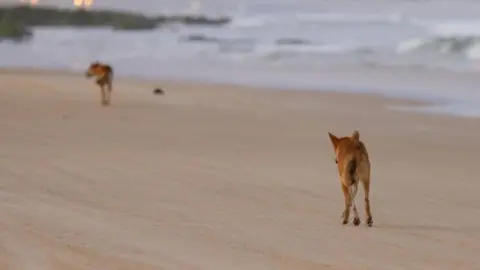
The area is known for its population of dingoes, a wild species of dog protected in Queensland national parks as a native species.
"K'gari is a wilderness area," Algie told local outlets, warning people they should avoid approaching the animals.
"Dingoes are wild animals, and whilst they are very culturally significant to the local First Nations people and to the people that live on the island, they are still wild animals and need to be treated as such."
