Seals stampede video shows risks to animals
Video of two male walkers causing 250 seals to stampede down two beaches in Cornwall has been released to educate people about how to give the animals space in the wild.
The Seal Research Trust said the incident, on 17 December 2023, on the north Cornish coast, was the worst on record in its 25-year history.
It happened on beaches protected as a Site of Special Scientific Interest (SSSI), where seals were a monitored feature, so disturbing them was an offence, it said.
Although an investigation found the incident was not malicious, experts said such events could have "serious negative impacts" on seals, including causing stress and injuries.

 Seal Research Trust
The men walked on to two adjacent beaches, which are not being identified, frightening 87 seals off the first and 163 off the second.
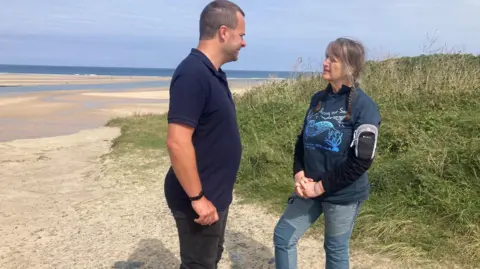
Sue Sayer, from the Seal Research Trust, said she was "devastated" by the terrified seals stampeding to the sea for safety.
She added it was "very distressing for volunteers to watch".
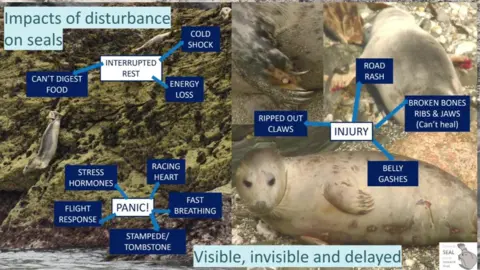
Ms Sayer said the footage had been released to show people what happened when seals were disturbed and how "they race over boulders... rushing" and wasting energy.
She added: "They risk gashing their bellies, catching their claws and having them ripped out, and, for youngsters with no fat to protect them, they can break a rib or a bottom jaw... that can be life-threatening."
 Seal Research Trust
Dan Jarvis, from the British Divers Marine Life Rescue, said: "It was quite shocking and disturbing footage to see on such a scale, and the impact on the animals would have been quite profound."
Ms Sayer said the seals would have been moulting at the time of the disturbance.
She said: "[They would have been] losing their entire fur coat over a three-week period, making them extra vulnerable to energy loss.
"But now we are entering the pupping season, where we have white pups on the beaches, and they are the most vulnerable."
 Seal Research Trust
 Seal Research Trust
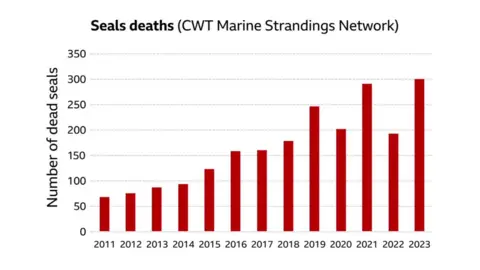
The Seal Research Trust said figures showed that last year more seals died in Cornwall than were born.
Figures said 301 dead seals were found in 2023, with less than 200 white-coated pups being recorded as being born in the same year.
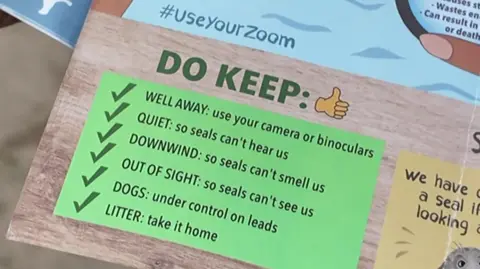
The trust said its advice to people was to stay away from seals if they saw them, and that people should keep their voice down and move slowly.
It added that dogs should be kept on leads and people should watch from cliff tops and use binoculars or camera zoom lenses to get a closer view.
In a statement, Natural England said the 2023 incident was "one of the most significant seal disturbance events we have recorded".
It said: "This was caused by walkers at low tide which inadvertently drove resting seals from the coast and into the sea.
"Events like these can have serious negative impacts on seals, including energy depletion, stress and injuries from stampedes.
“Evidence gathered at the time indicated the disturbance was unintentional and not malicious.
"In such cases, our first action is to inform and educate those responsible rather than taking immediate enforcement action."
Follow BBC Cornwall on X (formerly Twitter), Facebook and Instagram. Send your story ideas to spotlight@bbc.co.uk.
