Exploring eye catching items up for auction

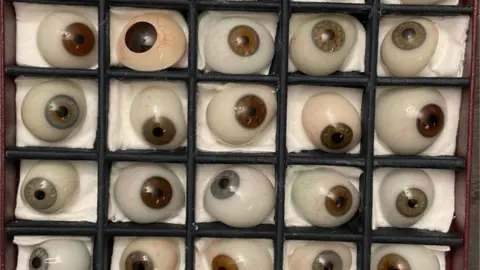 Guy Cooper/Martel Maides Auctions
Going....going...gone. From glass eyes to World War Two liberation plans, some unusual items have gone under the hammer in Devon, Cornwall and the Channel Islands.
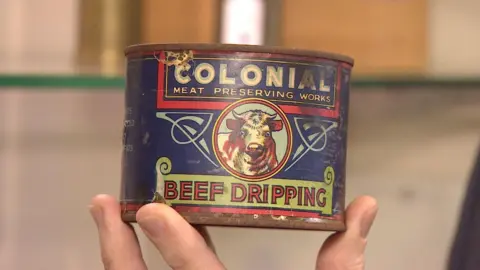
In March 2026 a tin of beef dripping that was taken on the first successful Mount Everest expedition was auctioned for £500 and in 2025 a rare first edition of Harry Potter and the Philosopher's Stone sold at auction for more than £21,000.
But what about these items piqued people's interest and what are some of the most unusual things to have sold?
Royal connections
A collection of 32 letters written by Princess Diana sold for £145,550 at an auction in Cornwall.
The letters written to two of her closest friends, Susie and Tarek Kassem, documented Diana's feelings in the last two years of her life were auctioned by Lay's Auctioneers in Penzance in 2023.
David Lay, from Lays Auctioneers, said it was "a great privilege" to sell them.
He said at the time it was a bit controversial selling the "private" letters but through it they learned how "loved she was".
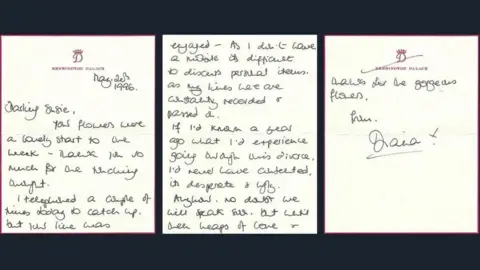 Lay's Auctioneers
He said: "In every case the owner (of the letter) was immensely fond of her.
"Often it's not necessarily the object that we sell, it's the circumstances in which we find them and the backstory that adds such a joy."
Unsuspecting letters addressed to Beatrice Stillman, the former head housemaid at Royal Lodge, are an example of this.
When Stillman's brother-in-law John Dicker was killed in an air raid in 1940, the Queen Mother invited his widow, Stillman's sister, and their two young daughters, Rene and Jean, to play with the princesses at Royal Lodge.
Jean Dicker's son, William Westacott, discovered an archive of letters in 2024 in a suitcase under his mother's bed after she died.
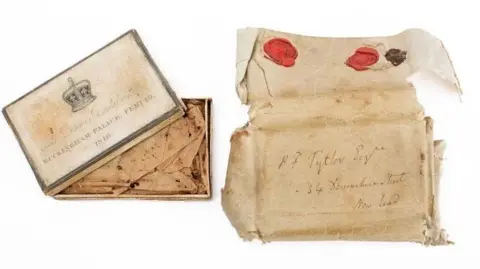 Bearnes Hampton & Littlewood Auctioneers & Valuers
These were penned by Queen Elizabeth II, written while the then Princess Elizabeth was at Praa Sands in Cornwall sometime between 1936 and 1940, at which time she would have been between 10 and 12 years old.
Westacott, from Sevenoaks, said: "We knew the letters existed, but to read them in the flesh was a 'wow' moment."
A quirky food item sold in 2023 was a slice of Queen Victoria's wedding cake. It sold at auction for £700.
Queen Victoria and Prince Albert of Saxe-Coburg and Gotha were married at St James' Palace on 10 February 1840 and it was the first marriage of a reigning English Queen for 300 years.
The cake was still in its original wrapping in a small presentation box bearing the words: The Queen's Bridal Cake, Buckingham Palace, Feb 10, 1840.
The three tiered wedding cake weighed 300 lb (136kg) and it was said after Queen Victoria's wedding to Prince Albert, wedding cakes became more commonplace at receptions across the country.
In November 2024 Flambards in Helston, Cornwall, closed its doors after 48 years due to "rising costs and a steady decline in visitor numbers".
Hundreds of historical items from the former theme park were sold at auction in March 2025.
This included a World War Two Jeep for £12,500 and a full-size mock-up of the front part of a Concorde aircraft, which sold for £17,000.
Some of the more unique items sold at the Flambards auction included a taxidermy cattle head for £880, 1930's and 1940's Bovril ration tins for £550, a fibreglass shark for £980 and an oak railway ticket dispensing machine for £120.
 David Lay Auctioneers
Items from other museums have also sold at auction in recent years, including items recovered from shipwrecks and vintage farm machinery.
In November 2024 artefacts from the Shipwreck Treasure Museum in Charlestown, Cornwall, were sold at auction. These included cannon, crockery, and other treasures.
Prior to the auction the Maritime Archaeology Sea Trust purchased 500 of the most historically significant items, but the 700 remaining lots went under the hammer.
This included coal recovered from the wreck of the Titanic which sold for £1,500.
Another unusual find in the sale was an early deep sea diving suit, 'Siebe Gorman' style with a brass fully-enclosing helmet with front weight and metal and leather diver's boots. This sold for £820.
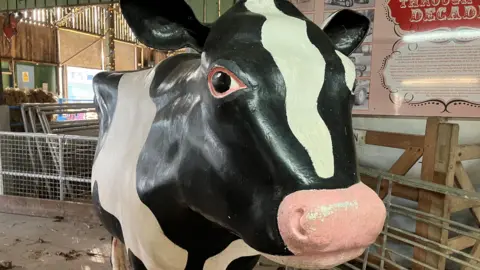
In January 2025, items from Dairyland Museum, near Summercourt, were auctioned off after it announced its closure in September 2024.
This included the attractions first mascot, a modern cyber-cow named Clarabelle which could be milked by children. It was bought by an online bidder for £1,900.
Why are items like Clarabelle interesting for buyers?
Who will want it?
Lay said it was a "broad range" of people.
He said it could be people who "just want to furnish their homes with something a bit unusual ... or it can be people with a passion for that one field."
Guy Cooper, an auctioneer at Martel Maides Auctions in Guernsey, said he did not think "unusual" and "one-off" items had a specific type of collector.
He said people would walk into the sale room and think "Oh, wow, that's really weird. That would be quite a fun thing to have in our house".
"You don't know who's going to want it, and there will be people who don't know they want it until they see it," he added.
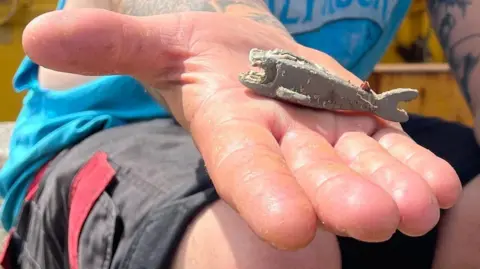 Richard West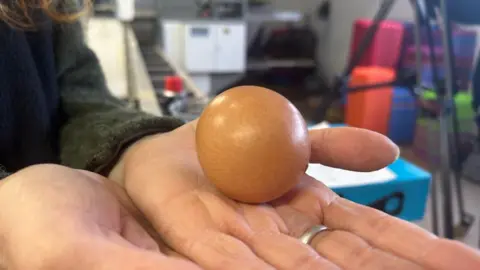
Cooper said: "A thing that happens in the Channel Islands that you don't get so much in the UK is the auction of number plates.
"We sold 111 last year for £270,000, which was pretty remarkable, and a couple of years previously we sold 007 for £240,000."
In June 2025 a 2012 Peugeot hatchback with a J69 number plate sold for £230,000.
Unusual numbers have always been popular, more than a decade ago in 2013 a JSY1 plate sold for £65,000.
Items too weird to sell?
Copper said: "I've never kind of come across something that someone's bought in and I've thought, that's too strange to sell.
"If you are kind of daring enough to buy something interesting like that. you're kind of marking yourself apart... it's just kind of a good conversation piece."
He added last year he sold a box of 50 early 20th Century French glass eyes.
"Weird on paper but kind of quite beautiful in their own way," he said.
 Hansons Auctioneers
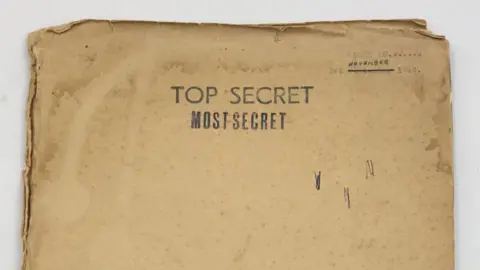
In 2025 a copy of a top secret plan for the liberation of the Channel Islands, which had been occupied during World War Two, sold at auction in 2025 for £3,800
The 50-page document, codenamed Operation Nestegg, was discovered in a cardboard box in Derbyshire.
At the time auctioneers Hansons described it as a "piece of history".
In Jersey history has also been prominent at auctions.
It as signed Henry R on 6 December 1513 at Windsor Castle, when he was 22 years old.
He was giving his approval for the supply of cloth and other materials to the royal household to be made into gowns and other garments.
It sold for £30,000.
'Tastes change'
Lay said fashions came and went as sometimes the "most wonderful pieces of antique furniture" were no longer in demand.
He said at the moment they had a 1760 Gainsborough Chair that would "struggle to make £2,000" because it was "out of fashion".
Lay added: "Forty years ago these chairs just used to be so popular and sell for tens of thousands of pounds."
Cooper said: "Tastes change, so what may once have been terribly important to one family member isn't to the next generation."
He added that despite this when people find a set of glass eyes or mummified cat "we certainly enjoy it".
Follow BBC Guernsey on X and Facebook. Follow BBC Jersey on X and Facebook. Send your story ideas to channel.islands@bbc.co.uk.
