Newcastle 2026 local elections: All you need to know

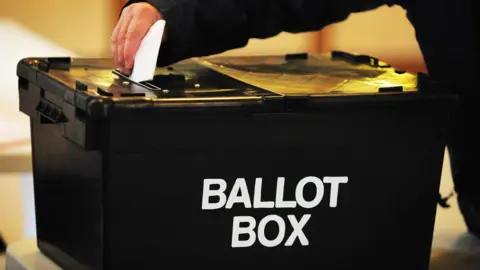 PA Media
Newcastle City Council has an all-out election Thursday 7 May, where all 78 council seats will be contested.
Voters will go to the polls to pick three councillors to represent their ward.
Information about who is standing for the local council elections in Newcastle will be released closer to the time.
The deadline to register to vote is Monday 20 April and can be done online.
The Labour Party runs a minority administration at Newcastle City Council with the parties split as follows:
- Labour - 34 seats
- Liberal Democrat - 22 seats
- Independents - six seats
- East End and Associates Independents - six seats
- Green Party - four seats
- Newcastle Independents - three seats
- Conservatives - one seat
There are currently two vacancies.
Who is standing in Newcastle?
Labour, the Liberal Democrats, the Green Party and Reform UK are all standing full slates of 78 candidates in Newcastle.
The Conservatives will have 35 candidates.
Rather than defending her seat in West Fenham, council leader Karen Kilgour is instead standing in Blakelaw and Cowgate.
This election will also mark the end of former council leader Nick Kemp's 24-year spell on the local authority. The Byker councillor, who quit the Labour Party in 2024 after resigning as council leader, is not seeking re-election.
The Imagine party, the Party of Women and the Communist Party of Britain will each have one candidate.
Two candidates each will be standing for the Trade Unionist and Socialist Coalition and Newcastle Independents.
There are also four independent candidates.
How to vote
Polling stations will be open between 07:00 and 22:00 BST, and photo ID is required to vote.
The council will send out polling cards nearer the time, with details on where to vote.
Voters can select up to three candidates. You do not need to use all the votes but three councillors will still be elected per ward.
Representatives will help shape the direction of the local authority, which is responsible for services like bin collections and planning applications.
An application for a postal vote must be submitted by 21 April and the deadline to submit an application to vote by proxy is 28 April.
Newcastle City Council said 132 polling stations would be open and votes are expected to be counted on Friday 8 May.
It said it planned to declare 13 of the 26 wards at about midday, and the other half in the afternoon.
Analysis by Luke Walton, BBC North East & Cumbria political correspondent
This year's local elections in Newcastle are likely to see some significant changes – with all 78 council seats up for grabs due to boundary changes.
Labour will face a struggle to hang on to power in the face of a three-pronged assault from Liberal Democrats, Reform UK, and the Green Party.
The city has been Labour-led since 2011 and the party has dominated local politics for four of the last five decades.
But in recent years Labour has been hit by personal and policy splits and lost its council majority in November 2024 after six Labour councillors became independents.
That left Labour's Karen Kilgour, Newcastle's first female leader, being forced to run the authority as a minority administration.
The Liberal Democrats, who ran the council between 2004 and 2011, are the second largest party and will be hopeful of making gains.
But their progress may be limited by the rise of the Green Party who won their first two councillors in the city in 2024, and have since doubled that total with a by-election victory and a defection from Labour.
The Greens will hope support from the city's large student population and recent success in the national opinion polls will propel them to further gains.
Their profile has been further raised by the announcement last December that the former Labour North of Tyne Mayor Jamie Driscoll had joined the Green Party and would bid for a return to the council chamber under his new political colours.
But it is Reform UK many expect to make the biggest inroads.
The party currently has no councillors in the city but came a strong second in two of Newcastle's parliamentary seats in the 2024 General Election.
Wards in Newcastle's economically deprived West and East ends are likely to be Reform targets.
As for the Conservatives, in 2024 they won their first council seat in Newcastle for more than 30 years, with retired GP Doc Anand making the breakthrough in Gosforth.
But the city as a whole remains difficult territory for the Tories and hanging on to that single seat is likely to be their main target.
An assortment of different independent groups across the city – some with strong local connections - makes the election even more unpredictable.
The contest comes shortly after the Labour-led administration announced a 4.99% council tax rise, 75 job losses and £4.9m of savings for 2026/27.
Labour says its plans will also see £50m of investment in local roads and streets, 15,000 new homes and help tackle rising demand for social care and Special Educational Needs and Disabilities in schools.
But opposition councillors claim complaints around litter, park maintenance and the delays affecting a £40m project to rebuild a leisure centre in West Denton reflect a lack of political direction.
