US says it shot down Iranian drone flying towards aircraft carrier

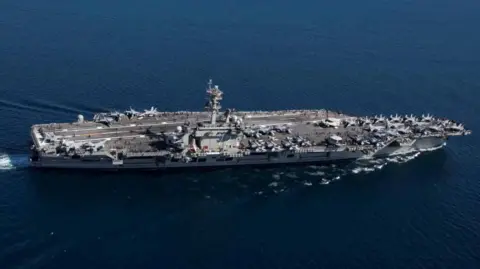 US Navy via Reuters
An Iranian drone was shot down as it "aggressively approached" an American aircraft carrier in the Arabian Sea on Tuesday, a US military spokesman has said.
An F-35C stealth fighter jet which took off from the USS Abraham Lincoln warship shot down the drone "in self-defence" to protect the aircraft carrier and its personnel, US Central Command spokesman Capt Tim Hawkins said.
The ship was approximately 500 miles from the Iranian coast when the drone approached it with "unclear intent".
No US equipment was damaged and no service members were harmed.
It comes as the US continues to build up a military presence in the region, with tensions high between Washington and Tehran.
US President Donald Trump has threatened to take military action against Iran if it does not negotiate an agreement to restrict its nuclear programme.
He previously raised the prospect of intervening during Tehran's deadly crackdown on anti-government demonstrations.
Speaking after the downing of the Iranian drone, White House Press Secretary Karoline Leavitt told Fox News that negotiations between the US and Iran are still scheduled for later this week.
She said Trump "remains committed to always pursuing diplomacy first", but added he "has always a range of options on the table, and that includes the use of military force".
Iran's Supreme Leader Ayatollah Ali Khamenei has previously warned that any attack on the country would spark a "regional war".
Tehran has not commented on Tuesday's drone incident.
In a separate incident on Tuesday, the US military said Iran's Islamic Revolutionary Guard Corps (IRGC) forces had "harassed a US-flagged, US-crewed merchant vessel" in the Strait of Hormuz - the world's busiest oil shipping channel.
Military support "de-escalated" the situation and the tanker proceeded safely, Capt Hawkins said.
Also on Tuesday, Leavitt said US special envoy Steve Witkoff, Trump's most senior overseas envoy, will attend the talks on behalf of the White House.
US media had previously reported he would meet Iran's Foreign Minister Abbas Araghchi in Istanbul on Friday, with the foreign ministers of Egypt, Oman, Pakistan, Qatar, Saudi Arabia and the United Arab Emirates also invited.
But US news website Axios has since cited two sources as saying Tehran wanted the venue moved to Oman, with only Iranian and US officials present.
The US had agreed to this request, the website reported, citing an Arab source. The BBC has reached out to the White House for comment.
Earlier on Tuesday, Iran's President Masoud Pezeshkian said Iran was ready to negotiate with the US "provided that a suitable environment exists".
Ahead of the planned talks, Washington has repeatedly reminded Tehran of the US strikes on Iran last year, which Trump said had "obliterated" the country's nuclear enrichment facilities.
He said a fresh attack would be "far worse" than those air strikes, which were launched last June during Israel's 12-day war with Iran.
The Israeli military also targeted Iran's nuclear facilities and scientists during a short direct conflict, as well as its military commanders and missile arsenal.
Tehran responded to the strikes by launching hundreds of missiles and drones at Israel. It also carried out a missile attack on a major US air base in Qatar.
Iran has insisted its nuclear programme is entirely peaceful and denies that it is seeking to develop nuclear weapons.
Last week, Trump told reporters at the White House that Iranian officials "do want to make a deal", and that they must commit to "no nuclear" and to "stop killing protesters".
The US-based Human Rights Activists News Agency (HRANA) has said it has confirmed the killing of 6,424 protesters, 152 children, 214 people associated with the government, and 58 bystanders. It is also investigating reports of another 11,280 deaths.
Norway-based Iran Human Rights has warned that the final toll could exceed 25,000.
Iranian authorities have acknowledged that at least 3,117 people were killed, but said the majority were members of the security forces or bystanders killed by "rioters".
The unrest was sparked by anger over the collapse of the Iranian currency and soaring cost of living, but it quickly developed into demands for political change.
Khamenei described the unrest as "sedition" orchestrated by the US and Israel.
