AI crowd counter confuses people with rock columns at Giant's Causeway

 Getty Images
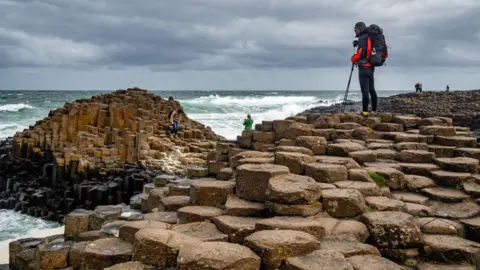
An attempt to count visitors at the Giant's Causeway using Artificial Intelligence (AI) failed because the software could not distinguish between people and the famous hexagonal rock columns.
AI software was used to analyse commercially available drone footage of crowds at the causeway, which is near Bushmills, County Antrim.
However its rock formations share visual features with human figures when viewed from a top-down drone perspective which confused the AI.
The researchers suggest this is because the data used to "train" the AI software model "may not include enough examples of the Giant's Causeway or similar environments, leading the model to generalise incorrectly".
The work was commissioned as part of a wider project by the UK government's Department of Culture, Media and Sport to explore the use of digital technology to assess visitor numbers at non-ticketed events.
The researchers from the University of Glasgow used yolo-crowd, an open-source AI model used for crowd counting and face detection.
They found that "the performance of the object detection model was poor when applied to Giant's Causeway footage, failing to arrive at a plausible count for attendance in this setting".
 Getty Images/Pat Batard
They explained that the model over-counted attendance because the hexagonal rock formations appeared too similar to people when viewed from above.
"Object detection models rely on patterns like shape, texture, and contrast to recognise objects," they added.
"Here the rocks and humans have similar contours, shadows, and colours, the model may misclassify the rocks as people.
"This happens because the training data may not include enough examples of the Giant's Causeway or similar environments, leading the model to generalise incorrectly."
They suggested that the AI approach would work in future if the model was trained with "considerably more data" and if more expensive high resolution drone filming was used.
