Record number of children in temporary housing

 Getty Images
The number of children living in temporary accommodation in Scotland is at the highest level on record, according to the latest figures.
There were 18,092 households and 10,480 children living in temporary accommodation as of September 2025 – increases of 9% and 1% respectively on the previous year.
The number of open homeless cases also reached a record high, while there was a rise in reports of rough sleeping.
However, the number of households assessed as homeless or threatened with homelessness was down slightly, as was the total number of homeless assistance applications.
As of September, the number of households with open homeless assistance applications to their local authority was 33,006, a 4% increase on the previous year.
Applications from those with refugee or leave to remain status accounted for 16% of that total, with applications from those groups up by 51%.
Between April and September last year almost 2,100 households reported a household member experiencing rough sleeping in the three months prior to application, and almost 1,500 the night before - rises of 16% and 24% respectively.
The number of instances of households not being offered temporary accommodation - which includes furnished local authority properties as well as hostels and B&Bs - also increased from 7,565 to 10,710.
However, there was a 4% fall in the number of adults (to 19,469) and a 14% decrease (to 7,304) in the number of children associated with homeless households compared to the previous year.
 Getty Images
Ministers declared a national housing emergency in 2024 and pledged last year to invest up to £4.9bn in affordable homes over the next four years.
Yet progress has slowed in recent months. As of September, 31,064 affordable homes had been completed. In the year until then there was a 5% drop in all sector housebuilding and an 8% decrease in completions, compared to the previous year.
The Scottish government has also passed housing reforms which will allow councils to cap rent increases in designated areas. Ministers also say the changes will strengthen protections for tenants and introduce a "gold standard" in homeless prevention.
Last month, First Minister John Swinney announced plans to create a national housing agency to help boost home building.
 PA Media
Housing Secretary Màiri McAllan said: "The number of people assessed as homeless and seeking support for homelessness has fallen and with so much work done in recent months, this is encouraging.
"However, there is still much to do and we are determined to turn the tide and ensure everyone has the opportunity of a place to call home."
She said the figures showed housing services were under "severe pressure" due to the Home Office's "mismanagement of the asylum system, particularly in Glasgow".
Glasgow houses more asylum seekers - about 3,800 - than any city outside of London.
Glasgow City Council leader Susan Aitken told BBC Scotland News last year that the city had essentially "run out of temporary accommodation".
The Home Office has been asked to comment.
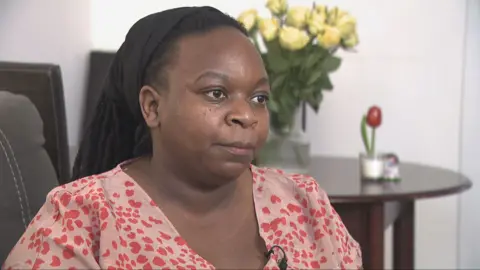
Mary, a healthcare support worker and student nurse, came to Glasgow in 2020 as an asylum seeker from Kenya.
She spent more than five years in temporary accommodation provided by either the Home Office or the local authority.
Mary, who now lives in Possilpark having been granted refugee status, said that at one stage she had to share a bed with her daughter in cramped, mouldy accommodation under the constant fear of being moved at short notice.
"It was sad and it was so stressful," Mary told BBC Scotland News. "It was taking a bad toll on our mental health."
Homelessness 'the new normal'
Shelter Scotland director, Alison Watson said: "Today's figures show how high levels of homelessness are increasingly accepted as the new normal.
"Social housing delivery remains too little, too slow, too late for Scotland's homeless children stuck in temporary accommodation."
Councillor Maureen Chalmers, Cosla spokesperson for community wellbeing, described the figures as "disappointing".
She added: "Whilst we are seeing some progress including fewer breaches of unsuitable accommodation orders, homelessness continues to have a profound impact on individuals and families across our communities."
Scottish Conservative housing spokeswoman Meghan Gallacher described the statistics as "appalling".
She said: "The SNP must urgently cut red tape, encourage investment and deliver the homes needed – but they seem totally incapable of doing so."
Scottish Labour's Mark Griffin said John Swinney should "hang his head in shame" over the government's record.
"We have had years of warm words and empty promises from a succession from SNP ministers, but the number of kids spending their childhood stuck in temporary accommodation is at its worst point ever," he said.
The Scottish Liberal Democrats said the situation had continued to worsen, adding: "It's clear housing is not a priority for the SNP."
