'Before Cortina d'Ampezzo we had Rother Valley'

 BBC
BBCThe glamorous Italian ski resort of Cortina d'Ampezzo, known as the "salotto dei famosi" - celebrities' living room - has attracted A-listers for decades, including George Clooney, Frank Sinatra, Audrey Hepburn, Sophia Loren and Brigitte Bardot.
As its challenging slopes are given a final polish ahead of the 25th Winter Olympics, it is a far cry from a large grassy hill in Rotherham which just under 40 years ago played host to a very different type of skiing competition.
In 1988, Martin and Graham Bell had already competed for Great Britain in several Winter Olympics.
But after their father, who worked for the RAF, moved the family home from Edinburgh to Harrogate, the grass skiing slope at Rother Valley Country Park on the site of the former Brookhouse Colliery became a regular training base.
Lining up at the British Grass Skiing Championships in 1988 were not only the brothers, but also members of the local South Yorkshire Grass Ski Club, founded a few years previously through the University of Sheffield.
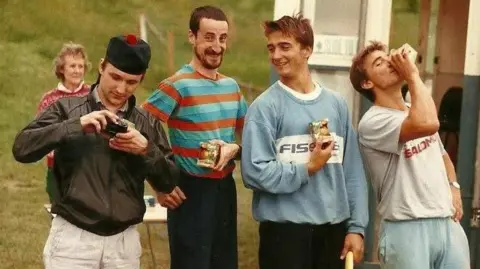 Molly Gill
According to the younger Bell brother Graham, who had been grass skiing in Scotland since he was 11, grass actually gave a "decent grounding" for skiing on snow.
"Obviously the skis are very different," he says.
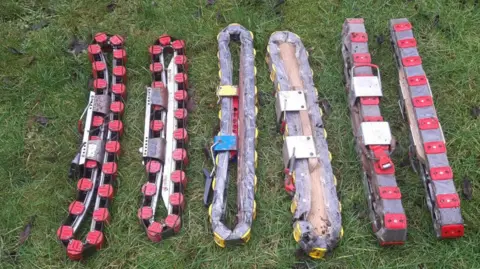
"They're like caterpillar tracks which are impossible to skid and side-slip, but you do go really fast and you roll your knees from side to side to create the turn.
"You can't get a full grip on dry slopes but on grass skis you can lean them over and grip well but you couldn't snow-plough and the only way to stop was to turn back up the hill and do a big turn."
Cleaning the grass skis would prove a tedious chore however.
Most oil to make the skis slicker and run faster was banned as it would kill the grass, but according to Molly Gill - Sheffield Sharks Ski Club founder and the secretary of South Yorkshire Grass Ski Club - vegetable oil was the preferred lubricant.
"They were horrendous to clean. Think of a thin tractor wheel, that's what they were like - though we used a normal Alpine boot," she says.
"You'd ski all morning and then spend the rest of the Sunday cleaning the skis with soap and water from a bucket.
"It wasn't just the grass but the oil and grass would clog."
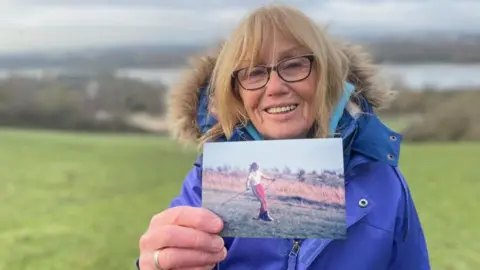
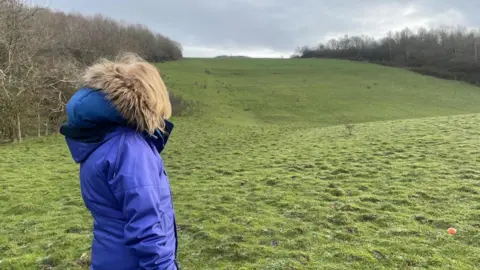
Looking down at the 300m (985ft) drop from the top of the grass hill at Rother Valley to the lake below, Gill, 82, reflects on the changes to the site.
"It seems even steeper that I remember," she says.
"I wouldn't want to grass ski on it now. It's like a mini mogul field."
Back in the 80s, the university group originally maintained the slope with regular mowing until, according to Gill, a cheaper more effective alternative was found.
"It got quite expensive to mow it before every competition so someone came up with the idea of getting sheep here during the week and they ate all the grass.
"Only problem was if we fell when skiing you'd often land in sheep droppings which wasn't very pleasant."
 Paul Grange
The university team attracted members of all abilities.
Many went on to represent Great Britain at grass skiing events around Europe, including the slalom winner at the 1988 British Grass Skiing Championships, Paul Grange.
The former Sheffield student swapped the high-octane life of grass skiing a long time ago for a life on the canals, running a canal tours business from Victoria Quay in Sheffield for the last 30 years.
"I used to coach skiing in the winter and then work on the canals in the summer – it was the perfect balance," he says.
Grange, 62 still looks back at his time grass skiing very fondly.
"We actually trained at Meersbrook Park in Sheffield too," he says.
"The council gave us a little shed and we kept a makeshift lift in there.
"It was basically a rope ski tow with a 7 horse-power engine with belts locked onto the rope."

The tour operator admits he and his peers did "have to be a bit mad" to do what they did.
"You basically went at 30mph down the grass. You could touch 50 on some hills but stopping is an irrelevant concept.
"You just want to get down as fast as possible, acceleration.
"It was always classed as the hard man's version.
"Sometimes the skis stopped and you didn't so it was hairy."
While Grange still has a collection of grass skis piled up in his garage at home, he has no plans to dust them down anytime soon.
"You've got to walk up the hills now. It's too hard."
The opening of the Sheffield Ski Village at Parkwood Springs in 1988 eventually pulled focus away from Rother Valley and the variety of artificial slopes meant most lost interest in grass skiing.
However when the snow melts it is still an activity enjoyed across Europe in the summer months, particularly in the Alpine ranges of Switzerland, Austria and Italy.
The Winter Olympics get under way on Friday.
Listen to highlights from South Yorkshire on BBC Sounds, catch up with the latest episode of Look North
