Fatal crash 'likely' caused by epileptic seizure

 BBC
BBCA driver who hit and killed a woman walking to a Take That concert suffered a number of "weird" episodes linked to undiagnosed epilepsy before the crash, a court has heard.
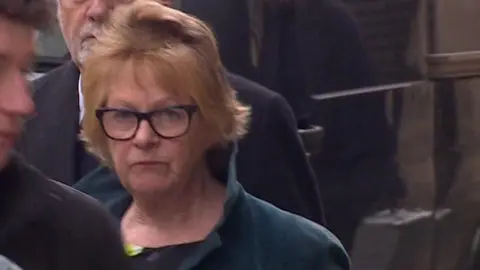
Fiona Hodge, 69, of St Werburgh's, Bristol, is on trial for causing death by careless driving after Donna Crossman, 53, died after the incident in 2024.
She told Bristol Crown Court she had "no recollection" of the moments leading up to the crash and had since been diagnosed with epilepsy by neurologists.
Prof Simon Shorvon, a world-leading expert in the condition, said Hodge had a history of incidents in the months and years before the crash that were consistent with complex partial seizures.
Hodge was seen driving erratically moments before mounting the kerb and hitting Crossman, but told the court she did not recall doing so.
Shovorn, acting in his capacity as an expert witness, told the court he thought it was "70 to 80% likely" a complex partial seizure had caused the incident.
The second expert witness - fellow consultant neurologist Dr Colin Mumford - said in an initial report he believed it was "vanishingly unlikely" Hodge had suffered a seizure, but later revised this opinion.
He told the court it was "more than 50% likely" the crash had happened because the defendant had a seizure while driving.
Mumford said someone having a partial seizure could appear to behave in an "odd" manner, rather than the total loss of consciousness normally associated with epilepsy.
Epilepsy cannot be diagnosed with one specific test, meaning doctors instead have to rely on a patient's history to reach a diagnosis.
Shovorn and Mumford told the court a number of "weird" episodes suffered by Hodge were indicative of undiagnosed epilepsy.
The episodes included what the defendant initially believed to be "sleepwalking" events, including one in which she emptied a bottle of wine on the floor and put kitchen knives in wellington boots.
She also recounted an event while making dinner, where she suddenly found herself in the living room covered in tomato soup, and another where she stopped talking mid sentence during a phone call with her son and later had no memory of the phone call.
 Stephen Price
In evidence, Hodge said she became aware of the moment she struck the kerb during the fatal crash.
"I do recall an incredible jolt which was a combination of a very loud sound and a terrific sense of movement," she said.
"I was then in a sudden extremely rapid sense of consequences... I was on the kerb... and in front of me were three women.
"In the moment of hitting the kerb and looking through the window, I saw those women. It was so quick, the windscreen was smashed and the car came to a halt."
She told the jury that in the immediate aftermath of the crash, which caused Crossman to fall over railings into a skate park below the bridge, she had remained in the car in "a complete state of shock".
"I was uninjured [though] I was terribly upset and very confused. The time I was in the car I looked ahead and didn't look out of the windows left or right... we were almost constantly silent," she said.
Responding to a question from her defence barrister Ian Bridge about what she had said in the immediate aftermath, Hodge recalled how she had said to her friends travelling in the car with her: "I think I may have killed someone."
The court also heard how Hodge, who told police immediately after the crash that she did not believe she had suffered a medical episode, had visited her GP after learning of Crossman's death to establish if she had to help her "find a reason" she had "driven in such a way".
"I did this at the time in the general spirit of trying to help the police with their inquiries," she added.
The trial continues.
Follow BBC Bristol on Facebook, X and Instagram. Send your story ideas to us on email or via WhatsApp on 0800 313 4630.
