'Two hours after clearing fly-tip, rubbish is dumped again'

 BBC
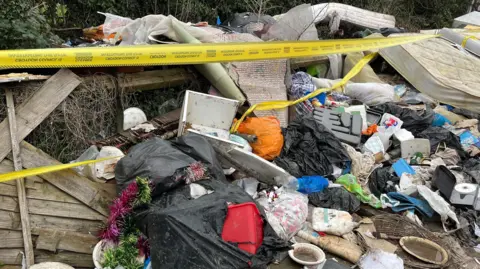
BBCYou can smell the rubbish, as you turn the corner. There is a huge amount of household waste left along a rough track in Croydon, south London.
Mattresses, bin bags, headboards, cabinets, plastic containers, even a CD collection including Madonna's Greatest Hits. And it has all been discarded right next to a playground.
According to government figures, Croydon has the highest number of fly-tips in the country, with over one thousand reported every week.
And here they are trying to fight back. But it is a challenge.
It costs Croydon Council £1m a year to deal with fly-tipping.
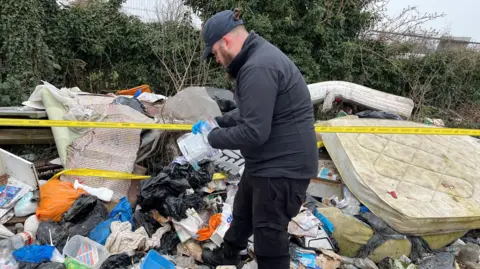
One of a new team of four community compliance officers is at the site. He is wearing blue plastic gloves and searching through the rubbish for names and addresses.
He finds something and puts it into a plastic bag. It is more than likely someone has paid a company to get rid of the waste, and it has been fly-tipped. The council is hoping it will be able to bring a prosecution.
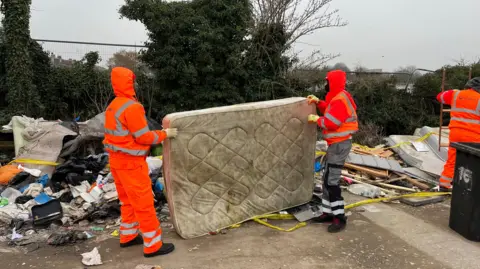
The flytippers are uncompromising and unrelenting. Private contractors clearing nearby tell me they cleared a fly-tip, only for it to be dumped again within two hours.
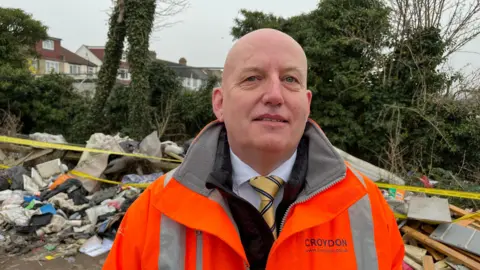
Charlie Baker is head of environment services at Croydon Council. He thinks the reason the figures are so high is that it's easy to report fly-tipping in Croydon via an app.
He also said the council clears tips very quickly which means it is a victim of its own success.
"I do believe we are making a difference. That's supported with our zero tolerance approach, along with the implementation of Fixed Penalty Notices (FPNs), and in cases like the one we're clearing today, we will be looking to secure a prosecution through the courts."
"This year alone, we've issued 315 FPNs for environmental crimes, but there's always more that we can do. In some cases, we are able now to issue fines up to £1,000."
"Significant cases like here, where we are confident we can secure a conviction, we will look to prosecute, and those fines, we'd be looking at anywhere in excess of £4,000."
He added that working with local residents and communities brings in extra intelligence to help secure a conviction.
"That may be through ring doorbell footage, evidence that we've extracted from this site today."
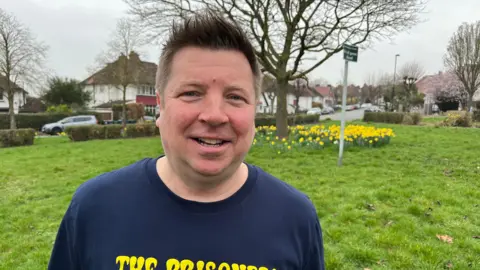
Tony Hooker is from the campaign group Litter Free Norbury. He thinks council policy has impacted the rise in fly-tipping.
"Council tax increases - you now have to pay for bulk waste collections, and garden waste to be collected. You have to pay for wheelie bins, so everything's costing more, and in certain areas of the borough, I think that's just led to behaviours where people say, 'well, I pay my tax, I'm not going to pay any more to have another service'."
"We used to have a free, bulky waste collection, so people can book to get their mattress or fridge taken away, rather than dumping it on the streets, which is what happens far too frequently now."
"We also need more enforcement. There's virtually been zero fixed penalty notices for any kind of fly-tipping or littering offences. So it's gone on for a long time and then it becomes engrained, it's become endemic that people think 'I can just can put it out, and it gets taken away'."
It's a view echoed by resident Graham Mitchell who is a prospective independent council candidate in the upcoming elections.
"I think there's an issue that we've fallen behind on enforcement, because the enforcement officers were taken away four years ago, and they're only building up the stock of them again now.
"I think there's a big issue around education with people. The guidance from the council was poor, I would say, for people in flats above shops and for businesses as well, leaving trade waste and pavements.
"Residents tell me it's got to be education, a deterrent, and then proper enforcement."
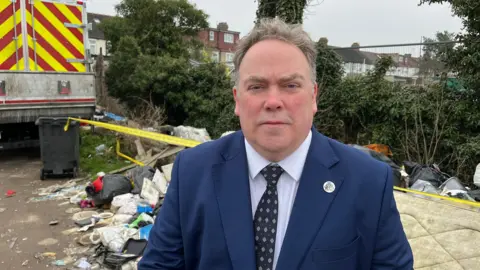
Croydon Council has declared effective bankruptcy, issuing a Section 114 notice, three times since 2020.
Residents have felt the pain of living in a borough that has been struggling financially and is debt-ridden. Council tax went up by 15% three years ago, several community buildings have been sold off and there have been reductions in local services.
Steve Downes works on the local news website, Inside Croydon. He said anecdotally, residents' access to the official dumps had become more difficult with some kinds of waste no longer being accepted.
"The previous free bulky waste collection service was axed with the first round of section 114 cuts.
"But if organised criminals who charge the public for 'waste clearance services' know that they can dump lorry loads of rubbish in Croydon without incurring any costs and with no risk of enforcement, that's exactly what they will do."
'Catch people, prosecute them'
Jason Perry, the directly elected Mayor of Croydon, says he is tackling fly-tipping with a zero tolerance approach.
"I don't believe we are the worst borough. I believe we are tackling fly-tipping. It's a problem right across London and the UK and we are taking measures to tackle that.
"Who knows why it is happening? A lot of this is illegal activity, criminal activity, a lot of rogue builders, rogue developers, who are not prepared to pay the proper costs and think they can just dump it and get away with it."
Perry adds: "We are putting eyes and ears on the ground so when there is a fly-tip, we are coming out and investigating.
"This fly-tip here we have found evidence of names and addresses and we are going to pursue that and prosecute. It has been going on for far too long, we are not going to allow it to happen. Catch people, prosecute them, don't do this in our borough."
"We are already seeing our numbers coming down. Just in January we have seen a 12% decrease in the number of fly-tips."
Listen to the best of BBC Radio London on Sounds and follow BBC London on Facebook, X and Instagram. Send your story ideas to hello.bbclondon@bbc.co.uk
