'Being in debt is a really lonely place'

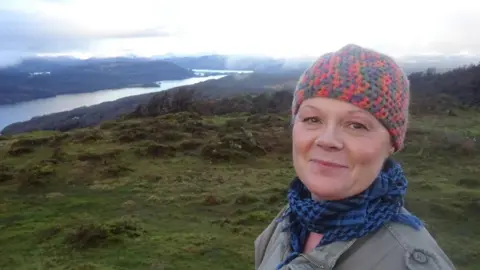 CAT JENKINS
A woman who found herself £30,000 in debt has opened up about the "shame" she felt and urged others to seek help.
Cat Jenkins, based in Douglas, was signed off from work when she began struggling with her mental health after facing mobility issues.
As she had not been making National Insurance Contributions through her third sector job, based in the UK, she was not eligible for incapacity benefits on the island.
"It was a scary time. There was no safety net," she said.
It comes as the Salvation Army's Debt Advice service has reached a record level of £2.5m in its debt caseload, since its inception five years ago.
The service, which currently supports 50 people, has seen a £300,000 rise in its debt case load in the past month.
Jenkins, who had previously worked in finance lost that job due to issues with alcohol abuse.
'Emotional impact'
"It took me about eight years to go to rehab, and I went from having piles of money, to almost none," she said.
While in recovery, she began working remotely for charities based in the UK.
But she said last year was "disastrous" for her family, and with deteriorating mobility and struggling with her mental health, she was signed off from work and fell into debt.
"There were times when we were cold and we didn't have heat, we didn't have internet or phones, so practical things were difficult," she said.
"I think the emotional impact, the shame and that I was not the big I am that I thought, was the most tricky bit for me," she said.
Now in full-time work, through the financial support of various groups, Cat has been able to pay off her debt.
'It's a really lonely place being in debt, it can feel shaming, and like you can't get out of it, but there is help out there, and it was the Salvation Army which sent me to all the points where I could get help," she added.
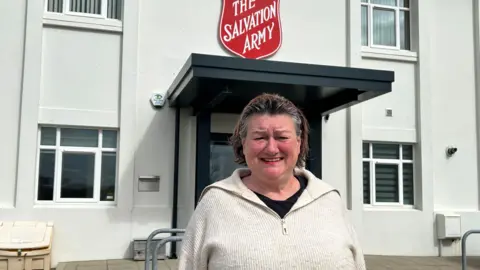 DEBBIE WHITE
Vanessa Edwards, from Braddan, was working as a corporate statutory administrator in 1995, when she became divorced and a single mother.
"That was the first time I was diagnosed with depression and postnatal depression," she said. "Because I succumbed to stress and anxiety I lost that job and have always had an issue with my finances since," she said.
Having been diagnosed with bipolar and struggling with addiction, she said her ability to carry on working had been "limited over the years."
At one point, Edwards found herself in £1,700 overdraft with her bank and unable to pay it off with mounting interest as well as in rent and gas arrears.
She described being in debt as being a "terrible blow, I lost my confidence, I lost my credibility with friends, family, and work colleagues, I lost my career.
"So the effect looking back has been catastrophic," she said.
No longer in debt following help provided by the Salvation Army's service, she now enjoys spending time gardening in her allotment.
"I manage my finances, I manage my mental health and I manage my addiction to alcohol sufficiently to allow me to be happy and feel rich in love, but poor financially," she said.
"What I want people to know, is no matter what your background is, it doesn't mean you are not a good person, and you don't deserve help from charities," she added.
'Debt is not failure'
Debbie White, Area Debt Co-ordinator for the Salvation Army's debt advice service said: "The high cost of everyday living has pushed people's finances to the max."
She said it was going to "uncharted waters" as the charity supports people who already have negative budgets through the gas or oil issues sparked by conflict in the Middle East.
"Debt can affect anyone and our team of experts are ready to show how being in debt isn't an embarrassment; it is a consequence of the high cost of living and life events and not a personal failure," she said.
The service, regulated by the Financial Conduct Authority, provides one to one support to help someone look at what they owe and make a plan to repay debts.
The service can also contact creditors on a person's behalf and explore and negotiate available options such as repayment holidays.
Read more stories from the Isle of Man on the BBC, watch BBC North West Tonight on BBC iPlayer and follow BBC Isle of Man on Facebook and X.
