How one school turned things around for SEND pupils

 BBC
BBCA school in Derbyshire says small and inexpensive changes to its approach to special educational needs have had a transformative effect in the classroom.
Holme Hall Primary in Chesterfield is one of a cluster of schools in the county that took part in a recent government programme seeking to boost SEND inclusion in mainstream schools.
The school reshaped its environment after staff received specialist training, introducing calmer classrooms, sensory support and a parent support group to better meet the needs of neurodiverse children.
Headteacher Jackie Littlechilds said the experience had helped to close "knowledge gaps" among teachers as the school grapples with rising needs.
"We've had fewer exclusions, suspensions. Behaviour has improved...we're able to look at our school through a [SEND] lens," she said.
And as the government contemplates significant reform to SEND, the school wants others to take note.
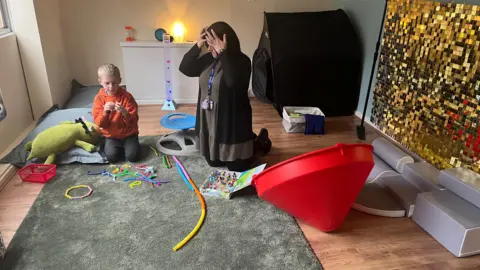
About a quarter of the 130-odd children at Holme Hall are on the school's SEND register, a high proportion for a small school.
Following specialist training for all staff - not just those who work with SEND children - the school's "environmental audit" also introduced standardised sets of concentration aids and visual timetables. Noise levels are also kept to a minimum.
"It's just the norm now in our school to have environments like this," said teaching assistant Helen Fowler.
"Parents need to look around schools and know their child will be comfortable, not think, 'What will need to change to fit my child?'."
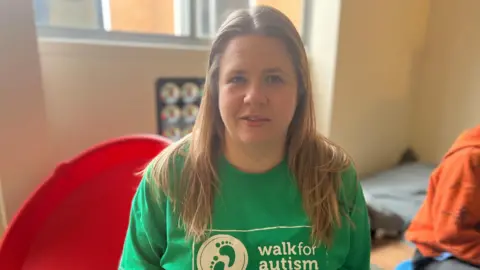
Since introducing the changes, the schools involved in the prgramme across the county have seen an 80% reducation in permanent exclusions, the number of half day sessions lost to suspenson reduced by 40%, and those on part-time timetables saw their hours in school often more than double.
Lindsay's nine-year-old son Elliot, who is autistic and has ADHD, was suspended numerous times and close to permanent exclusion at a previous school before moving to Holme Hall.
"He really struggled with the emotional regulation of being at school," she said.
"Every day was a battle for him...destroying classrooms, sweating, throwing things."
She said Elliot was now "thriving".
"He's got more stability, he's happier, he loves coming to school," she said.
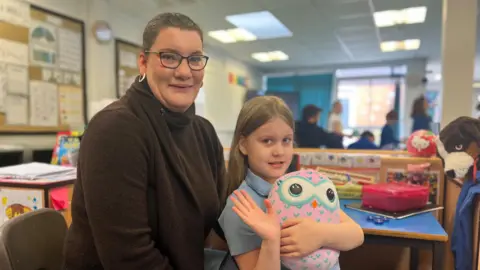
Leigh-Anne has also seen a big change in her daughter, eight-year-old Annabelle.
Annabelle is autistic and has speech and language difficulties, and used to be on a part-time time table at a previous school because of the difficulties she had.
However, she now attends her new school full-time, and Leigh-Anne also credits the school's comfortable environment with helping Annabelle begin to speak, having previously been non-verbal.
"I wouldn't have thought Annabelle could cope in a mainstream school," she said.
"The achievement my daughter has made in a couple of years being here is out of this world."
The NHS in Derbyshire, one of the local authorities in charge of SEND support, says the school is an example of one successful approach which is in line with the ambitions of the government's recent White Paper.
However, headteacher Jackie Littlechilds warns that schools will still need the right support if the government wants to get its reforms right.
"Teachers need to be taught how to cater for the needs of all children. It will impact workload," she said.
"There's a time issue there and there's a training issue.
"They need to think about the capacity of schools and how to fund it...the funding has to come through."
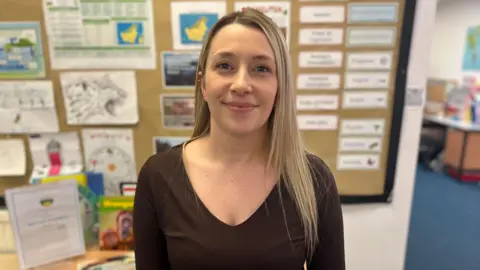
The school's SEND coordinator Holly Hinitt agrees, and says while some elements of the reforms sound promising,such as earlier intervention, uncertainty remains.
"My concern is [the reforms] will put a lot of pressure on schools that are already quite stretched. Staff retention...is a challenge," she said.
"If they get the resources and the capacity right, it could work.
"A lot of parents have concerns as well about the changes with EHCPs...they need more support."
Derbyshire's SEND service came under the spotlight in 2024 after an Ofsted report accused local authorities of "systematic failings". Its performance is still being monitored by the government.
Rosa Waddingham, executive director of quality (nursing) for NHS Derby and Derbyshire, said: "We know we have a major challenge in Derbyshire to better meet the needs of children who have special educational needs and disabilities.
"At the same time we are working together with the county council, with schools and across the NHS to better meet the needs of children who have special educational needs and disabilities.
"We are continuing our work to ensure every child gets the best start in life."
Listen to BBC Radio Derby on Sounds and follow BBC Derby on Facebook, on X, or on Instagram. Send your story ideas to eastmidsnews@bbc.co.uk or via WhatsApp on 0808 100 2210.
