Peers suggest over 900 changes to assisted dying bill

 PA Media
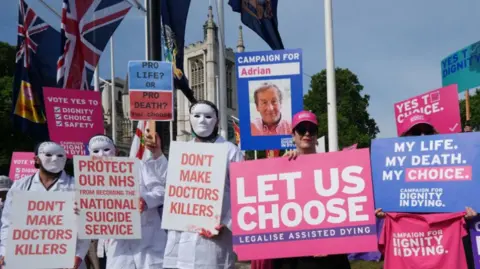
Members of the House of Lords have put forward more than 900 proposed changes to the law to deliver assisted dying, as peers continue to debate the legislation.
Experts believe the number of amendments is unprecedented, but opponents say significant alterations are needed to ensure any scheme can operate safely.
The volume of amendments has sparked a letter from 65 supportive peers to their colleagues in the Lords, raising concern about possible delaying tactics.
Those opposing the bill have been urged not to "frustrate" the passage of the legislation, which has already gained the approval of MPs.
The House of Commons passed the Terminally Ill Adults (End of Life) Bill in June, and it passed its first stage in the Lords in September.
But it will only become law if both Houses agree on the final drafting, with approval needed before spring next year, when the current session of Parliament ends.
The legislation, which would cover England and Wales, proposes allowing terminally ill adults with fewer than six months to live to apply for an assisted death.
This would be subject to approval by two doctors and a panel featuring a social worker, a senior legal figure and a psychiatrist.
Peers have now begun line-by-line examination of the bill, with this stage due to take place over at least four days.
During Friday's debate, a number of peers raised concerns that the bill in its current form was flawed.
Baroness Gisela Stuart argued that however long the proposed legislation was debated she did not think peers "can actually get it to a stage where it is legislatively fit to be passed".
Lord Andrew Tyrie said while he was a supporter of the bill's intentions, it was "demonstrably flawed".
He called for the government to take control of the draft legislation, warning there was a risk it could be "talked out" and run out of time to become law.
"[The government] need to consult nationally. They need to consult widely. They need to try and find as much consensus as possible, and then in a considered way, they need to come back to the House," he said.
The bill was put forward by backbench Labour MP Kim Leadbeater rather than the government.
While the government can choose to make extra time available for this type of bill - known as a private member's bill - they are generally allocated less time than government legislation so can be vulnerable to delays.
There appear to be seven opponents to the bill who have submitted 579 amendments between them.
Parliamentary authorities say the total number of amendments tabled at this stage is almost certainly a record for a piece of backbench legislation.
A peer in favour of the legislation told the BBC that the number of amendments "looks like a delaying tactic to me... It's obviously not a coincidence."
Defending the volume of amendments, Baroness Luciana Berger, who opposes assisted dying, told the BBC that evidence heard by a committee of peers scrutinising the legislation "strongly refuted any suggestion this bill is either safe or workable".
"This bill is full of holes which vulnerable people will fall through and be harmed if peers don't act to change and amend it," the Labour peer added.
However, signatories to the letter highlighted how the bill had "already undergone unprecedented scrutiny" and "offers dying people the choice of a safe, dignified end while strengthening protections for the vulnerable".
Former Royal College of Nursing president Baroness Rafferty was among the 65 peers to have signed, and she was joined by scientist and broadcaster Lord Winston, former Labour leader Lord Kinnock and former Whitehall chief Lord O'Donnell.
They urged opponents to focus on refining the bill to find where "genuine improvements can be made, while respecting both the will of the Commons and the overwhelming support of the public".
The bill is being treated by parties as a matter of conscience, meaning they will not instruct their MPs or peers how to vote.
If it does pass into law, the government has four years in which to get an assisted dying service into place, meaning it could be 2029/30 before the first assisted death happens.

Sign up for our Politics Essential newsletter to read top political analysis, gain insight from across the UK and stay up to speed with the big moments. It'll be delivered straight to your inbox every weekday.
