Could a huge data centre revitalise Ayrshire - or ruin it?

 BBC
BBCIt is currently a large, unassuming patch of farmland in East Ayrshire - but within years it could be one of the largest artificial intelligence data centres on Earth.
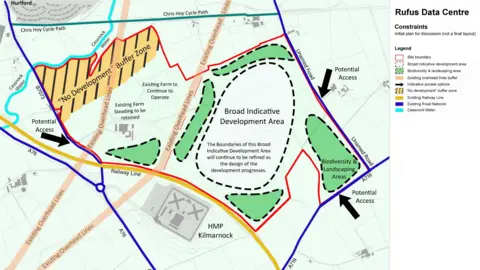
About 100 hectares (250 acres) of land near HMP Kilmarnock has been earmarked for a technology hub by energy firm ILI Group.
ILI says the development would be similar in size to the prison, while the "vast majority" of the land would be set aside for "biodiversity and landscaping".
Supporters talk of it revitalising the region, bringing new jobs and investment that would be ploughed back into the community. But the plans have met strong opposition from locals concerned about the impact on the wider area.
Some of those opposed have contacted BBC Your Voice, and say the firm has not provided concrete details about a building that would dominate Hurlford for decades to come.
In recent years, a string of applications for data centres have been made across Scotland. The group Action to Protect Rural Scotland estimate 17 are at various stages of the planning process.
It comes during a worldwide rush to develop data centres. Estimates in 2025 suggested about $3tn (£2.2tn) will be spent on data centres that support AI between now and 2029.
That surge has been accompanied by growing concern about the knock-on effects of the facilities, especially the large amounts of energy and water they consume.
Last autumn, Intelligent Land Investments (ILI) - a company with a background in clean energy development and battery storage projects - announced ambitious plans for a data cluster called the Stoics, spread across sites in Ayrshire, Lanarkshire and Fife.
It has secured land rights, permission to use the local electrical grid and is currently beginning the planning process with local councils.
The cluster would, the company declared, be "more than twice the size of many of today's leading campuses", comprising various buildings, an on-site electrical substation and wildflower areas.
For some Hurlford residents though, the announcement of the facility - called Rufus - prompted questions, and a lot of them.
 ILI Group
Lisa Beacham became aware of the proposal - which ILI stress is still at a very early stage - shortly after the initial announcement.
A student from Hurlford, she then went down a rabbit hole looking at the amount of water that would be needed for coolant, the process which stops the computer chips there from overheating.
"The site proposal is that it would be powered at 540MW, which would require millions of litres of water a day," she said.
"Water is a global commodity and we are currently facing global water bankruptcy, according to the UN. Yet we'll have a site that is using up a huge amount, and due to residue [from the centre] the water used there cannot easily be recirculated."
Last year the BBC told of people who lived near a data centre in Georgia in the USA who were struggling with an excessive build-up of sediment in water supplies.
Climate impact
This is disputed by ILI. The company said part of the reason for the surge in data centre plans in Scotland was because the nation's cooler climate was well suited to keeping data centres running.
A spokesperson for the company said: "Water use for a data centre in Scotland is significantly less than somewhere like the deserts of California, and cooling may only be required perhaps as little as 2% of the time.
"It is possible, therefore, that all the water needs for the project could be met by harvesting rainwater on-site."
He added that the company was currently investigating a variety of technical solutions regarding water usage at the site.
Yet the impact of the climate is doubted by some experts.
Alex De Vries, who runs the Digiconomist blog and website, said he estimated a 540MW facility "could result in almost 6bn litres of annual fresh water consumption" to generate the power needed.
He told BBC Scotland News: "The relatively cooler climate in Scotland isn't going to do much to mitigate this."
ILI, though, are bullish about the plans.
The company recently held the first of three consultations in the region at a Kilmarnock hotel, yards from the local football team's Rugby Park ground.
Views among those attending were mixed.
One couple told BBC Scotland News that East Ayrshire needed investment, and anything that could get jobs locally would be welcomed.
Another man said that while he was not thrilled about data centres in general, it was where the future was and Ayrshire could benefit as a result.
Greig Templeton of ILI was among staff speaking to locals as they visited.
He said the company's plans would be a positive for the whole area.
"ILI have a track record of bringing in community benefits," he argued, pointing to the Red John hydropump storage project in the Highlands, which has been bought by Norwegian company Statkraft.
"By the time we moved the project on to them, we had committed to the community. That has involved things like a community fund, setting up a water taxi, and installing walkways around the area.
"These are benefits that came from speaking to people in the area about what is needed."

Something that finds general agreement among everyone is the importance of creating more jobs in Ayrshire.
Templeton estimates that about 120 to 150 roles could be created via the data centre, from security and cleaning jobs to specialised tech posts.
Cheryl Rowland, an admin assistant at a construction company, who lives in Hurlford, is sceptical.
Speaking at the consultation event, she said: "They are talking about something that will be here for 40 or 50 years.
"Would they arrange education upskilling, to bring local people through and help them grow into jobs here, or will the jobs all be people coming into the area?"
ILI said it hoped to boost Scotland's economy by "tens of billions of pounds in private investment" via the cluster. When asked by BBC Scotland News, the company said there was interest from private companies, but no confirmed funding yet.
Rowland says it is a worry such a large site will be built by a company who will not be there long term.
Lisa Beacham has other fears, too.
She is concerned about pressure on the local electricity grid, and the effect on the local environment, pointing to the lack of an environmental impact assessment (EIA).
Templeton says this is partly due to the proposal being at an early stage.
He added that ILI was conducting its own assessment and consulting the likes of Scottish Water and Sepa. An EIA may then follow.
"Our assessment is quite detailed, it's maybe not written in the formal terms of the EIA but we will look at all of the aspects," he said.
For Beacham though, there is a lack of detail in a proposal that will permanently transform the area.
Leaving the consultation event and heading into an overcast February evening, she added: "Do they have the substance for what they're proposing?
"They don't have experience building data centres and I feel they're underselling it all - both the actual development itself and the impact it will have on Ayrshire. Because once it's built, that's it - it'll be here for decades."

