'My husband got early dementia, now I'm a full-time carer'

 BBC
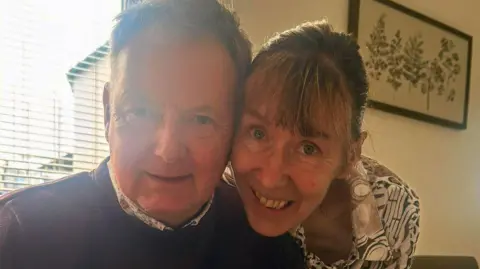
BBCJill Scott planned to travel the world with her husband in their retirement, but instead she is living the "very isolating" experience of being his carer 24-hours a day.
Her partner Stuart, from Blackburn, was told he had dementia at the age of 61, a shock diagnosis that made Jill "cry every day for over 12 months, wondering how we would manage", she said.
The early-onset diagnosis left their "hopes and dreams" in tatters, and highlighted how little help there is for those who develop the condition under the age of 65, she said.
"I never thought I would see myself as a carer but unfortunately, that's what I've become. And a lot of the support available is aimed at people older than us."
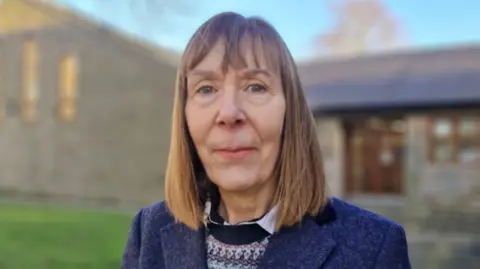
Jill told BBC North West her husband first displayed symptoms when he was around 60 - he is now 64.
The couple have been married for 40 years and had been looking forward to retirement when Stuart was diagnosed.
But Jill, who is 62, said their life now bears little resemblance "to the hopes and dreams we had".
"We thought we were going to go travelling when we retired. Sadly... that hasn't happened."
Stuart is one of more than 70,000 people in the UK living with early, or young-onset dementia, according to the Alzheimer's Society.
It is when dementia begins before the age of 65, and is characterised by a wide-range of symptoms, with the support required different to that needed by older people, the charity said.
Jill had to stop work soon after Stuart's diagnosis, leaving her feeling isolated and worried about their future, and she said life has continued to be difficult.
"If I'm really honest. I'm sad quite a lot of the time because I see a very vibrant person disappearing before my eyes and I feel like it's a grieving process."
'Can't participate'
The couple attend a Singing for the Brain group where people with dementia sing to improve their wellbeing and brain activity, while Stuart spends some time each week Hopwood Court day centre in Blackburn.
But Jill said elsewhere there is very little help for people with young-onset dementia.
"There's a lot of support out there but it is aimed at people who are a lot older than us and it's been exceedingly difficult to find activities that are suitable for Stuart that he wants to engage in, as he wants to be with people his own age.
"It can be very isolating living with somebody with any age dementia but especially with somebody with young onset because a lot of your social circle is still out and about enjoying themselves, going on holidays and sadly for us that's not something we can participate in anymore."
The couple should have been celebrating their 40th wedding anniversary but Jill said they "can't celebrate in the traditional way".
Instead, Jill said they have decided to have a range of "dementia adventures - so for every year of marriage we are doing a different activity".
"We are going to shows, the theatre, we went to see a pantomime for the first time ever, we went to a drag show... that was quite interesting, not our normal thing but we had a laugh.
"And when I take Stuart out to a show or live music you've got him back in the room for that hour. Life just feels normal and it's something to look forward to."
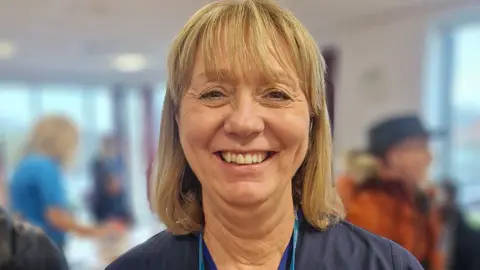
Helen Smith, a community mental health nurse with Mersey Care NHS Foundation Trust, set up an early-onset support group in Southport 20 years ago.
She said much of the help offered includes support for people still at work, or looking after dependent children that are still at home.
The group "gives people the opportunity to come somewhere where they would feel safe and just to combat that isolation a diagnosis like this can bring," she said.
"Also there's lots of changes in people's relationships so they can come and feel safe here, they can tell us anything and we can share information."
'Death sentence'
Phil Burdekin, who lives in Southport and attends the monthly sessions, was diagnosed with early-onset dementia four years ago when he was 63.
"At the time it felt like a death sentence. My dad died of it so I thought that I was going to go on a spiral down to where my dad was when he was put in a home.
"Luckily enough, I feel a little bit different. I've put things in place so that I can handle a life easier. For now, I'm just happy where I am. I feel quite lucky."
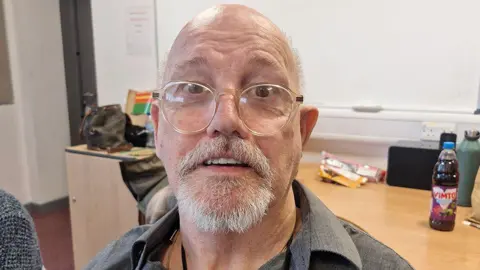
Phil said he changed his lifestyle after he was diagnosed and joining this group has "made a big difference because we are all sat in the same place, we've all got the same problem".
He said: "You don't want to be known as someone with Alzheimer's really, you know there's a stigma stuck to it.
"A lot of people won't go and get diagnosed because they are frightened of what will happen to them but if you've got dementia it's going to happen to you anyway.
"So it's better to know about it and then you might be able to do something slightly different... there might be drugs coming out or you can change your diet."
Many of the people who attend this group said getting a diagnosis was difficult and often people assumed they were too young to have dementia.
'Long way to go'
Phil Harding is 67 and was diagnosed when he was 55 years old when he still had a young family to look after.
He has been coming to the group in Southport for 12 years now and said even his doctor doubted that he had dementia.
He said: "No-one believed me - even doctors. You'd be sat there during the examinations and they'd say 'have you got dementia?' and I'd say yes [and they replied] oh you don't look it."
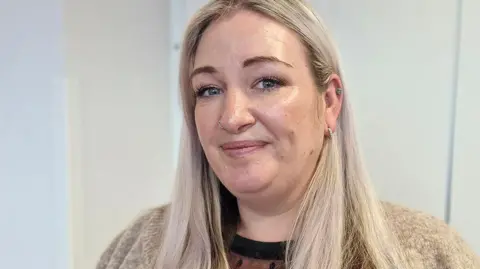
Hayley Winstanley, a services manager for Alzheimer's Society, said the charity was seeing an increase in the number of people being diagnosed with young-onset dementia.
"There is a challenge in terms of raising awareness so that more people are coming forward for a diagnosis, raising their concerns with their GP."
She said diagnosis was improving with "an increase in the level of awareness around young-onset dementia but I think also GPs are getting better at recognising those symptoms".
However, she added "there's still a long way to go".
Listen to the best of BBC Radio Lancashire on Sounds and follow BBC Lancashire on Facebook, X and Instagram. You can also send story ideas via Whatsapp to 0808 100 2230.
