Two of the world's rarest lions put to sleep at zoo

 Belfast City Council
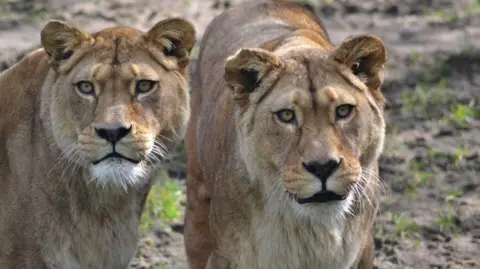
Two of the world's rarest lions have died at a zoo.
The Barbary lionesses, Thheiba and Fidda, were 22 years old and were the remaining two females at Belfast Zoo.
The zoo said they will be "fondly remembered" by staff and visitors.
Barbary lions are now extinct in the wild.
Thheiba and Fidda
They were previously housed at Port Lympne Zoo in the south of England.
In a statement, the zoo said: "We're sad to share the news that our two remaining Barbary lionesses at Belfast Zoo, Thheiba and Fidda, have passed peacefully.
"During their lives, the sisters received exceptional care and became key contributors to conservation as part of the EAZA Ex-Situ Programme (EEP), producing multiple offspring and helping secure the future of Barbary lions, a lion sub-species now extinct in the wild."
They added that in recent weeks Thheiba experienced "mobility issues and weight loss".
A decision was taken to "euthanise her and end her suffering after a veterinary assessment".
"Lions are highly social pride animals that rely on companionship within a group.
"Thheiba and Fidda had lived together their entire lives and shared a very strong bond. On veterinary advice, and to avoid significant stress and welfare challenges if left alone, Fidda was also euthanised."
The zoo said they have had an association with lions for "many decades, with Barbary lions first arriving at the zoo in the 1960s".
"Thheiba and Fidda's longevity, their strong bond and their vital role in conservation is testament to our long-standing commitment to the care and conservation of this iconic species."
What is a Barbary lion?
Male Barbary lions are generally larger than other species and are distinguished by their thick black mane and belly hair.
In the past, they were considered a royal beast and Roman emperors often had them imported from North Africa.
In medieval England they were kept in the Tower of London. The skulls of two male Barbary lions were found by workmen in a moat in the Tower in 1937.
