University established in 1901 looks to AI future

 Harper Adams University
The vice-chancellor of a university specialising in agriculture has reflected on the huge changes in the farming sector as the college prepares to celebrate its 125th anniversary in 2026.
As Harper Adams University looks to the future, a key development will be the opening of an artificial intelligence (AI) unit.
The university, based in Edgmond, near Newport, heard in November it had received more than £500,000 from the Office for Students for the Telford facility, vice chancellor Prof Ken Sloan said.
He described how AI could be used to scan plants growing in fields, or animals, to check whether they were healthy.
The university can trace its history to 1901, when the then college opened with six students and a 178-acre farm, thanks to a bequeath from landowner Thomas Harper Adams.
In the early years it ran egg-laying trials and specialised in poultry farming, and remained open through both world wars, training disabled soldiers and women in wartime farm work.
Now with more than 5,000 students, and a full university, it is looking at tackling "the economic and environmental challenges facing our planet".
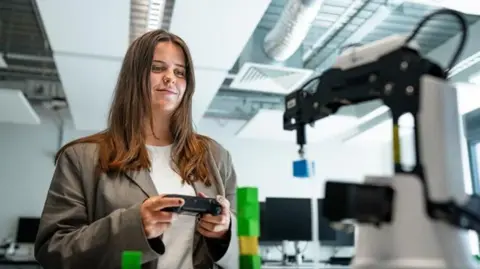 Harper Adams University
Explaining the uses of AI, Prof Sloan said a farmer growing plants in fields needed to check for pests.
"Go back even 10 years, you would have had to manually go around and actually look at all of those plants," he said.
"Now what you can do, is you can take a machine... you can scan individually, you can compare what you're seeing very quickly to what a healthy plant looks like."
He said it was the same with animals, adding: "A cow can tell you by the way it walks, the way it sits, how it spends its time, whether it's OK or not OK."
It took time and experience for a person to check them, he said, but with cameras, "we can spot them, we can see them, and we can act really quickly to keep the animals healthy".
The university has posted on social media how "building on almost 125 years of agricultural expertise, we're using cutting-edge technology to transform the future of food and farming".
As well as AI, developments in recent years have included using autonomous tractors, robotics and drones, with researchers "driving innovation" to find "real-world farming solutions", it said.
Follow BBC Shropshire on BBC Sounds, Facebook, X and Instagram.
