Canada's new NDP leader says party must have 'hard conversations' over energy policy

 Reuters
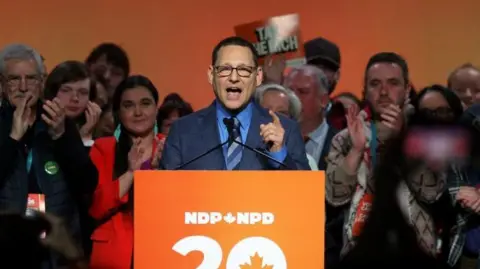
The newly-appointed leader of Canada's left-leaning New Democratic Party (NDP) Avi Lewis has said "hard conversations are necessary" after he was criticised by some for his stance against new oil and gas development.
Lewis won the party's leadership on Sunday in the first ballot, running on a platform that prioritised action on climate change and affordability issues.
Challenges emerged almost immediately for Lewis, with leaders of some NDP provincial wings publicly distancing themselves from him due to his refusal to support Canada's oil and gas industry.
The rift comes as the NDP looks to rebuild after it suffered significant losses in last year's federal election.
Lewis told reporters on Monday that the disagreements meant the party's tent was growing and were "a sign of health".
He added that he intended to support the NDP's provincial leaders by trying to grow support for the party across the country. And he said his door was open to speak to those who disagreed with his energy policies.
However, he doubled down on his opposition to new oil and gas development.
"The energy economy is extremely unstable," Lewis said, citing as an example the rising cost of oil as a result of the ongoing US-Israeli war on Iran.
"We think we need to accelerate the transition to a more stable, secure and safe economy, and a more independent Canadian economy," Lewis said, adding that he believed Canada should accelerate its investment in renewable energy.
Canada is home to one of the world's largest oil reserves, and the export of oil and gas is its most profitable industry. The vast majority is exported to the US.
Prime Minister Mark Carney, a Liberal, has made turning Canada into a global "energy superpower" central to his bid for reducing trade reliance on the US, and has openly supported building new infrastructure to achieve that goal.
Some have criticised Carney for this, including former Liberal minister Steven Guilbeault, who resigned late last year over an agreement signed between the prime minister and Alberta that would explore building a new oil pipeline to Canada's west coast.
 Reuters
Lewis' stance on oil and gas has been unpopular with high-ranking members of his party in western Canada, where the country's energy resources are concentrated.
The leader of the NDP in Saskatchewan, Carla Beck, said she had turned down the new leader's invitation to meet.
"The positions that you have taken when it comes to natural resource development are ideological and unrealistic," she said in a letter to Lewis that was sent shortly after his win.
Meanwhile, the NDP leader in oil-rich Alberta, Naheed Nenshi, said in a post on X that the direction the federal party was heading in under Lewis was not in the interests of his province.
"Albertans deserve federal leaders who understand the importance of Alberta and our essential role in the federation," he said.
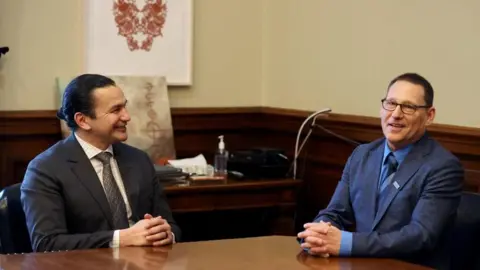
Not all provincial NDP leaders have criticised Lewis, however. Wab Kinew, Manitoba's premier, said there could be "heated debates" within the party, but he believed that he and Lewis were aligned on big-picture issues.
"We're fighting for the people who don't have a voice right now and that's the most important thing," Kinew told reporters on Sunday.
Lewis said on Monday that he and Kinew had met for over an hour in Winnipeg following his win, and that he had received "words of wisdom and encouragement" from the Manitoba premier.
He added that he also met the party's federal MPs. Don Davies, an NDP MP from Vancouver and its previous interim leader, said the caucus was "100% united" behind Lewis.
Davies said he believed the NDP had an important role to play in Canadian politics, and could be "a powerful voice for all the voters who do not see themselves reflected" by the policies of the Liberals and Conservatives.
Lewis does not hold a seat in Canada's parliament. He said he would focus on speaking to the party's base across the country and would not run for a seat immediately.
