Majority of immigration centre's women released

 Helen Groom
Almost two thirds of detainees at a women-only immigration removal centre ended up being released, according to prison inspectors.
HM Inspectorate of Prisons (HMIP) said of the 723 women who left Derwentside Immigration Removal Centre (IRC) in Consett, County Durham, during a six-month period in 2025, 59% had been let go and 41% sent to other centres.
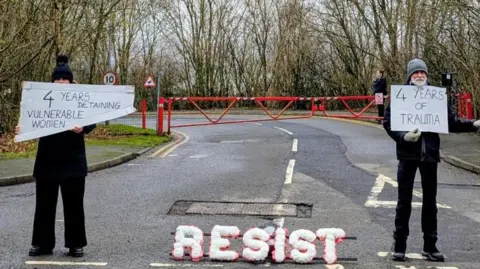
Dr Helen Groom, from the No To Hassockfield campaign group which seeks the closure of Derwentside, said the figures proved many of detainees were being held unnecessarily.
The Home Office said almost 50,000 illegal migrants had been removed or deported from British soil under this government.
The Derwentside centre is used to hold women subject to immigration control, with the average stay being 25 days and the longest 162 days, HMIP said.
Groom said it was not clear how many of those moved to other centres also ended up remaining in the UK.
"The government's own inspectorate report shows that [Derwentside] is not an immigration removal centre," she said.
She questioned why so many women were being locked up in this way, adding: "It's cruel, unnecessary and expensive."
'Further isolates women'
HMIP inspected the site between September and October 2025, at which time there were 55 women being held there. It also said the largest nationality groups held at the site were Chinese, Brazilian and Polish.
Over the past 12 months, five women were homeless when they left the site, including a woman who had previously been sectioned under the Mental Health Act, inspectors found.
HMIP said the site held "multidisciplinary meetings" on the day of release of each woman but they "gave little consideration to individual risks".
Another issue highlighted was the removal centre not doing enough to "encourage and support family contact".
It said only 17% of the women it surveyed had been visited by friends or family while being held at Derwentside IRC.
But Groom said the numbers highlighted how remote the site was and the distance the women were from their homes.
"[People's] family and friends will not have lots of money and therefore the ability to travel to Derwentside," she said, adding: "It further isolates women and increases the deterioration in their personal, physical and mental health."
'Shortest detention necessary'
HMIP said living conditions at the site were "very good", staff were "dedicated" and, while there remained areas for improvement, all those involved should be "commended for their hard work".
But there were also "concerns", inspectors said, including:
- There being not enough female staff to cover duties where detainees needed supervision and support from a woman
- Many detainees were still being transported overnight and had long journeys to the centre
- Too much of the food on offer was bland and unappetising, and portion sizes varied significantly
- Complaint responses took too long and were not translated
- In a number of cases, the Home Office had not taken sufficient account of vulnerability in making its initial decision to detain
A Home Office spokeswoman said its policy was "clear" that people should be detained "for the shortest period necessary", while the government was "doing everything possible to reduce the legal challenges which can delay removal".
She said the risk of releasing people with no home was "managed" while the number of asylum decisions being made had doubled, with some 31,000 initial decisions made per quarter.
