More digital records for Devon patients to go live

 NHS
NHSA project to digitalise patient records regarded as one of "biggest changes to healthcare in Devon in a generation" moves a step closer next week.
Torbay and South Devon Hospital will become the second trust in the county to move to an electronic patient record using a system called EPIC.
Devon will be the only county in England to use the same electronic patient record (EPR) across all its NHS trusts this summer, which officials believe will improve patient care.
It will mean one single online system for each patient that every clinician in the county will be able to access, including GPs and mental health services.
'Improved patient outcomes'
The Royal Devon University Healthcare NHS Foundation Trust (RDE) was the first to roll out its electronic patient record using EPIC.
It switched it on in 2020 for east Devon, and 2022 for its north Devon sites.
Professor Adrian Harris, chief medical officer (digital and research) for the trust believes it is "one of the biggest changes to health care in Devon in a generation".
He said: "It will support the delivery of improved patient outcomes, higher quality research and advanced service planning."
Torbay and South Devon Hospital NHS Foundation Trust will switch on its EPIC system on Good Friday after integrating hundreds of systems it previously used.
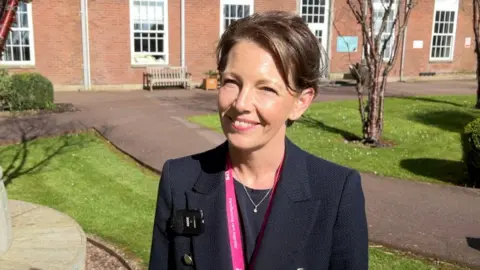
"At the moment we have a mix of paper systems and multiple electronic systems that don't talk to each other," its Chief Operating Officer, Adel Jones, said.
"What we'll move to now is a single digital integrated record that patients will have access to on their phone."
She added it was "the first of its kind nationally" and it would "provide game-changing improvements in patient care".

Lisa Reynolds from Paignton has medical proxy for her sister, whose care is divided between the RDE in Exeter and Torbay.
"For Torbay at the moment we still get appointment letters, and consultant letters by post. Things like test results too," she said.
"But at the RDE, I get all that stuff on the app – it's just so much easier.
"I can't wait for it to change – to have everything in one place".
 NHS
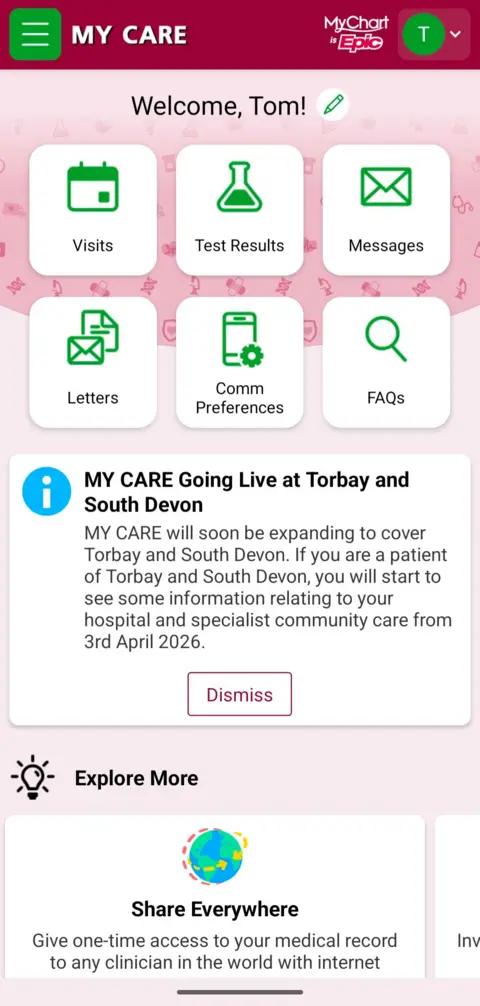
NHSLisa is an early adoptee of My Care - an app that links patients with their electronic patient record in Devon.
"I absolutely love it," Lisa said.
"It gives you reminders – like for an appointment we had yesterday and it asks you to confirm attendance which saves all that hassle of no shows.
"It really helps us plan ahead".
NHS officials believe the new EPR will be hugely beneficial as clinicians spend less time on administration and more time with patients.
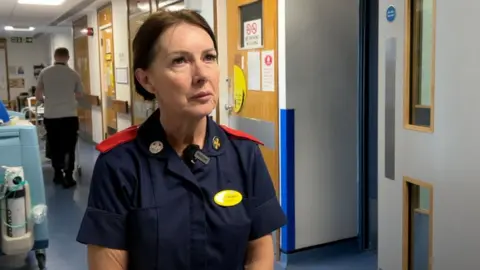
"At the moment our clinical staff spend quite a lot of time handwriting notes, chasing blood results on different systems and checking for x-rays," Nicola McMinn, chief nurse for Torbay and South Devon Hospital NHS Foundation Trust, said.
"But now, having all of that information in one system means that we'll spend less time doing admin and more time at a patient's bedside."
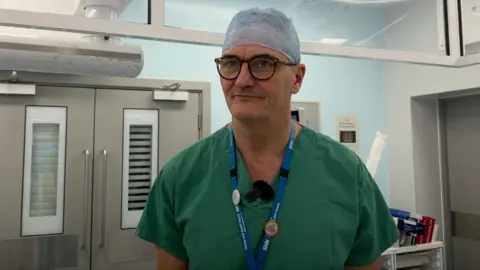
The switch on in Torbay has been intentionally planned for the start of the Easter Bank Holiday when there is less organised activity and fewer routine appointments.
Michael Green, consultant surgeon and chief clinical information Officer for Torbay and South Devon NHS Foundation Trust, said: "If the trust system goes down, we have access over the internet to a mirrored system.
"The worst case scenario is we have to go to paper for a short period of time."
He added: "The only time RDE has had a short but significant outage is when some contractors accidentally cut through an internet cable that was of critical importance to the system."
The chief executive of National Voices - a coalition of health and care charities - said an electronic patient record relies on the accuracy of data.
"I think that the important thing is that whenever a record is made that the clinicians get to see it, but also that patients get to see it so they can correct any errors that they might spot" Jacob Lant said.
"In the past I've described NHS records as being like Swiss cheese, essentially full of holes.
"But for people with very complex medical histories, that can be a real burden. So, making sure that we've got an accurate and comprehensive record for patients that are shared across services is really, really important".
'Safely and smoothly'
University Hospitals Plymouth NHS Trust has yet to adopt the EPIC electronic patient record.
The South West's only major trauma centre will not go live until July - only then will the whole county have one streamlined system.
This will mean that by the summer no matter which hospital or health service patients attend in Devon, their medical history will be available.
The whole region will not be joined up as the Royal Cornwall Hospitals NHS Trust (RCHT) will be using a different system.
The RCHT was meant to go live with ORACLE in spring last year but that was delayed until June.
Its chief strategy officer, Ella Stracey, said the project was postponed to ensure it could be delivered "safely and smoothly".
"We selected Oracle as our EPR partner following a national procurement framework which identified it as the system that best meets our needs," she said.
"The existing Devon and Cornwall Care Record is a joint solution for sharing clinical information and will continue to be developed alongside the respective EPR programmes".
NHS England said more than 90 percent of trusts across England have had electronic patient records since 2023 - putting the South West far behind.
Jones said money was the reason the region was only just catching up, adding "the level of investment has been significant".
She said that a national program helped organisations which did not have an electronic patient record to become digitally enabled.
"We're hugely grateful for that level of investment from the government that has enabled us to make what is a significant improvement in patient care."
NHS England said it has invested £1.9 billion nationally to support hospital trusts to either adopt a new system, or improve their existing electronic patient record systems.
Dr Stephen Trowell, NHS England South West's director of digital transformation, said patients and staff are already seeing the benefits.
"We have seen improvements in safety and productivity, reductions in length of stay, lower costs of admitted patient care, and reduced sepsis mortality."
Follow BBC Devon on X, Facebook and Instagram. Send your story ideas to spotlight@bbc.co.uk.
