MoD dismisses drone firms' claims of lack of support

 BBC
BBCThe Ministry of Defence (MoD) has denied claims from military drone makers that they are not getting enough government support.
British start-ups are at the cutting edge of drone technology, which is playing an increasingly important role in modern warfare, but firms have said they have had more interest in their industry from governments overseas.
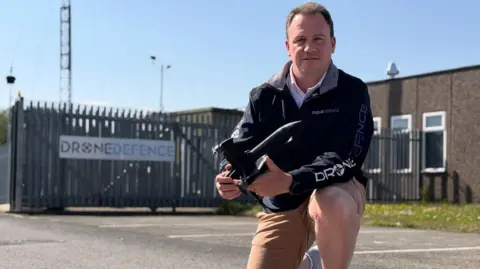
Richard Gill, founder of Nottinghamshire-based Drone Defence, said Britain was "somewhat chasing" other countries.
The MoD said it did not "recognise these claims" and pointed out that spending on counter‑drone technology had "quadrupled to £200m this year".
"Through the Strategic Defence Review, we are investing up to £1bn in air and missile defence, with British industry at its core," an MoD spokesperson added.
Drone Defence's products can detect the presence of drones, stop them entering protected areas and disable, capture or even destroy them.
The Retford-based company has several international clients and Gill said it was in advanced discussions with Gulf states, keen to protect infrastructure such as oil refineries.
The UAE, for example, detected 1,442 drone attacks in the first week of the Iran war, according to the Center For Strategic and International Studies (CSIS).
However Gill believes UK safety rules, while "well intentioned", are constraining this fast-moving industry.
"Working in aviation is an extremely regulated space and some stuff which is easier to do in other parts of the world is extremely difficult to do here," he said.
"We have a really rich history of developing aviation solutions and I think we should be supporting that industry a lot more.
"So if we had a more permissive regulatory environment, that would help us as well."
The firm's concerns have been echoed by other businesses in the same field.
Skycutter, a drone maker which is also based in the East Midlands, works closely with the Ukrainian military and has recently signed a multi-million dollar contract with the US.
It warned in April that without more interest from the government, it would have to move its operations across the Atlantic.
Governments in the Middle East are also looking for cost-effective ways to fend off attack drones without having to scramble fighter aircraft or launch ground to air missiles.
Gill said conventional drones could be defeated by jamming or blocking the radio signal to its operator but as attack drones like Iranian Shaheds do not use radio signals, they require a different approach.
"They are pre-programmed before launch and then fly autonomously to their target.
"Once they are in the air, there is no signal to jam. So the problem changes completely. Instead of interrupting a pilot, you are dealing with a flying object that is effectively on a one-way mission," Gill said.
"So the firm's AeroStrike drone interceptor is designed to physically hit the hostile drone causing it to crash before it can cause destruction in a sensitive or populated location.
"It flies at 250 kilometres per hour (155mph) for about 20 minutes, out to about 20 kilometres (12 miles).
"There's no explosives, it's just designed to hit the target, to knock it out of the sky," he added.
More generally, Gill believes drones have completely transformed modern conflict.
He likened them to the invention of the longbow and the self-loading rifle.
"It's that impactful on the battlefield," he said.
"This isn't going away. We've got to be able to have industry evolve to develop solutions to this new threat."
An MoD spokesperson said: "Through Project GOSHAWK we're backing UK firms to rapidly develop low cost interceptors which we intend to purchase at scale, and Cambridge Aerospace - a veteran-founded UK defence start-up - is already delivering cutting-edge missiles for our Armed Forces.
"UK forces have intercepted more than 100 Shahed type drones in the Middle East, the majority using British made missiles manufactured by Thales in Belfast.
"Through our trade missions, we have expanded the number of UK defence companies operating in Ukraine from 94 to 619 and will open a British Business Centre in Kyiv later this year to further support UK industry."
Listen to BBC Radio Nottingham on Sounds and follow BBC Nottingham on Facebook, on X, or on Instagram. Send your story ideas to eastmidsnews@bbc.co.uk or via WhatsApp on 0808 100 2210.
