Libraries urge people to measure blood pressure

 BBC
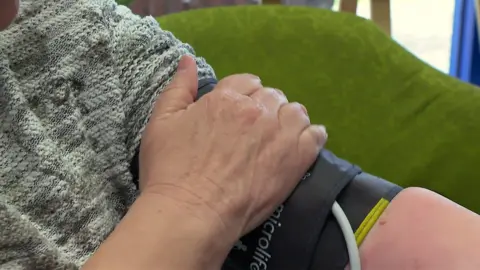
BBCA scheme where people in Devon can borrow blood pressure monitors from libraries has been nominated for an NHS national excellence award.
The One Devon initiative, led by Devon County Council Public Health, Libraries Unlimited and the NHS Devon Integrated Care Board (ICB), was launched in September 2025.
More than 50 libraries are included in the scheme and have blood pressure kits which could be borrowed for up to three weeks.
Kay Brennan, a GP in north Devon, said: "You can pop along to your local library and... you can borrow a blood pressure machine, monitor it, write it down and take it back to your GP."
'Hadn't made time'
Sam Colier, from Cornwall, had a stroke at the age of 42.
Colier, a nurse, said she had high blood pressure and headaches in the lead-up to the stroke which she put down to stress-related migraines.
She said: "I just had this horrendous headache and felt iller than I'd ever felt, so I went off to hospital and after quite a few tests found out I'd had a stroke, which was quite unexpected when I was age 42.
"I genuinely thought I was going to die."
She added: "There's a lot of things I would do differently. The main thing I'd ignored was that, because I was just over 40, I'd had letters from my GP surgery inviting me for the annual health check and I just hadn't made time.
"I was working full-time, I'd got teenage kids, life was just really busy."
Colier said had she made the time she would have known her blood pressure was high.
Causes of strokes
The NHS says a stroke is when blood stops flowing to a part of your brain.
It can affect things including such as speech and movement, and take a long time to recover.
A stroke needs urgent medical help in hospital because it can be life-threatening.
It can happen to anyone at any age, but risks may increase if someone is:
- Over 50 years old
- From a black or South Asian background
- Has sickle cell disease (SCD)
- Has an unhealthy lifestyle
- Has migraines
- Take the combined contraceptive pill
- Are pregnant and have pre-eclampsia
- Have just had a baby
Certain conditions also increase the risk of stroke. These include:
- High blood pressure (hypertension)
- Diabetes
- Irregular and fast heartbeats (atrial fibrillation)
- High cholesterol
- A transient ischaemic attack (TIA or mini stroke)
Colier said: "There's lots of different causes, but mine... they confirmed it was completely related to my high blood pressure."
"I've taken antihypertensives ever since and my blood pressure is nice and controlled," she said.
Since her stroke, Colier has gone on to run three marathons.
She said: "Before I was discharged, I asked the doctor what can I do and he said to me: 'I don't think you're going to go out and run a marathon.'
"He meant it as in 'take gentle exercise, don't go and push yourself'; but that stayed with me and that became my challenge."
'Take it home'
Brennan said: "The basics of it are that having a high blood pressure is still the leading cause in the world of the most preventable amounts of deaths and heart attacks and strokes.
"So, if we can pick up people a little bit earlier and support them either to make some small changes in their daily lives or potentially for some people start some medication, it will really help reduce the burden on the NHS as well and do your bit."
Agnes Finlayson, who works for Devon's library service, said: "You come in with your library card, you take it home as you would a book you can borrow it for three weeks.
"It's been really great and lots of people anecdotally coming in and saying that you know it really helped them."

BBC Radio Devon is running Wake Up Call encouraging everyone to take a look at their health by speaking to a range of experts about health issues and hearing from people in Devon who have been through difficult times.
If you are affected by any of the issues raised in this story, help and support is available via BBC Action Line and One Devon.
