'Nightlife culture isn't dying but it is evolving'

 BBC
BBCLondon's nightclubs have been struggling to survive, with rising costs, disgruntled neighbours and changing attitudes all posing a threat to their existence.
According to the Night Time Industries Association, there will be no major clubs left at all in the UK by 2030 if venue closures continue at the current rate. Is the future really that bleak?
It's near to midnight on a Friday and a queue wraps around the arches of Charing Cross.
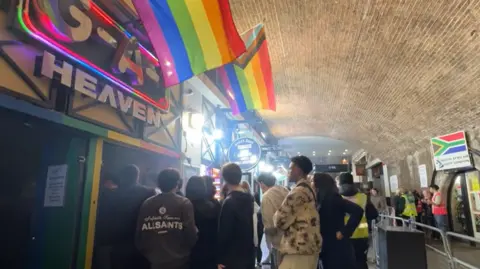
Students in glitter and vintage jackets shuffle forward outside Heaven, one of London's most iconic and longest-running LGBTQ+ clubs.
It looks like business as usual, but talk to the 20‑somethings waiting to get in and a different story emerges.
They say that contrary to the Gen Z stereotype, demand for clubbing exists for people their age - but affordability does not.
Design student Ellie said: "Yes, we did go through Covid at the coming-of-age time and maybe that has affected us a bit, but really the decision comes down to how much is this going to set me back?"
Another, Saffron, 21, said: "My student loan is literally nothing. If my parents didn't send me any money, I'd be sat at home right now.
"Drinks are so expensive. There aren't many student nights with cheaper drinks for example. Where is my student night?
"Yes, there's a long queue right now, but I don't think it's as busy as it should be."
Her friend Antos added: "You already spend so much money on other things.
"A lot of people our age probably pay for maybe three different streaming services, that's around £50 a month as a student just to have entertainment at home."

But while young people are feeling squeezed, the pressure on venues themselves is even more intense.
Industry groups warn of accelerating closures. The Music Venue Trust found there have been on average two to three closures a week across the country.
London's independent Nightlife Taskforce was set up by Mayor Sir Sadiq Khan a year ago to examine the state of the capital's night-time economy. It found in its final report published last month that the capital's nightlife was in decline due to planning, licensing, transport, costs and safety pressures.
BBC London spoke to owners of clubs big and small across the capital, and they were in agreement that London's nightlife is grinding through one of the biggest transformations in its history.
They say drink and ticket sales are simply not enough to cover costs any more and the business model is outdated.
 The Cause
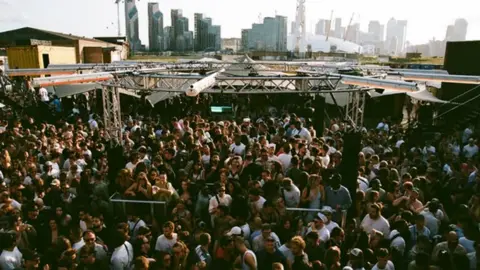
The Cause opened as a DIY event space in Tottenham in 2018.
Co-founder Stuart Glenn said the biggest challenges to staying open were rising costs and red tape.
"Running a venue in London isn't easy, you take risks and many don't survive," he said. "It takes a long time to get the right permissions, and securing finance is tough because clubs aren't seen as a safe bet by banks or lenders.
"You need real stamina to push through hard periods and stay in the game. We have incredible weeks, then quieter ones where we can lose £20,000. It's a volatile industry, peaks and troughs.
"You have to maximise the big weekends like Halloween, New Year's, because they carry you through the slower periods.
"We can have a sell-out weekend, then spend three weeks balancing the books again. That's the reality of running independent nightlife today."
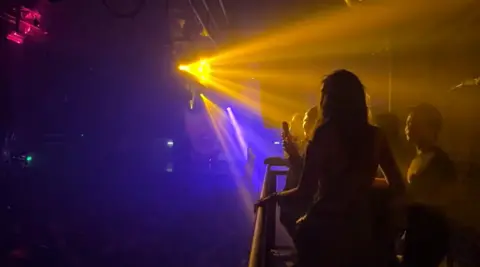
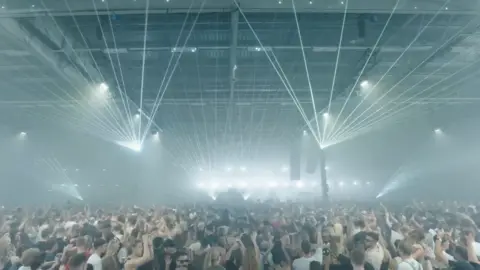
Drumsheds, located in a former Tottenham IKEA, is a massive 608,000 sq ft venue with a total capacity of up to 15,000 people.
The managing director of Broadwick Live, the company behind Drumsheds, Luke Huxham, has a wildly different operation to that of The Cause but sees similar challenges.
"Closures aren't a sign of failure, they're a sign that the framework around us needs modernising," he told us.
"Demand hasn't disappeared, it's being squeezed by outdated attitudes, inconsistent regulation and planning decisions that prioritise short-term development over long-term cultural value.
"While operators can innovate, the long-term survival of club culture depends just as much on policymakers recognising that nightlife is essential."
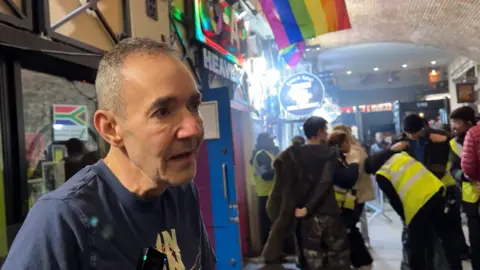
Noise complaints and planning licences are significant points of conflict. This is one issue Jeremy Joseph of Heaven has been battling with.
He claims that AI was used to create a fake residents' petition with fake signatures with the aim to close the venue.
He says: "Had we not managed to prove that they were fake, we could have been closed, or we could have had conditions put on our licence that would have been unsustainable for us to run the business."
Joseph says the issue will go to court this year and could be a landmark case.
"Where we are, you're in an impact zone of central London, your licencing conditions are a lot stronger than somewhere a mile down the road," he says.
"The problem is that residents have more weight than businesses in the area, too. Councillors care more about residents because they can vote but businesses in the area can't.
"For example, if residents move in near to Heaven, they can complain, despite consciously knowing that they are moving near a nightclub and they can file objections against our licence, even though we've been here for 46 years.
"We have no protection. It's ridiculous and the policy is very outdated."
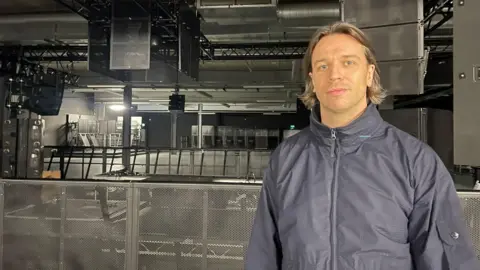
Faced with rising costs and a generation that cannot afford to fill dance floors every weekend, club owners say they have had no choice but to diversify what their venue can offer.
"The future is multi-use spaces. You can't just sell drinks on Friday and Saturday nights and expect to cover rent for 52 weeks a year," says Glenn.
"Venues now have to be flexible, hosting daytime projects, arts events, community work, rehearsals, gallery use or film and location shoots.
"Some of our big film bookings have literally carried us through months that would have been major losses."
Huxham says Drumsheds was built with a similar approach in mind, to "accommodate a wide range of uses" from large-scale electronic and live music, to art, product launches and brand showcases.
"This hybrid approach and versatility is what makes it commercially resilient and sustainable," he says.
 Broadwick Live
Palais is a nightclub in Peckham that closed 15 years ago. Now under new owners, tonight it reopens for the first time since then, with New Zealand house music duo, Chaos in the CBD to kick it off.
When asked how they were planning to make it work against the odds, it also came down to multi-use.
Owner Jamie Rule, who also owns Netil 360 and Night Tales in Hackney, says: "One thing we've learned from our other venues is that no single revenue stream can carry a venue any more.
"You need all of them working together. Tickets, the bar, food, private hires, birthdays, brand events, even weddings, they all matter.
"Palais is designed so that every floor, every room, every facet contributes to the overall picture. That's what will make it sustainable."
He says he does not believe in the "death of clubbing", adding: "As long as there's talent, creativity and a desire for shared experiences, there'll be a scene.
"It is getting harder to operate - rising costs hit clubs just as much as they hit individuals - but people still want to go out, dance and hear great music.
"The culture is changing, yes, but evolving isn't the same as dying."
Following the mayor's Nightlife Taskforce report which held surveys, research and consultations over the past year with industry members, City Hall was given 23 recommendations to make changes on transport, licensing, noise and safety, with a new night-time commission to enact them.
With the goal to achieve a "24-hour city", the mayor said: "London's independent Nightlife Taskforce has put together the most detailed picture we've ever had of the challenges and opportunities facing our capital at night. I'm committed to working with partners to do all I can to support this."
Listen to the best of BBC Radio London on Sounds and follow BBC London on Facebook, X and Instagram. Send your story ideas to hello.bbclondon@bbc.co.uk
