Who is To Lam, the ex-cop who wants to revamp Vietnam's success story?

 Getty Images
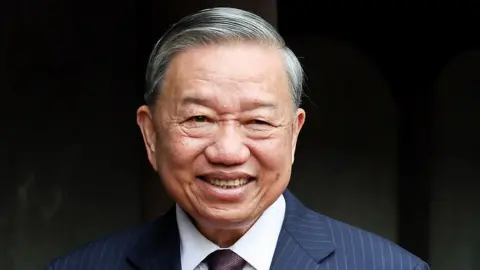
Vietnam's Communist Party Congress has chosen To Lam as its leader for the next five years, appointing him as general secretary to lead the one-party state.
Having assumed the role after the death of long-serving leader Nguyen Phu Trong in July 2024, To Lam sought the position again, following a short first term that saw him launch sweeping administrative and economic reforms.
The 68-year-old wants Vietnam, a manufacturing powerhouse, to break out of the "middle income" trap and become a developed economy. But critics say he has been too hard-fisted in his attempts to accelerate the country's growth.
To Lam was barely eight months into the job in April when he laid out plans to chart a prosperous new course for Vietnam.
Appearing before hundreds of thousands of Vietnamese citizens in Ho Chi Minh City on 30 April, the 50th anniversary of the end of the Vietnam War, known locally as "Liberation Day", he pledged to "build upon the spirit of the great victory in the spring of 1975, and the values and triumphs over the past 40 years under 'Doi Moi'".
Doi Moi refers to the series of economic and political reforms, launched by Vietnam's Communist Party in 1986, which aimed to transform the country into a "socialist-oriented market economy".
Along with cheap labour and political stability, the reforms helped Vietnam go from being one of the world's poorest nations to an economic success story.
Standing before political leaders, war veterans and foreign dignitaries, he declared, "We will definitely reap greater triumphs and forge new miracles in the new era of wealth, civilisation, prosperity and national advancement".
This was a bright-eyed mission statement. Vietnam, which has already grown into a middle-income economy within a single generation, wants to become a high-income country within the next 20 years.
That would require maintaining its average annual economic growth - which is about 6.5% according to the World Bank. If that happens, it could more than triple income per capita in the country.
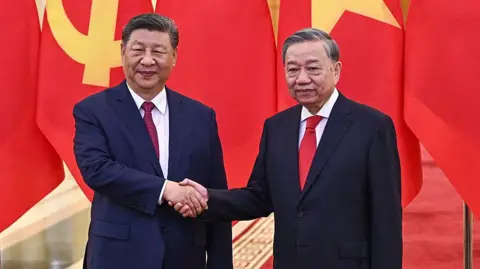
But with a heavy reliance on foreign-owned industry, an American trade war that has seen Vietnam threatened with potentially crippling tariffs, and an increasingly wobbly geopolitical tightrope between the United States and China, To Lam has his work cut out for him.
 Getty Images
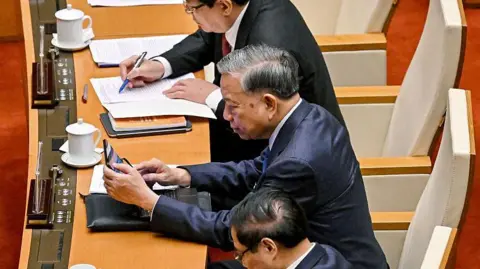
When he assumed the mantle of general secretary on 3 August 2024 – a position for which he was nominated by the party's central committee behind closed doors - To Lam cemented his status as the most powerful man in Vietnam.
But authority was far from new to him.
Following in the steps of his father, To Quyen, a former military colonel and police chief and a recipient of the Hero of the People's Armed Forces, To Lam spent most of his career in the police and and security apparatus.
Having spent more than 40 years working for the People's Public Security Forces, he became a major orchestrator of the "blazing furnace" anti-corruption campaign: an ongoing effort to root out corrupt officials across Vietnam's government and public sector.
These have included high-level officials such as presidents and politburo members as well as high-profile figures like Truong My Lan, who had secretly controlled Saigon Commercial Bank and taken out loans and cash over more than 10 years amounting to a total of $44bn (£34.5bn). She was sentenced to death in April last year.
The "blazing furnace" campaign has also seen tens of thousands of Vietnamese officials disciplined, dismissed and expelled since it was established by former president Nguyen Phu Trong in 2016.
As his successor, To Lam has pledged to continue the anti-corruption drive which has boosted Vietnam's ranking in Transparency International's corruption perceptions index, from 113 in 2016 to 88 in 2024.
He has also utilised the campaign to try and drastically streamline the bureaucracy, laying off at least 100,000 civil servants, halving the number of provinces around the country and abolishing several ministries. Such high-stakes moves highlight his reformist ambitions - but there are also fears that the anti-corruption drive, in its zealousness, could be creating more bureaucratic problems than it's solving.
 Getty Images
To Lam's own career is not without controversy. Throughout his time as a public official, he has gained notoriety for repression and hostility to civil rights.
Authorities hold a tight grip on power in the communist dictatorship. And between 2016 and 2024, under To Lam's leadership,Vietnam's security agency enacted a raft of hard-fisted crackdowns against activists and journalists, arresting members of human rights groups and launching troubling attacks on free speech and press freedom.
Since 2016 more than 70 Vietnamese journalists have been imprisoned, often in life-threatening conditions, and 38 are still behind bars, according to Reporters Without Borders (RSF). Vietnam remains among the worst-ranked countries in the world in the RSF World Press Freedom Index.
One of To Lam's more infamous controversies stemmed from a viral TikTok video of him eating a $20,000 (£14,881) gold-flecked steak prepared by none other than chef Nusret Gökçe, otherwise known as "Salt Bae".
The video, which was posted in November 2021 and showed Gökçe feeding To Lam the piece of beef at his expensive restaurant in London, drew the ire of many Vietnamese social media users, who noted the incongruence of a top communist official eating a dish costing more than his monthly salary.
Days later, a noodle vendor in Vietnam was jailed for five-and-a half years after posting a video that imitated Gökçe's theatrical way of sprinkling salt, but with green onions. He was accused of spreading anti-state propaganda.
The indictment accused Bui Tuan Lam of posting 19 videos on Facebook and 25 on YouTube which "affected the confidence of the people in the leadership of the state".
While the famous Salt Bae parody was not mentioned, the embarrassment it caused the Vietnamese government was widely presumed to be the reason for his arrest.
 Getty Images
After becoming party chief, To Lam has been modelling himself as an aspirational reformer, pegging his flag to the promise of sharp economic growth.
In his first meeting as chair of the Central Steering Anti-Corruption Committee last August, he emphasised that "the fight against corruption must not hinder economic growth", an apparent bid to quell fears that the "burning furnace" campaign had negatively disrupted Vietnam's bureaucracy and impacted the country's economic prospects.
He has also championed "high-quality" growth led by technological development, announcing a quadrupling of the science-and-technology budget and pledging to aggressively expand the country's semiconductor industry, setting a target to earn $100bn a year from that sector by 2050.
"Lam's emerging leadership style appears pragmatic rather than ideological, focused on economic development and political stability over doctrinal campaigns," Nguyen Khac Giang, a visiting fellow at the Yusof Ishak Institute's Vietnam Studies Programme, wrote last year.
"While he treads carefully between reform and continuity, Lam's actions hint at a bolder, more assertive leadership style."
