Former asylum with storied history is now on market

 County Asylums
One of Nottingham's most striking buildings has been put up for sale, but what stories lie behind the imposing facade of Duncan Macmillan House?
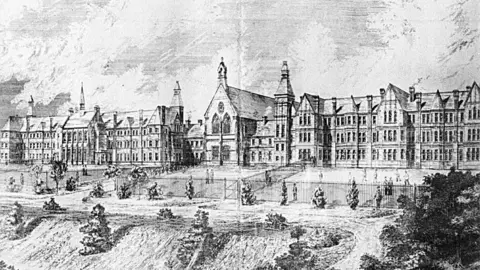
Built at the height of the Victorian era to cope with surging demand, what was then Mapperley Asylum has seen huge changes in the treatment of mental illness.
From padded cells to the rise of psychotherapy and care in the community, the site has been part of both the landscape and neighbourhood.
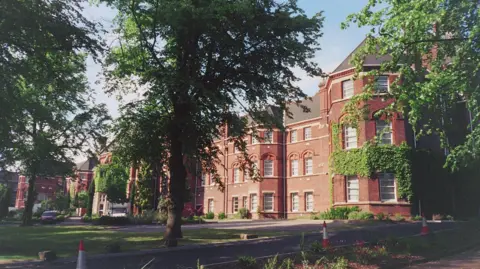
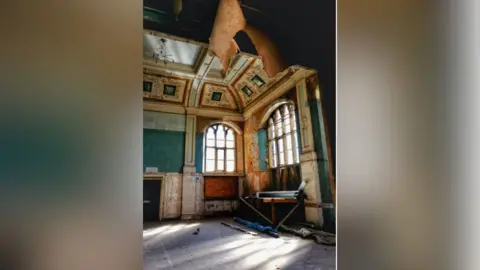
The main building, in recent years used as offices for Nottinghamshire Healthcare NHS Trust, is now up for sale and its future is uncertain.
 Getty Images
Nottingham pioneered the concept of publicly funded lunatic asylum in 1812 - but quickly encountered the problem of overcrowding in the facility.
The Nottingham General Lunatic Asylum was built to house 80 people, but by the end of 1857 it held 247.
Its rising numbers, along with buildings which had started to crumble, led to plans for a new facility by 1874.
The design of the new Nottingham Borough Asylum was given to the inexperienced George Thomas Hine, a decision possibly influenced by his being the son of noted city architect Thomas Chambers Hine.
But it proved to be a significant choice.
Tom Ford, who helps run the County Asylums history website, said: "He went on to become Consulting Architect to the Commissioners in Lunacy which saw him directly designing, or having some say in, the majority of asylums built in England at this time.
"Hine was groundbreaking in that he looked at how the design impacted care and he evolved it into something which still influences hospital design even now."
 County Asylums
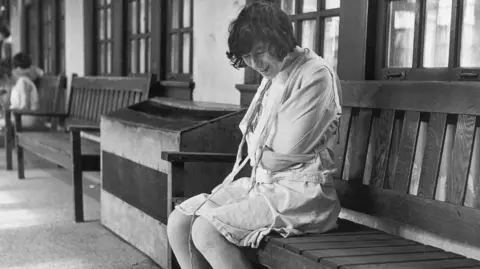
While primitive by today's standards, Mapperley was part of a move away from the prison-like conditions of the past.
Mr Ford said: "It was a world away from the workhouse where people were made to work to earn a bed.
"People coming in were patients, and were treated as such.
"Although they did things like occupational therapy, it was to try and benefit them."
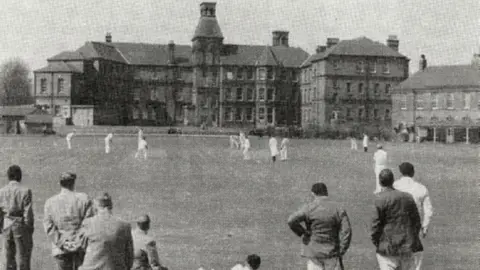
Mapperley was noted for its sports pitches, electricity was introduced in 1924 and cinema equipment was installed in 1927.
It was used as a military hospital during World War One, but the conflict put a strain on the building for years afterwards.
Mr Ford said: "Although it was not talked about much at the time, there was a lot of post traumatic stress disorder afterwards.
"During the 1930s asylums were jam-packed, with some two to three times over capacity".
 County Asylums
Advances in drug treatment in the 1950s meant patients stood a good chance of being discharged in a relatively short timescale.
Mapperley also became the first mental hospital to unlock all cells, going on to completely abandon the practice of seclusion, with the padded cells dismantled in 1956.
But its large buildings were soon being viewed as remnants of the past and their forbidding reputation meant successive governments cut investment.
Derek Jackson, who still lives nearby, had a work experience placement there in 1972.
He said: "There was a lot of stigma around Mapperley Hospital while I was at school.
"There was all the scare stories about people in white coats and straightjackets.
"So I was pleasantly surprised when I did my work experience from school that people didn't look the way I had anticipated them to look.
"The staff - although they did wear white coats - were genuine human beings and the building was just amazing!"
 County Asylums
While drugs and electroconvulsive therapy was still extensively used, the times were again changing.
Mr Jackson said: "Mapperley was innovative, they started to use psychotherapy which was quite groundbreaking.
"I went away and worked in other areas but came back in 1997 and there had been significant changes - I ended up teaching in rooms which used to be wards when I was a 16-year-old."
Care in the Community - a government initiative to move patients out of institutions - was the end for this type of care and Mapperley closed as a psychiatric hospital in December 1994 and part of the site was sold off for apartments.
Now the remainder is to go on the market.
 Mark McLaughlin
Nottinghamshire Healthcare NHS Trust said: "The decision to sell the site follows careful consideration of how best to use public funds for the future.
"The building is ageing and requires significant investment to maintain. Its sale will allow the Trust to redirect resources into frontline services, patient care and modern, fit-for-purpose environments."
Mr Ford said: "You can't ignore that a lot of terrible things happened in them but, architecturally, Mapperley is a striking building.
"We have lost at least 50% of these and it's important we keep those that are still standing.
"The last generation who worked and were patients in them are dying off and it's important to remember the role they played for so long.
"The methods and treatments we use now wouldn't exist without these buildings."
Follow BBC Nottingham on Facebook, on X, or on Instagram. Send your story ideas to eastmidsnews@bbc.co.uk or via WhatsApp on 0808 100 2210.
