Family of man who died in custody call for law change

 BBC
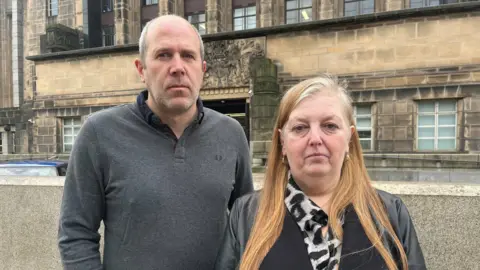
BBCThe family of a man who died in prison are calling for the mandatory implementation of recommendations from fatal accident inquiries.
Allan Marshall, 30, was on remand at HMP Edinburgh in March 2015 when he was restrained face down by 17 prison officers. He died four days later.
The Scottish Prison Service has since admitted his death was unlawful.
Mr Marshall's family said they had a positive meeting with First Minister John Swinney at St Andrew's House in Edinburgh on Monday.
Mr Swinney said he had undertaken to set out to the families the steps taken to implement the fatal accident inquiry recommendations that are relevant.
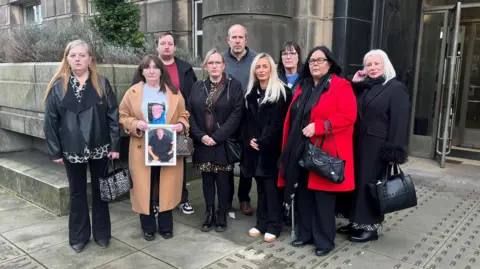
They met the first minister along with other families who have lost loved ones in custody.
Sharon MacFadyen, Mr Marshall's aunt, told BBC Scotland News the meeting was very positive.
"They listened to us and they are willing to involve us in getting input from the families who have lost people," she said.
"All the recommendations are at the moment recommendations, they don't need to uphold them so we want them to make them law.
"If there is a recommendation made by a sheriff it should be upheld.
"There are lots of things they are looking into, they are looking into changing everything.
"They are looking into the prison service, they are looking into all the factors, how long the FAIs take and just everything we have asked for they are looking into already.
"I wish they had done this 10 years ago but at least now we are starting to get somewhere and hopefully it will prevent deaths."
 Marshall family
In September Mr Marshall's family received an apology from the prison service, Crown Office and Police Scotland after the Court of Session heard the level of force went beyond what was necessary.
It was the first time all three parties have publicly apologised, accepted it as an unlawful death and accepted the state failed to adequately investigate.
Mr Marshall, from Carluke in South Lanarkshire, was on remand for unpaid fines and breach of the peace charges when he experienced a mental health crisis.
He was transferred to HMP Edinburgh's segregation unit after prison officers said he had become agitated.
CCTV showed Mr Marshall, who had an underlying heart condition, being dragged and restrained by up to 17 prison officers - some of whom used their feet.
The court heard there was "never any need" for force to be used on Mr Marshall and how he should have received medical attention instead.
'Listened with great care'
Mr Swinney said: "I listened with great care to what the families of those who have lost their lives in custody had to say and the first thing I expressed to them was my sympathy for the loss they have suffered.
"It is important for people in Scotland that their rights are protected and that they are supported so it is vital when individuals are in custody they are given the support and the care they require.
"Where that has fallen short, and of course we have had fatal accident inquiry recommendations and conclusions that make that point, those issues have got to be addressed.
"I've undertaken to set out to the families the steps we're taking to implement the fatal accident inquiry recommendations that are relevant.
"I've also indicated to the families that I want them more closely involved in the steps we are taking within the government to make sure that there is progress made on all of these recommendations so that the lessons that are learned from these tragedies can be applied to custom and practice within our prisons."
