Crabs break down microplastic particles - study

 Getty Images
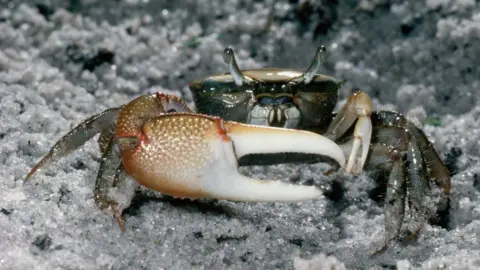
A species of crab has been found to play an "unheralded role" in the breakdown of microplastic particles, according to scientists.
The University of Exeter said scientists observed fiddler crabs in a polluted mangrove forest in Colombia ingest "large quantities of small plastic particles in the sediment".
It said the species could break down plastics within days - but scientists warned of a potential release of harmful nanoplastics into their tissues and, consequently, the food chain.
Tamara Galloway, professor of ecotoxicology in the Department of Biosciences in Penryn, said: "Until now, we did not know whether they avoided plastic in the natural environment or would adapt to its presence."
'Adapt to pollution'
The university said the research was led by Professor José M. Riascos, with other institutions including Universidad de Antioquia in Turbo and Medellin, the University of Exeter, and the Corporation Center of Excellence in Marine Sciences (CEMarin) in Bogotá.
It said the Gulf of Urabá, where the study took place, had some of the highest levels of plastic contamination reported anywhere in the world.
"Despite this, fiddler crab populations are thriving in the area, raising the question of how these creatures tolerate such high levels of plastic waste," it said.
It said researches sampled a total of 95 crabs.
Daniela Díaz, of the Universidad de Antioquia, said it showed living creatures were finding ways to cope with pressures.
"The results could lead to a better understanding of how animals adapt to pollution and the fate of plastics in the environment."
Follow BBC Devon on X, Facebook and Instagram. Send your story ideas to spotlight@bbc.co.uk.
