Wetherspoon dog policy could be breaking the law, watchdog says

 BBC
BBCJD Wetherspoon's policy to refuse to serve disabled customers who do not have photo ID for their assistance dogs could be breaking the law, the equality watchdog has said.
The pub chain has had a ban on dogs – with the exception of assistance dogs – in its UK pubs for a number of years.
However, in May last year the firm introduced a new policy to ask anyone wanting admission with an assistance dog to produce identification from a charity called Assistance Dogs UK (ADUK).
The BBC has spoken to a number of disabled people who said they have been challenged and refused service if they do not have ID.
One woman said she felt sick and humiliated when she was challenged to show identification for her guide dog.
Wetherspoon said it believed its policy, which was an adjustment to its usual "no dogs" rule, was lawful and reasonable and that they had taken legal advice on it.
It said it was brought in to protect customers after seeing an increase in the number of people trying to gain access to its premises with dogs, using ID and jackets, which can be purchased online without showing proof of training or a medical need.
However, the Equality and Human Rights Commission (EHRC) said it had now written to the pub chain after it received complaints from disabled people and said it was concerned the policy may not comply with UK law.
The charity Assistance Dogs UK said it believed, from its understanding of the law, that the pub chain's policy was discriminatory and that no identification was legally required.
'I just felt so sick'
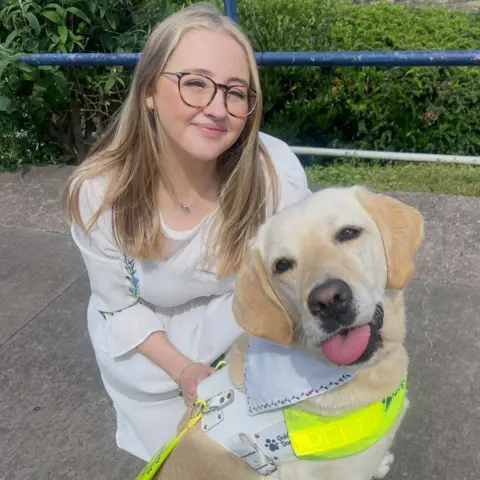
Megan Stephenson is visually-impaired and has an ADUK ID card. She said she felt humiliated when she visited a Wetherspoon pub on three occasions between May and September last year and bar staff asked her for her identification.
"The staff stopped me as I walked in and were like 'we need to see your dog's ID'. Bobby was in harness, had the flash in her lead, was very obviously a guide dog, but they wouldn't let me go if I didn't have an ID for her.
"Fortunately, on this occasion, I did actually have it with me so they thankfully let us in. But I was still stopped, still singled out, still treated differently. I just felt so sick, so stressed."
She said she no longer uses Wetherspoon pubs after feeling discriminated against.
 Getty Images
The BBC has spoken to more than a dozen people who use assistance dogs and were asked to produce ID, including many who were then asked to leave pubs. The charity Guide Dogs said it had received 27 complaints about Wetherspoon from people either being challenged or refused entry.
Liberal Democrat MP Steve Darling said he was challenged for ID last August. He said he felt a duty to stand his ground, saying the policy would also impact people with a range of other disabilities, including those with conditions such as PTSD.
While he said he understood Wetherspoon wanting to crack down on dogs who are misbehaving in its pubs, he added: "Why tarnish all assistance dog users with that brush?"
The law on access to businesses and restaurants for disabled people with assistance dogs is ambiguous.
Under the Equality Act 2010, service providers have a duty to make "a reasonable adjustment" to accommodate the needs of disabled people and not to treat them less favourably than other customers.
A reasonable adjustment might include waiving a no dogs policy, but in this context the law does not set training standards for assistance dogs or explicitly say they must be allowed access. Only a court can decide, based on the individual circumstances of a case, whether a policy is unlawful.
Exceptions to the pub chain's policy on dogs include trained guide dogs and assistance dogs with accredited training from ADUK member organisations.
JD Wetherspoon said: "We consider the requirement for assistance dogs to have accredited training from ADUK member organisations to be a reasonable adjustment to our policy, as required by the relevant legislation.
"Our pubs are large and very busy. Bearing in mind the significant increase in dog bites and hospitalisations, common sense indicates a clear need for documentary proof of training in our pubs."
But ADUK, the umbrella charity representing many assistance dog users, said it believed the policy was discriminatory.
It said its identification was not a legal requirement and not all assistance dog users will carry ID.
Its chief executive, Vicky Worthington, said Wetherspoon had approached the charity for guidance before establishing the policy, but added: "Sadly they didn't take on board any of the advice we provided."
The charity separately said it had seen a "huge surge" in businesses contacting it for advice, some increasingly confronted with people "misrepresenting pet dogs as assistance dogs".
A spokesperson for the Equality and Human Rights Commission told the BBC: "We are aware that a significant number of disabled people with assistance dogs have been refused entry from JD Wetherspoon venues because they aren't carrying formal identification for their assistance dogs."
"We have written to JD Wetherspoon to ensure they are aware of their duties under the law."
