What happens next to the boats at the bottom of the canal?

 Jacob King/PA Wire
When part of the Llangollen Canal collapsed just days before Christmas, it was clear it would be a huge operation to get the area back to normal.
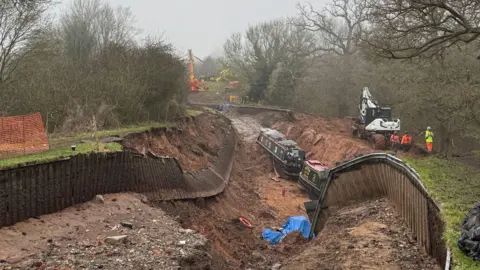
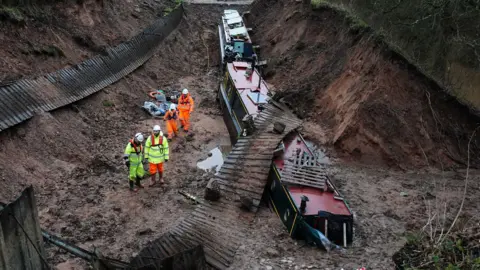
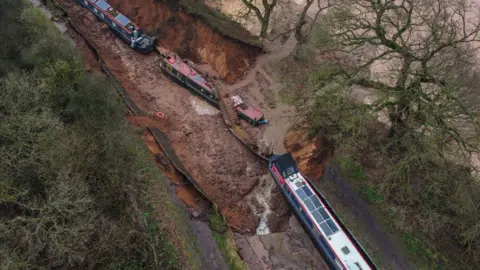
A huge hole sent gallons of water spilling into nearby agricultural fields in Whitchurch, Shropshire, and saw two boats falling to the bottom, with one hanging over its edge.
Two boating families are still without their homes and the breach has meant much of the canal, which runs from Hurleston Junction in Cheshire to Llangollen in Wales, cannot be navigated until it is fixed.
There has been talk of a massive operation to rescue the stranded boats and fix the hole to allow the waterway to function again, but what exactly does that involve?
On Tuesday the Pacemaker, the boat left hanging over the hole's edge following the collapse, was officially refloated after being pulled a few feet back to safety by a winch system on 24 December.
Now the Canal and River Trust, which is leading the repair and recovery operations, is setting its sights on the two other boats.
 Andy Kelvin/PA
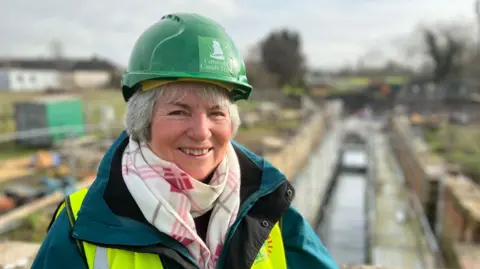
"This week we're going to focus on removing these boats, getting them to safety, getting them floated away and giving them back to the owners," said Simon Hardin, project manager.
The biggest challenge is access. The team have asked permission for an emergency closure of the nearby A41 and will then need to get their machinery through farmland before reaching the canal.
Once arrived in the area, they face the daunting task of pulling the two boats out of the hole.
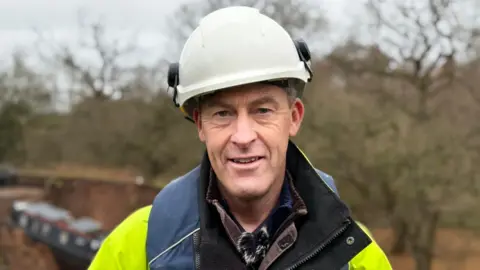
"We've gained access to an agricultural field through negotiation with the farmer, we've got a fantastic machine called a Menzi Muck, which is actually a walking excavator," Hardin said.
"The machine is going to walk into the canal... and we're going to create a ramp, and then we're going to use the same winching system to pull the boats up the ramp."
He said teams would create a dry dock to get the boats out - this is a basin that can be filled with water to get them afloat again, and then be drained once they are removed.
To do this, they will move existing dams closer to the boats.
Hardin said that the Pacemaker was an easier rescue because it was sitting flat.
"These boats are partially buried, one's pretty much full of water as well, so there's additional weight in that," he said.
"The sand when it's wet is like quicksand, the stability of the side slopes are a concern as well with a machine operating in there, so we need to dig around the boats to release them before we can pull them out as well."
'Most of 2026'
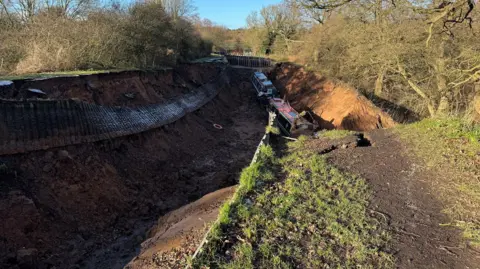
Following the removal of the two boats, the task will be the construction of the canal.
Hardin said it was hard to give an exact timeline of events but estimated that repairs could take most of 2026.
The Canal and River Trust previously told the BBC it estimated that it could cost millions of pounds.
"It's very sandy ground, access, 7,000 metre cubed of material in there approximately, but that's not when you've dug the hole - when you dig the hole and refill it, you could double that."
He said this could mean more than 350 wagons of materials.
"All of a sudden, the scale is huge isn't it?" he said.
Follow BBC Shropshire on BBC Sounds, Facebook, X and Instagram.