China is the star at Kew Gardens orchid festival

 Getty Images
Inspired by China's sweeping landscapes and rich traditions, Kew Gardens' annual orchid festival has made a return on its 30th anniversary.
Solène Dequiret, who oversees Kew's Princess of Wales Conservatory, said the event celebrated Chinese tradition "with plants and people at its heart".
She said the festival "brought some colour and joy at a time when the garden is looking a bit sad," having previously featured orchids from countries including Columbia, Indonesia and Madagascar.
This year's focus, China, is one of the most biodiverse countries in the world, and is home to about 10% of the world's known botanical species - with more than 30,000 native plants.
 Getty Images
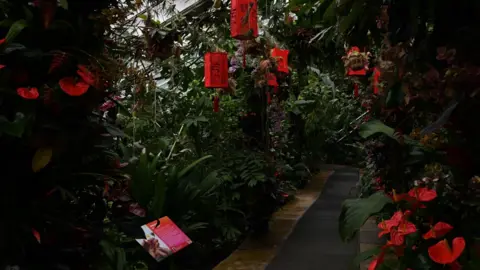
Entering through a snake‑inspired archway, visitors pass under lanterns, ornate arches of good wishes, and a traditional moon gate.
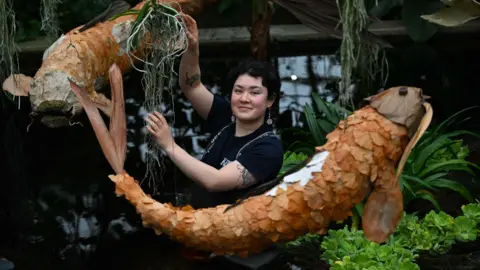
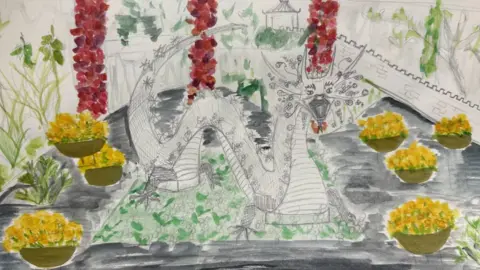
A dragon made from lotus seed heads, orchid plants, and dried leaves stretches across the central pond, while nearby nine koi sculptures made from ginkgo leaves glide over a smaller pool.
The experience culminates under an arch adorned with a horse - a nod to 2026 being the year of the horse.
 Royal Botanic Gardens, Kew
The design for the plant sculptures were drawn up almost a year ago and dry material was saved from the rest of the garden at the end of summer, with the all-important orchids ordered not long after.
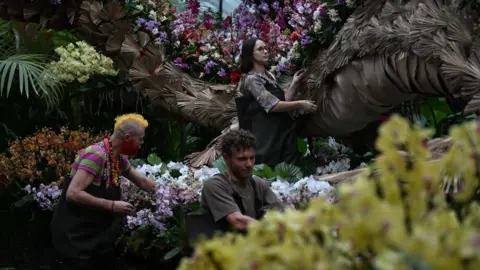
Aidan Pike, a botanical horticulturist at Kew, said putting the show together could "go down to the wire," with almost a hundred staff members and volunteers needed to arrange the more than 6,500 plants.
He said many of the orchids were ordered from the Netherlands as suppliers there have the "infrastructure to grow at scale," but the event also features Kew's permanent collection.
 Getty Images
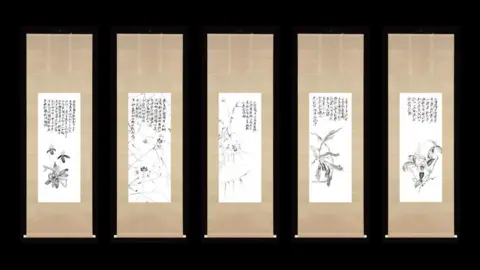
Near the end of the exhibition, a series of artworks tell the story of five orchids from Lantau Island, the largest island in Hong Kong, who long to migrate to the ocean.
The piece, created by Zheng Bo, was made using twigs and vines collected during his walks on the island he calls home.
The artwork includes Chinese calligraphy depicting a conversation between the plants.
He told BBC London the work was inspired by children who live in a village overlooking the sea.
"It made me think about their desires when they look at the ocean every day."
 Zheng Bo
A cave installation sits at the heart of the conservatory, drawing visitors into a shadowed world that raises awareness of Kew's scientific and conservation partnerships in China.
Alex Monro, a lead researcher at Kew, has spent nearly two decades studying the plants that inhabit caves in China.
He said the dramatic scenery of the Yunnan-Guizhou Plateau - featuring landscapes reminiscent of the Avatar films - supported a host of species found nowhere else.
Monro said that beneath the plateau's rugged landscape "highly specialised communities of cave flora survive in a twilight world".
Researchers at Kew and the Guangxi Institute of Botany hope that by learning how these species endure such extreme conditions, they will be able to understand how plants adapt to a changing climate.
 Getty Images
Kew's expertise is also being called on as the use of traditional Chinese medicine grows.
According to the World Health Organisation, traditional medicine has long contributed to medical research and innovation, with about 40% of pharmaceutical products drawn from natural sources and old knowledge.
Medicinal plants are named and used differently around the world, with some names used for several different species.
In response, Kew has created an online encyclopaedia for medicinal plants as a resource for researchers and regulators.
Listen to the best of BBC Radio London on Sounds and follow BBC London on Facebook, X and Instagram. Send your story ideas to hello.bbclondon@bbc.co.uk
