University tuition fees system is a 'mess', says Clegg

 BBC
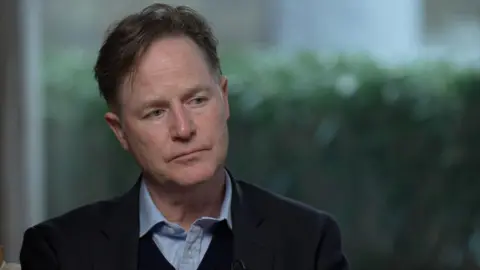
BBCSir Nick Clegg, the former Liberal Democrat leader, has said the current university tuition fee system is a "mess".
Pressed on his time in government when - while deputy prime minister - higher tuition fees were introduced, Sir Nick said he would take any criticism of his role in increasing fees "on the chin".
But he told the BBC he was not responsible for changes made afterwards, including the repeated freezing of the graduate repayment threshold, which he said contributed to a system that was now "deeply unfair".
Plan 2 loans, issued to students in England who began courses between September 2012 and July 2023 and still issued in Wales, have been criticised this year over high interest rates.
The repayment thresholds for Plan 2 loans will be frozen at £29,385 between 2027 and 2030. This means more graduates will start repaying their loans sooner after starting work.
Amira Campbell, president of the National Union of Students (NUS), described the move as "breaking a contract" and creating "a massive issue of trust".
Graduates are 'very sore'
The coalition government, formed by Conservatives and Liberal Democrats, tripled tuition fees in England to a maximum of £9,000 a year from 2012.
Sir Nick faced fierce personal criticism and later apologised for breaking an election pledge to oppose any increase in student tuition fees.
He said the intention at the time was for the graduate earnings threshold for repayments to keep rising with inflation, but it was frozen for several years under the next Conservative government.
He also criticised the Conservatives' decision in 2016 to remove maintenance grants for students from low income families.
The shift towards loans to pay for living costs led to the overall debt increasing for students whose families were not able to contribute to costs, such as rent.
He told the BBC the priority now should be to bring back maintenance grants and restore the link between inflation and the earnings threshold where graduates start to repay.
Sir Nick is now involved with AI in education and spoke exclusively to the BBC as he joined the board of a company called Efekta, to work on technology he described as "transformative".
He said: "I think graduates quite rightly feel very sore, because they're sort of running to stand still."
The government has promised to reintroduce maintenance grants for some students and has said the current system "protects lower-earning graduates".
To ensure fairness and restore trust, Sir Nick suggested there was scope in future for an independent institution to oversee the terms of student loans.
The NUS told the BBC students should not forget it was the Lib Dems who had broken their initial promises around tuition fees in 2012.
There has been an escalating political row in recent months over both the earnings threshold - the point graduates start to repay their loans - and interest rates, particularly those applied to Plan 2 loans.
Interest rates are calculated using an older measure of inflation, plus up to 3%. That means the current maximum interest a higher earning graduate is charged is 6.2%.
As a result, graduates have seen outstanding balances increase far higher than the initial amount of their loans, fueling a sense of injustice.
That anger, together with government plans to freeze the repayment threshold from 2027, has seen opposition parties putting forwards competing suggestions for how to provide redress.
The Conservatives have vowed to cut the rate of interest charged on Plan 2 loans, while the Lib Dems have called for the point at which graduates start repaying their loans to be linked to average earnings.
However, any attempt to reduce the amount graduates repay over their lifetime would ultimately come at a cost to taxpayers, according to recent analysis by independent economists at the Institute for Fiscal Studies.
The government has already committed to reintroducing maintenance grants of up to £1,000 a year for students on some courses.
A government spokesperson said: "We inherited the student loans system, including Plan 2, which was devised by the previous government.
"Threshold freezes have been introduced to protect taxpayers and students now, alongside future generations of learners and workers. The student finance system protects lower-earning graduates, with repayments determined by incomes and outstanding loans and interest being cancelled at the end of repayment terms."

Sign up for our Politics Essential newsletter to keep up with the inner workings of Westminster and beyond.
