Five years since Sarah Everard, what's changed?

 Getty Images
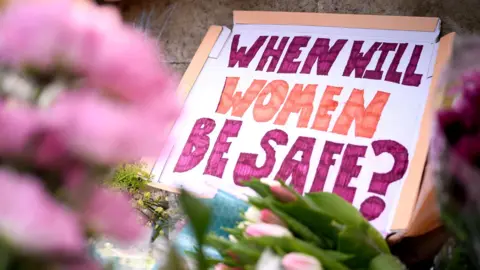
Five years ago, Sarah Everard was abducted, raped and murdered by a Metropolitan Police officer.
The premeditated killing continues to resonate with women who live and work along her route home from Clapham to Brixton in south London, on 3 March 2021.
Wayne Couzens ensured she never reached safety. The women interviewed by BBC London said male violence against them posed a persistent threat - with little, if anything, having changed to improve women's safety in public spaces.
They still alter their plans, routes and lives to feel safe.
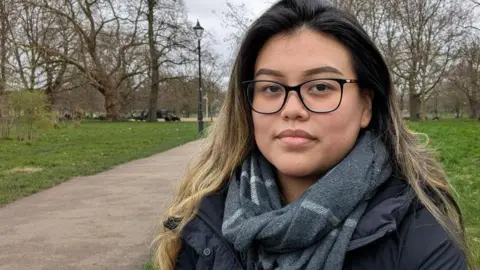
"It seems like it just happened yesterday," said Mishelle Leiva, 27, who regularly walks through Clapham Common and lives nearby.
"I remember Sarah's case. It was really sad and upsetting because this was my local park - my sister makes her way home from school passing this park," she said.
The details of what happened to Everard, a 33-year-old marketing executive, unravelled in the media over several days.
Her body was discovered in Kent.
Off-duty officer Couzens was later sentenced to a whole-life term in prison for her kidnap and murder.
It sparked an outpouring of grief and fury and shone a spotlight on male violence against women.
Since then, women living locally said they have routinely altered their plans and daily decision-making to feel safer - such as choosing to live within a ten-minute walk from a station or always refusing lifts from strangers.
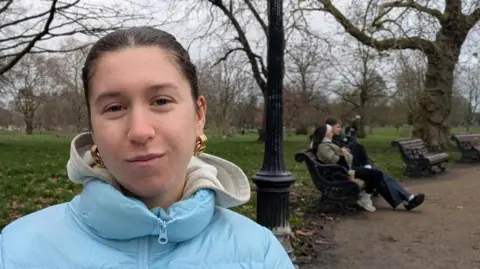
Kristina Candy, 27, was thinking of moving to Clapham when Everard's murder took place.
"When I was discussing with my family that I wanted to move there…they were like are you sure? Is it safe? It doesn't sound safe," she said.
Candy said the attack prompted her to move somewhere that was close to a station, along a well-lit and busy road.
"I think everyone should be more cautious and more aware," she said.
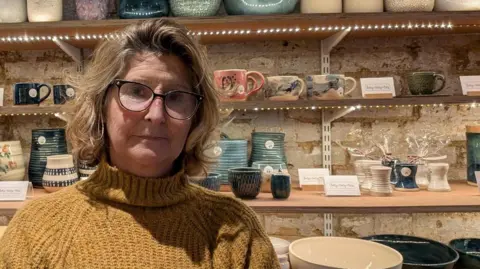
Mel Condon, 65, who has lived in the area for more than two decades and runs a pottery studio near where Sarah was abducted, said she had always known to avoid walking down dark streets or through the park late at night.
But now, she said, "we would be very careful about taking lifts from anybody who has an official badge or an official uniform".
"I always think of Sarah when I drive past where she went, where she got picked up,' said Condon.
Women's habitual decision-making around their safety in public spaces and routine altering of plans was laid bare in the Angiolini Inquiry, set up to investigate how Couzens was able to carry out his crime.
Part one, published in February 2024, investigated Couzen's career and actions prior to March 2021, detailing multiple allegations of sexual offending, including incidents of indecent exposure, and missed opportunities within the police to strip him of his position and power.
Part two, published only three months ago, examined broader issues about policing and the safety of women. It followed Sarah's case and others such as the conviction of former Met officer David Carrick, who committed sexual offences against a dozen women over two decades, including rape.
The report outlined how sexual harassment was normalised. It said women are often "on high alert" - particularly at night, in parks and on public transport - when there is a risk of sexually motivated crimes.
"I take the main roads most of the time," said Shareece Curran, 22, who works in a cafe just by Clapham Common.
She said that when walking at night, her big dog makes her feel safe.
"My sister has my location at all times, just generally, because you never know what could happen," she added.
Mishelle Leiva also shares her location with her sister.
"If it's getting really late at night, I just prefer to take an Uber. I won't take public transport anymore... I would be on the phone with my friends or send a text message to my mum or my sister. My location is always on," she said.
"I still have to take extra steps to protect myself because you never really know, it could be you next time."
'Men are getting bolder'
Although there have been considerable efforts in the past five years to improve women's safety, including cross-government strategies and dozens of recommendations put forward by part one and two of the Angiolini Inquiry, the consensus among all the women interviewed was that the situation regarding their safety in public was the same, or for some, even worse.
"Living in London over the past few years, as a woman, there are a lot more scary things happening, or lot more things that we know about," said 22-year-old Curran.
"It's getting quite bold, the things that men are doing to women," she said.
According to government's strategy for tackling violence against women and girls, published in December 2025, one in eight women in England and Wales in the year ending March 2025 experienced domestic abuse, sexual assault or stalking.
 Getty Images
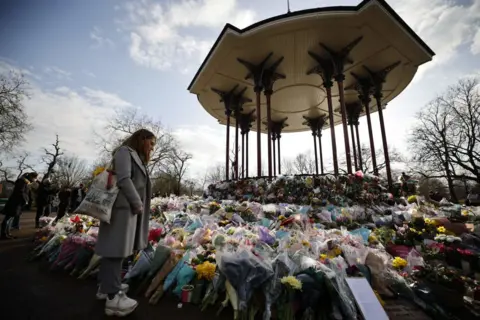
Patsy Stevenson, who was arrested at the vigil for Everard in Clapham Common five years ago and who has since become a predominant campaigner on women's safety, said online misogyny in recent years was making men bolder.
"I've been harassed and assaulted multiple times since," said Stevenson. "It doesn't stop."
She said accountability lies both with the men who commit these crimes, and with those who sit silently and doing nothing about it.
"I'm constantly watching my back," she said, "I have something on my phone so when I tap it three times, it sends an alert. It's dystopian but this is not unheard of."
Nahar Choudhury, Chief Executive of Solace Women's Aid, said Sarah Everard's story raised awareness about the "endemic of violence against women".
But her story is not an isolated one in the capital.
For example, in June 2020, sisters Bibaa Henry, 46, and Nicole Smallman, 27, were stabbed to death in a park in Wembley, north-west London, by a 19-year-old who claimed he believed the killings were a "sacrifice" to win the lottery.
Two Met officers guarding the scene took photos of their bodies and shared the images on WhatsApp.
Sabina Nessa, a primary school teacher, was attacked and killed in Kidbrooke, south-east London, in September 2021.
Zara Aleena, an aspiring lawyer, was stalked and murdered on her walk home in Ilford, east London, in June 2022 by a man recently released from prison, intent on attacking a random woman.
Choudhury said modifying behaviour to feel safer was embedded in women.
What was needed instead, she added, was for predatory men to modify their behaviour.
Listen to the best of BBC Radio London on Sounds and follow BBC London on Facebook, X and Instagram. Send your story ideas to hello.bbclondon@bbc.co.uk
