Has investigative crime unit improved military justice?

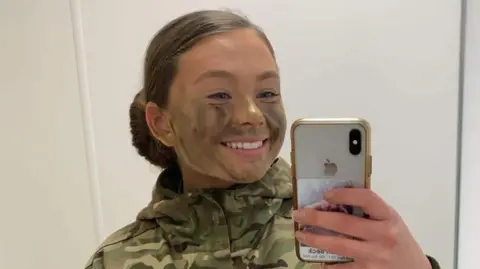 Family Handout
For years, most soldiers who reported rape or sexual assault either took their complaints to the military police or their own chain of command to investigate.
However, the inquest into the death of Jaysley Beck, who took her own life in 2021 at Larkhill barracks, Wiltshire, exposed "systemic" failings in how reports of serious crimes were mishandled internally, and pressure mounted for reform.
The 19-year-old soldier had been sexually assaulted by a colleague.
Twelve months after her death, the Defence Serious Crime Command (DSCC) was launched, dedicated to investigating major crimes committed by personnel across the globe. It combines three special investigations bureaus from each of the three military branches into one, removing them from any direct chain of command.
Warning: This article contains distressing content relating to sexual assault
For the first time, the BBC has been invited inside the DSCC headquarters in Bulford.

An inquest into Jaysley's death found the Army's failure to take action after she was assaulted by Warrant Officer Michael Webber had contributed to her suicide.
The coroner said Jaysley, originally from Oxen Park in Cumbria, was pressured to drop the allegations and it was only reported to higher command "when the cat was already out of the bag".
Her mother, Leighann McCready, began calling for an independent watchdog to investigate sexual assault, rape and murder within the military.
However, service personnel have always been able to report crimes to the civilian police.
The DSCC conducts interviews and gathers surveillance, medical assessments, forensic and digital analysis - with investigators prepped to deploy 24/7 globally, an Ministry of Defence (MoD) spokesperson said.
This information is then passed to the Service Prosecuting Authority (SPA), which determines whether there is enough evidence to pursue a conviction.
If so, the case goes to trial at the Military Court Service, where a board of up to six current or previously serving personnel deliver a verdict.
The DSCC also offers a Victim Witness Care Unit (VWCU), providing tailored support for victims and witnesses from initial report through to court proceedings.
The military promised independent scrutiny, forensic expertise, and greater support for victims - but has it delivered?
Emma, not her real name, joined the Royal Navy when she was just 19.
A year later, a male colleague she thought was a friend shoved her to the floor of a ship and tried to assault her.
"Obviously, a boy is a lot stronger when he's got your arms and legs pinned down," she said. "It was terrifying because there was no-one there, it was just me and him."
After managing to escape, the incident was reported and her attacker was immediately removed from the ship.
Within a year, Emma's case was through the military court.
Her attacker pleaded not guilty to attempted sexual assault, but the panel handed him a two-year suspended sentence and he was dismissed from the Royal Navy.
His name will also be added to the sex offenders register for 10 years.
"It was such a relief to see, it was actually justice," she said. "It was good to see hope in the system. You definitely get listened to, you get cared about. I feel safe 100%."
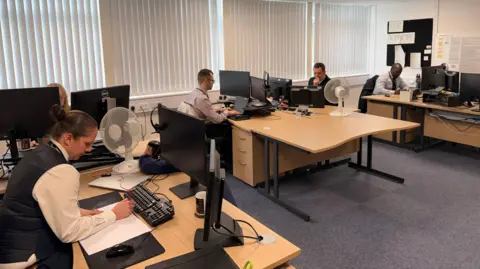
According to Cleaven Faulkner, director of the Military Court Service, a rape case is heard in the military court, on average, within six months of referral to the SPA, while some rape cases are currently listed in crown court for 2030.
He added "the conviction rate for adult-rape-flagged cases in the Court Martial was 51% compared to 36% in a crown court".
However, MOD guidance suggests these figures are not directly comparable as each court records convictions differently.
For example, data from the CPS includes both guilty and non-guilty pleas, while the military court excludes guilty pleas.
In addition, "rape-flagged" cases may mean the defendant was initially charged with rape but ultimately convicted of a lesser crime, which still contributes towards the statistic.
The MOD guidance states: "Conviction-rate data must be treated with caution and are not indicative of the performance of the system, individual agencies or a trial process."
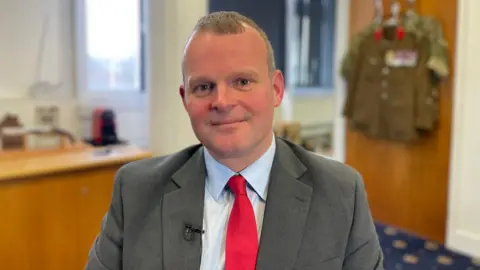
Kris Rotchell is head of the DSCC and says dealing with allegations "quickly and credibly" bolsters faith in the reporting process, whilst also acting as a "deterrent" for other criminals.
"Defence mirrors society, and unfortunately, people make mistakes," he said. "Our people need to be held to account if something's gone wrong."
But Kate, not her real name, says she feels the new system failed to follow through on its promises after she reported being raped by a male colleague after a night out with her unit.
She told the BBC she had "absolutely no memory" of what happened.
She believes her drink was spiked and says she awoke the next morning on the floor of a hall at her military base, "surrounded by men", her nude and battered body covered in bruises.
Someone later pulled her aside to warn her that a video had been circulated, showing her being dragged around naked by her ankles like a "dead weight".
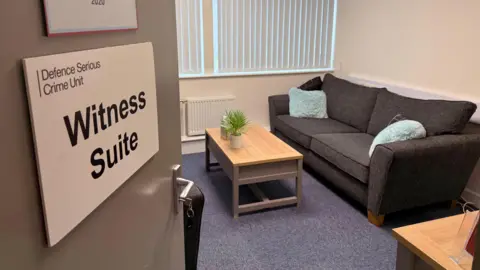
The DSCC were immediately called, and the alleged perpetrator of the rape was arrested the following day. Kate was taken to the sexual assault clinic to undergo a full medical exam.
"I had a lot of bruising to my hips, bum cheeks, lower legs, ankles, and I was found to have blood in my rectum," she recalled.
"All of that medical evidence did get passed to the DSCC, but it doesn't appear they did much with it."
Kate said the man admitted to having sex with her, even "bragging" to colleagues, but the issue ultimately came down to whether consent had been obtained.
A DSCC spokesperson said they were "deeply concerned to hear about this individual's experience".
"We expect DSCC investigations to meet clear professional standards, and we take it seriously when someone feels those standards have not been met.
"We encourage anyone in this position to contact our professional standards department," they added.
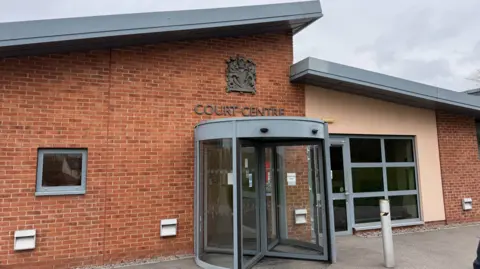
Kate soon received a letter from the SPA to say they would not be pursuing charges against her alleged attacker – largely consisting of what she called "rape-myths".
"It doesn't put forward any of the supporting evidence. It only states evidence that would undermine the case," she said. "It does make you feel like it's your fault.
"I'm obviously angry at [the alleged perpetrator] for doing what he did, but I'm even more angry at the military police and the SPA for not allowing me to have that justice.
"After seeing the stuff that come [sic] out around Jaysley Beck, my mum said 'it could have been you', and it really, really could have been."
McCready, Jaysley's mother, accepts that the DSCC is a step in "the right direction" and said, had it been available to her daughter, "I'd have liked to think it would have made a difference, and maybe Jaysley would still be here now".
However, she still strongly believes "the military should never, ever mark its own homework".
"It has to be completely removed from their hands for soldiers to have faith in the reporting process," she said.
Correction 01 April: This article originally contained a line which stated: "the conviction rate for adult-rape-flagged cases in the Court Martial was 51% compared to 36% in a crown court."
This line was removed from the story on 18 March and has been re-added along with attribution to the Director of the Military Court Service, Cleaven Faulkner.
References to how long a case takes to be heard compared to crown court have also been attributed to him.
We have also included more detail from the MOD guidance which makes clear the reasons why the Crown Prosecution Service and Military Court Service figures are not comparable, including how CPS figures include guilty pleas whereas military court figures do not, and that the MOD guidance states that "Conviction-rate data must be treated with caution and are not indicative of the performance of the system, individual agencies or a trial process".
Follow BBC Wiltshire on Facebook, X and Instagram. Send your story ideas to us on email or via WhatsApp on 0800 313 4630.
