Adams' lawyer questions bomb victims' delay for claim

 PA Media
A barrister acting for Gerry Adams in a civil trial in London has questioned why the three men bringing the claim waited several decades to do so.
The victims allege that Adams, 77, is personally liable for injuries they received in IRA attacks in London and Manchester in 1973 and 1996.
This is the eighth day of the trial at the High Court, which has heard from 12 witnesses including Adams, who testified for almost 10 hours.
The former Sinn Féin leader has insisted he had no role in the explosions and has strongly denied a claim that he was a "major player" in the IRA.
Adams' legal team has said the action should be subject to the three-year limitation period set out in legislation passed in 1980.
On Thursday, the court was told by Adams' barrister that the delay by John Clark, who was injured in the Old Bailey bomb in 1973, in bringing his claim almost 50 years after the attack was "genuinely unprecedented in magnitude".
"We have not been able to find a case where Section 33 (of the limitation act) has been disapplied after such a long delay, almost half a century," said Craven.
Clark did not give evidence in person at the trial due to ill health.
The court heard that in his written statement he gave several reasons for waiting to bring the case, including the death of his wife in 1981 and looking after his young children at the time, and that he also believed after the Troubles ended in 1998 that no claims could be taken.
Craven cited two other civil cases taken in later years including the Omagh bomb claim and the Hyde Park bomb, which were successful, and questioned whether the claimants in this case would have been aware of those.
Referencing the second claimant, Jonathan Ganesh, who was hurt in the 1996 London Docklands attack, Craven said he had only decided to take a case after hearing that Adams had taken action in 2020 against the government over his wrongful internment in the 1970s.
He said Ganesh ultimately did not take his case until May 2022, and suggested that the claimant was not "acting promptly and reasonably".
The third claimant, Barry Laycock, was hurt in the Manchester Arndale Shopping Centre bomb in 1996, and took the witness stand last week.
'Left to last minute'
Adams' barrister suggested that the claimants had left their action "to the last minute" in 2022, after realising the then-Conservative government's Troubles legacy legislation, about to be introduced in Parliament would have prevented new Troubles-era civil cases from being taken.
When questioned by Mr Justice Swift, who is hearing the case, Craven said he did not suggest the claimants were "acting irrationally", but that if it had not been for the impending legacy act, the claim may never have been acted on.
"The door closing was why they rushed to get through it," he added.
The victims are seeking £1 each in "vindicatory" damages.
Adams' lawyers have argued the case is based on "an assortment of hearsay" and that it has been brought several decades too late.
Judge told claims should fail
The judge was also told that the claims should fail on the basis that they are abuse of legal process.
Craven said the true purpose of the legal action was to try to compel the court to carry out a much wider "public inquiry style examination" of Gerry Adams' alleged involvement with the IRA over half a century.
The lawyer said the civil action was not about trying to prove liability for the three bomb attacks, but to try to establish a much wider process which "the court is not intended to perform or is equipped to perform".
"There has been very, very little evidence relating specifically to the three bombings, instead there has been an enormous array of allegations that have no direct connection to those events whatsoever," he said.
A lawyer for the claimants told the judge that the timing of the abuse of legal process application, at the end of the trial, was grossly unfair.
Anne Studd KC said the claimants had run their trial and were entitled as part of that process to a judgement.
The judge said that was not the case, if the proceedings were considered an abuse of process.
'I came to London to reject the allegations'
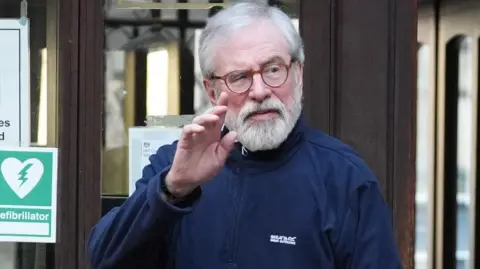
Speaking outside the High Court, Gerry Adams told the media he was restricted in what he could say.
However, he added: "I came to London to reject the allegations levelled against me.
"And to assert the legitimacy of the Republican cause and the right of the people of Ireland to be free.
"I am also here out of respect for the claimants. I am very mindful of the many other victims of the conflict. They too deserve our respect."
