Keep suspended pupils in school, ministers say
 Getty Images
Pupils should not automatically be sent home if they are suspended from school in England and could instead remain on site, the government has said.
Education Secretary Bridget Phillipson said being sent home could mean children "retreating to social media".
She said on-site suspensions should be used for pupils who had not been violent.
The Department for Education (DfE) said the move, which will form part of broader changes to the school system in England, should limit the amount of learning pupils miss.
Pupils can be removed from classrooms without being suspended, and many schools already use internal suspensions - although what that looks like can vary.
The DfE said pupils could sometimes be set "generic work that does not support learning or reintegration" when they were internally suspended, and it would make clear that "internal suspension is a short, structured intervention with meaningful learning and time for reflection".
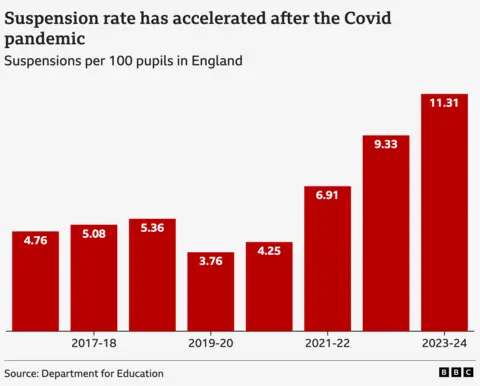
The number and rate of suspensions had been increasing before Covid, but the rise has accelerated ever since.
The number of suspensions increased by 21% between 2022-23 and 2023-24 - from 787,000 to 955,000.
Over the same period, the rate of suspensions rose from 9.33 per 100 pupils in 2022-23 to 11.31 in 2023-24. The largest percentage rise was in primary schools.
Head teachers will decide which form suspensions should take.
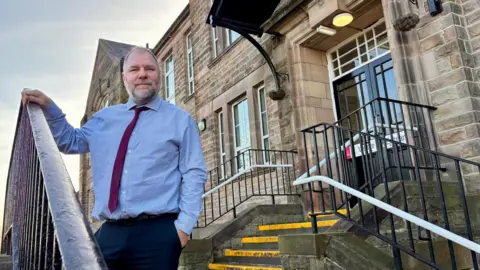
Richard Walkden, head teacher at Ecclesfield Secondary School in Sheffield, said sending children home was seen as a last resort, but suspensions demonstrated to pupils that there were "lines in the sand" when it came to behaviour.
"Suspensions are never easy. They cause harm," he said.
"Lost learning is the biggest one. Students get one chance at education in secondary. They've got five years and every day matters."
But he added: "I fundamentally understand running the schools I have done for many years, that suspensions sometimes are needed and required."
 BBC/ Hazel Shearing
Phillipson said: "Suspensions will always play a critical role in helping heads manage poor behaviour, but time at home today can too easily mean children retreating to social media, gaming and the online world."
She said it resulted in "high levels of lost learning", adding: "We want to restore suspensions as the serious sanction they should be, while keeping young people engaged in their education and reducing the time teachers spend helping pupils catch up."
Phillipson also said this week that all schools in England should follow new government guidance and be phone-free for the entire school day.
Pupils with Special Educational Needs and Disabilities (Send) and those who are eligible for free school meals have much higher rates of suspensions and permanent exclusions than average.
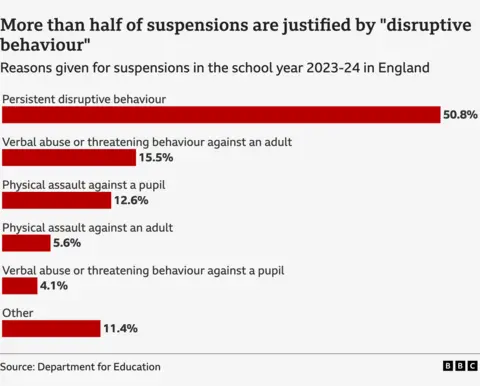
Schools can give up to three reasons for suspending a pupil.
In 2023-24, "persistent disruptive behaviour" made up more than half (51%) of all reasons given for suspensions.
"Physical assault against a pupil" made up 13% and "physical assault against an adult" accounted for 6%.
The DfE said "the most serious and violent behaviour" would still result in pupils being removed from school. Permanent exclusions will continue to exist.
It said it would consult on a new "framework" that would "give heads the flexibility to ensure pupils facing suspension for non-violent behaviour continue learning in a separate, supervised setting, away from other pupils".
The measure will feature in the government's delayed Schools White Paper, which will also set out plans to reform the Send system.
Pepe Di'Iasio, general secretary of the Association of School and College Leaders, said he welcomed greater consistency, but told the BBC there needs to be "greater investment" and "specialist support".
He said "this is happening right now, but it's pulling on the funding that will go into mainstream classes, or to what you're able to provide to support that young person in an internal suspension."
Di'Iasio added: "It's important that you have the people with the right training and specialist support and knowledge to help that young person better understand what they've done and make sure they don't repeat what it is that has happened."
Steve Chalke, founder of the Oasis Charitable Trust that runs more than 50 schools, also questioned how schools would resource more internal suspensions, but welcomed the move to "include children rather than exclude them".
He said there were "other dangers" of children being sent home besides the use of screens.
"It is socio-economically underserved communities that are far overrepresented in terms of suspensions," he told BBC Radio 4's Today programme.
"They're going to wander the streets, they're prone to falling into violence, danger, being groomed, becoming mules in gangs."
Matt Wrack, general secretary of NASUWT teachers' union, said there was an opportunity to "offer helpful clarity" for schools, but questioned how schools would be able to meet expectations without additional funding.
Meanwhile Paul Whiteman, general secretary of school leaders' union NAHT, questioned whether schools had the physical space for internal suspensions.
Marianne Lagrue, a policy manager at Coram Children's Legal Centre, said existing approaches to internal suspensions and removing pupils from classrooms varied.
She said "worst case scenarios" existed where children were being kept in isolation away from friends and the classroom for months "without being suspended or excluded formally".
Isolation could be particularly difficult for pupils with certain types of Send, she added.
"We hope that with the Schools White Paper... the Department for Education will take the opportunity to make sure that those children get better support rather than just being isolated in a room with no stimulation."

Sign up for our Politics Essential newsletter to keep up with the inner workings of Westminster and beyond.
