England was 'close' to suspending courts after 2024 riots

 PA
PAJustice chiefs almost had to shut down the country's magistrates' courts as prisons became overwhelmed in the wake of the 2024 riots, it has been revealed.
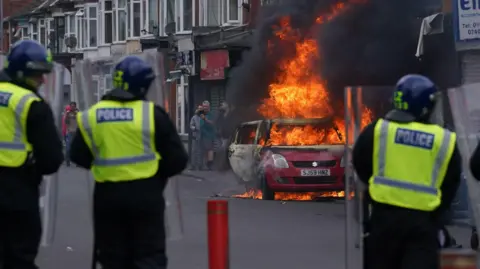
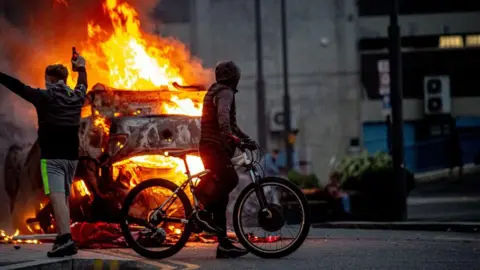
Hundreds of defendants were fast-tracked through the courts after six days of violence and disorder, fuelled by online misinformation that followed the Southport dance class murders of three schoolgirls.
Rioters who had attacked police, started fires, and besieged mosques and hotels housing asylum seekers were held in custody after their first court appearances.
The situation meant senior judges and the Ministry of Justice considered suspending new hearings so that no-one else could be sent to the overflowing prisons.
Lord Justice Green, the senior presiding judge for England and Wales, revealed details of the crisis as he called for greater collective working across the criminal justice system, as well as the introduction of an "early warning system" to alert government ministers if there is a looming disaster in the courts.
He said police, prosecutors, courts and prisons collaborated successfully in the aftermath of the riots in late July and August 2024, rapidly sharing evidence and bringing criminal charges to send a deterrent message to quell the rioting – while not causing the prison system to breakdown.
"As each day passed, cell capacity dwindled and we headed towards crisis point," he said.
 Getty Images
Matters came to a head on 27 August 2024 after a bank holiday weekend which saw a new wave of arrests at Notting Hill Carnival and the Leeds and Reading Festivals.
At a 09:00 BST meeting over Microsoft Teams, senior figures in the justice system met to discuss the situation.
"If we survived that day, we knew that prison vacancies would increase over the next week," he said.
"At one minute past nine we learnt that we were close to capacity."
Green said the courts would have had to be suspended had that happened.
But he said: "We had survived, by a filament dangling by a thread from the skin of our teeth.
"We survived because, collectively, over the preceding days, over Teams, decisions were made which balanced the need for swift justice with the regulation of remands into custody."
How large is the backlog?
Green made remarks at London's Guildhall at the first annual conference of the Criminal Courts Improvement Group, which was established in 2021 in a bid to tackle growing backlogs of cases in the Covid pandemic.
Emergency measures have been taken by the last Conservative government and the current administration to set thousands of prisoners free from prison early, as the jails reached full capacity.
The government published its long-awaited Courts and Tribunals Bill on Wednesday, kick-starting a planned reform of the courts which includes stripping back the right to jury trial and using AI and digital technology to increase efficiency.
The crown court backlog is currently at about 80,000, with some trials now being listed in mid-2030. The backlog is expected to reach 100,000 next year.
The Lady Chief Justice Baroness Carr told the conference that pilots were already under way of AI tools being used to improve the way criminal cases are listed, while so-called Blitz courts are being planned across England and Wales to try to cut the backlog.
Baroness Carr said: "Reform can offer bold options for modernisation, and modernise we must, but it is essential that we always apply due diligence and we guarantee that no shortcuts are taken to compromise justice and the fairness of our procedures.
"Human judgment must lie at the heart of the system."
The government announced a £2.78bn financial settlement for the justice system from the Treasury this week.
It is hoping to pass reforms to jury trial and the court processes through Parliament by the end of the year, with changes coming into force by 2028.
Read more stories from Cheshire, Lancashire, Greater Manchester and Merseyside on the BBC, watch BBC North West Tonight on BBC iPlayer and follow BBC North West on X.
