To go or not to go: Should pupils be allowed to use the toilet when they want?

 Getty Images
Can you hold it? Is it safe to hold it? Should you be asked to hold it?
These are some the questions being worked through in secondary and grammar schools across Northern Ireland, as pupils and teachers search for the right answer to the age-old classroom question: Can I go to the toilet?
Some schools with a stricter policy say pupils should only go between class or at break times, due to the risk of classroom disruption or truancy, vandalism and vaping in bathrooms.
For pupils, however, it can mean undignified waits or requests to go, which they say "infringes on human rights".
Some young members of the North West Youth Ministry - which supports children and teenagers in the Derry City and Strabane council area - have gone so far as to lobby the council to ask every school in that area to clarify their toilet policy.
Education officials say it's a matter for individual schools to consider issues like behaviour, safeguarding and their duties to pupils' individual needs - including "those arising from menstruation or medical conditions".
BBC News NI spoke to pupils, teachers and principals on the ins and outs of a debate exercising school pupils and teachers alike.
What have young people been saying about it?
 Kayla
KaylaBen and Kayla are two members of the North West Youth Ministry who are lobbying for clarity on when they and their peers can go to the bathroom on school time.
At a recent youth-focused engagement event called Have Your Say, Kayla said "everybody was talking about" the issue.
"It feels like everybody is being punished for the bad actions of a few people, and that's not fair.
"Using the toilet shouldn't be a privilege, it is a basic right," the Year 10 pupil from Londonderry said.
 Ben
BenBen added that "pupils cannot be expected to focus with a full bladder".
"I know teachers say classes are only 30 minutes long and we should be able to hold it for that long, but double periods are an hour, which is quite a long time."
Both Ben and Kayla said their schools expected pupils to go during break time and lunch, while other schools in the area operate different rules with some having pupils log themselves in and out of class when they need to go.
"I can sort of understand why teachers might be reluctant to let somebody out at the beginning of a class right after break," Ben added.
"But even at that, you can't always perfectly plan and predict when you're going to have to use the toilet."
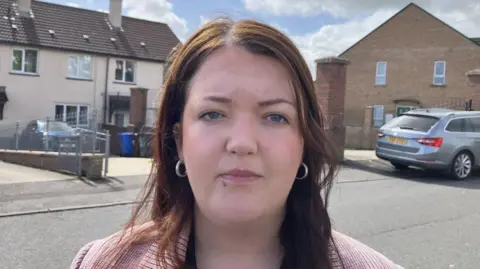
Sinn Féin councillor Emma McGinley, who brought the relevant motion before the council, said she had been contacted about the issue by "parents, young people and even classroom assistants and teachers".
"At more or less every youth engagement I've had over the last three years, this has never failed to come up," she said.
McGinley said she was recently called by a parent whose son felt embarrassed that every time he went to the toilet he had to produce a doctor's note.
"Her son has issues with his kidneys and it's not something he wants everybody in his class to be aware of."
She said vaping and antisocial behaviour were "relevant concerns" but collective punishment was unfair.
The councillor also said she was particularly concerned for young women managing periods, as well as those with endometriosis - a condition which, among other things, can cause painful, urgent bowel movements or urination.
She called for schools to give pupils the same autonomy that people get in their workplaces.
"As adults, we are given the dignity, if you're at your work and you need to use the bathroom, you just go and you do it. Why are we not giving young people that same dignity?"
What do teachers and principals think?
 Graham Gault
The toilet debate is just as live among educators as it is among young people.
In a UK-wide study focusing on toilet access for those on their periods, almost a third of teachers (30%) felt students should wait until the end of a lesson to access a toilet.
Graham Gault, Northern Ireland secretary of the National Association of Head Teachers (NAHT), thinks all school toilet policies are "designed to protect pupils and learning, never to punish children".
However he said that school leaders "fully recognise the importance of pupils being treated with dignity and sensitivity".
"No pupil should be made to feel embarrassed or unsupported when they have a genuine need to use the toilet during the school day," said Gault.
However there has to be a balance with "the complex realities of school life," he added, citing issues of safeguarding, supervision, class disruption and vaping.
"Schools, therefore, have to strike a careful balance between individual need and the safe, orderly running of the whole school."
 Brian Banks
Brian Banks, a teacher at Hazelwood College, Newtownabbey, said it's a big debate in the sector, with different schools adapting different policies.
However, his view is that "having a strict policy about using the toilet is madness".
"In our school, except for the first and last five minutes of class, pupils can use the toilet whenever they ask.
"I know some schools lock toilets at various times, but ours are pretty much always available."
He said notes were kept of bathroom breaks, so year heads could look and see "patterns of toilet behaviour", but overall Banks said it was a "humane approach".
"If they ask and I say no, then they have an accident, that pupil is going to be humiliated to the point of being psychologically scarred, and I'm likely going to end up in front of an industrial tribunal, and rightly so."
Banks said it could be "extremely disruptive" permitting every classroom departure that is requested but said "it's the only way".
"Even if 95% of the time I am right when I think a pupil is a malingerer who doesn't really need to use the bathroom and just wants to go for a walk around the school, that 5% of the time I'm wrong is what matters. So why take the chance?"
 Getty Images
A spokesperson for the Education Authority (EA) said managing access to toilets was a matter for individual schools.
"Schools have a duty of care to their pupils, which includes ensuring reasonable access to toilet facilities. This forms part of the pastoral care responsibilities of boards of governors and principals."
Factors schools must consider, said the EA spokesperson, include behaviour management, safeguarding and their responsibilities to meet pupils' individual needs - including "those arising from menstruation or medical conditions".
"Whilst challenging, all schools are expected to act reasonably and with due regard for the health, wellbeing and dignity of all pupils."
