Tories say Zahawi peerage request turned down before defection to Reform UK
Former Chancellor Nadhim Zahawi has become the latest senior Conservative to defect to Reform UK, as Tories claim the move came after he was rebuffed for a peerage.
Zahawi, who is a former MP, said he felt the UK had reached a "dark and dangerous" moment, and the country needed "a glorious revolution", as he outlined why he was joining Nigel Farage's party.
However, Conservative chairman Kevin Hollinrake said the move came after he made "a number of approaches" to party leader Kemi Badenoch, pressing his case to be nominated for the House of Lords, but was rejected.
Farage unveiled Zahawi's defection at a press conference on Monday, one of around 20 former Tory MPs to join the party.
Zahawi was chancellor for two months under Boris Johnson and served as a minister from 2018 to 2023, making him the most senior former Tory to join Reform so far.
Speaking in a pre-recorded video before walking out on stage at the press conference, former minister Zahawi said Britain was "broken".
He said: "Nothing works, there is no growth, there is crime on our streets, and there is an avalanche of illegal migration that anywhere else in the world would be a national emergency."
He added: "I've made my mind up that the team that will deliver for this nation will be the team that Nigel will put together and that's why I've decided that I'm joining Reform."
Answering questions from journalists, Zahawi said Badenoch had the "baggage of a defunct brand", before Farage said elections in Scotland, Wales and English councils this May would be the point where the Conservatives "cease to be a national party".
But Hollinrake suggested Zahawi's thwarted "personal ambition" was linked to his decision to defect, telling the BBC he had been unsuccessfully pressing his case for a Conservative peerage with "people very close to Kemi".
The party chair said conversations had taken place in recent weeks, adding: "It seems strange to change his perspective only a few weeks down the road from those conversations taking place."
He said: "Our position was very clear, Kemi's position was very, very clear - we want to make sure the people we elevate to the House of Lords are the right people, who make the right contribution and, indeed, have the right back story.
"We were very concerned Nadhim's past problems with his tax affairs, which led to his dismissal in the past from a role in the party.
"It was quite clear that we didn't feel Nadhim was the right person to be elevated to the House of Lords."
A source close to Zahawi said: "Nadhim did not beg for a peerage as they claim - Kemi called him for advice on how to save the party and he decided to join the only party he feels can save Britain."
Earlier, a Conservative spokesman said Reform was "fast becoming the party of has-been politicians looking for their next gravy train".

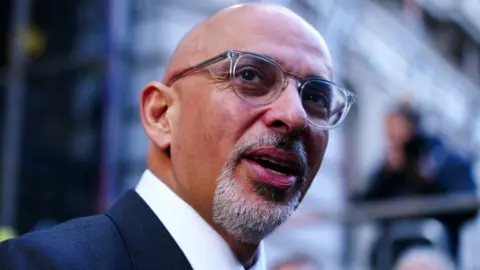 PA Media
Farage insisted that this latest Tory defection did not mean Reform was becoming the Conservatives 2.0.
He added there were "plenty" of current Conservative MPs asking about joining Reform and some were not being accepted, but he said Zahawi believed "in what we're doing" and also has the necessary "conviction".
As well as his two months as chancellor at the end of Boris Johnson's time as prime minister, Zahawi was education secretary, Chancellor of the Duchy of Lancaster and chairman of the Conservative Party.
He was sacked from that last position by Rishi Sunak in January 2023 after the prime minister's independent ethics adviser found that he had broken ministerial rules by failing to disclose that his tax affairs were under investigation by HMRC.
Asked by the BBC about being sacked over his tax affairs, Zahawi said: "The mistake I made was not to be specific about my declarations to the Cabinet Office.
"I absolutely think that politicians should be held to a higher level of accountability but I shouldn't be precluded from doing the right thing by my country."
The Labour Party chair, MP Anna Turley, said Zahawi was "a discredited and disgraced politician" who had previously "repeatedly lambasted his new boss over his divisive and extreme rhetoric".
"This shameless scurry of yet another failed Tory over to Reform will tell people everything they need to know about both of them," she said.
And the Liberal Democrat MP in his old constituency of Stratford-on-Avon, Manuela Perteghella, said: "Reform is becoming a retirement home for disgraced former Conservative ministers."
Zahawi was a candidate to succeed Johnson as prime minister in 2022 but only attracted the support of 25 of his colleagues and was eliminated in the first round of the leadership contest which Liz Truss won.
He was education secretary from September 2021 to July 2022, and his short stint as chancellor of the exchequer came between July and September 2022.
In November 2020, in the middle of the pandemic, he was appointed vaccines minister and oversaw the rollout of the coronavirus vaccine programme for nearly a year.
Born in Iraq in 1967, Zahawi's family fled Sadam Hussein's rule when he was 11 after his father was threatened with arrest and he grew up in the UK.
Had the family stayed in Iraq, he told Nick Robinson on the Political Thinking podcast in 2021, he could have been sent to fight in the 1980s Iran-Iraq War. "I would have been drafted in to the Iraqi army, had to go to front line and probably die."
Questioned on whether he had concerns about allegations of racism made against his new party leader by more than 30 school peers, claims denied by Farage, Zahawi responded: "If I thought the man sitting next to me had in any way a problem with people of my colour… I wouldn't be sitting next to him."
Correction 15 January: This article was amended to describe more clearly why Nadim Zahawi's family fled Iraq to the UK and to remove the inadvertent suggestion they did so to avoid him being conscripted into the Iraqi army. His father was targeted by the regime and left the country in December 1977, followed by the rest of the family in 1978 - two years before the Iran-Iraq war began. We have also clarified that Zahawi said in a BBC interview that if the family had remained in Iraq, he would have been conscripted.

Sign up for our Politics Essential newsletter to read top political analysis, gain insight from across the UK and stay up to speed with the big moments. It'll be delivered straight to your inbox every weekday.
