How Cornwall shaped the imagination of famous writers

 BBC
BBCCornwall's cliffs, moors and sea views have sparked some of Britain's most iconic literature. From Poldark to du Maurier's Rebecca and Woolf, we explore how the county's dramatic landscapes continue to inspire generations of writers.
For hundreds of years, Cornwall writers have drawn on its rugged cliffs, stormy seas and mining history for characters, settings and storylines.
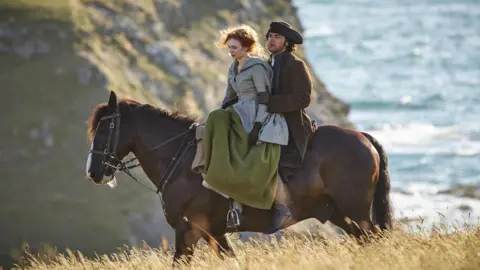
Ross and Demelza Poldark were born from Winston Graham's coastguard watch over the coast at Perranporth, where the sea meets old mining works.
It was Virginia Woolf's childhood view from Talland House in St Ives across the bay to Godrevy which inspired three of her books, including To the Lighthouse.
For Daphne du Maurier, Fowey struck a chord. She set many of her novels there with a freedom she had not felt before.
It was Bodmin Moor's rich history and St Austell's clay pits which sparked more than 40 novels for EV Thompson, while his son Luke continues to focus on Cornwall's landscape in his own work.
Winston Graham: Storms, mines and Poldark
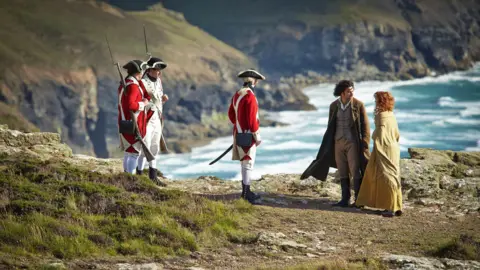
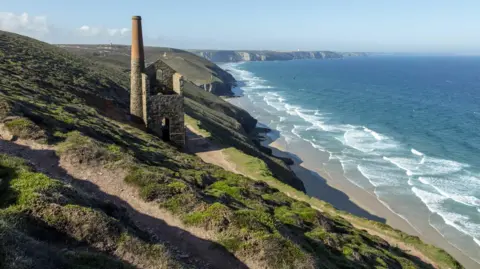
Keeping watch over Perranporth Beach and its steep cliffs led Winston Graham to create Ross Poldark.
He wrote a 12-book series around the character, a British soldier who returns to Cornwall from the American War of Independence and rebuilds his tattered estate, reopens his father's derelict mine and finds love.
Graham moved to Perranporth from Manchester aged 17 in 1926 and wrote the first four Poldark books there.
His son, Andrew Graham, said his father had been a coastguard during World War Two, based in a small hut on Perranporth Beach.
Graham said: "They were sitting there watching the sea and the wind and the cliffs, where there were still the remnants of the mine tunnels coming out.
"So seeing all of that, I think, and sitting there on your own looking at the stormy weather, that's when I think the Poldarks got into his imagination."
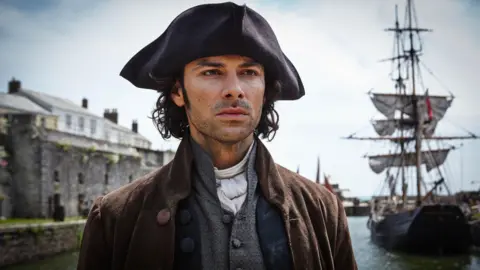
Andrew said his father had garnered authenticity through people and detail.
He said: "It was from him listening, sitting there with these people who were dentists, builders, fishermen, people looking after the beach around him, that he got the feel of the Cornish voices.
"He began to think more about the history of Cornwall as these people had lived there all their lives, they knew about the mining, they knew about the fishing."
Graham consulted Fred Harris, a historian of Cornwall, during his writing.
Andrew said: "I know my father talked over all the details of his books with Fred in considerable detail.
"When Dwight Enys goes into Launceston Prison, the account of what it's like in there is drawn from records of the time - it's absolutely on target."
Virginia Woolf: Light, sea and the imagination
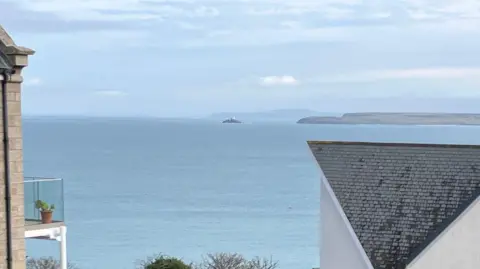
There has been an outcry from local authors and Virginia Woolf fans across the world as the iconic sea view from Talland House, St Ives, is set to be blocked by a five-storey development.
During her childhood, Virginia Woolf was inspired by the view across St Ives Bay to Godrevy Lighthouse and the coast beyond from her family's holiday home.
In To the Lighthouse she described this view: "The great plateful of blue water was before her, the hoary lighthouse, distant, austere, in the midst; and on the right as far as the eye could see, fading and falling, in soft low pleats, the green sand dunes with the wild flowing grasses on them, which always seemed to be running away into some moon country, uninhabited by men."
Emeritus professor Maggie Humm, vice chair of the Virginia Woolf Society of Great Britain, said the view was "absolutely central to Woolf, absolutely entwined".
"For 13 years, Virginia Woolf - or Virginia Stephen, as she was then - woke up to the view of Godrevy Lighthouse, and it was the last thing she saw at night when she went to bed... it just flooded her imagination and creativity.
"There are a lot of references in her writing about light, how light transfigures people, how it changes characters, and it all stems from that very, very early moment, those 13 years, when she was seeing Godrevy."
In the 1920s and 1930s, the view informed three of her novels - Jacob's Room, The Waves and To the Lighthouse.
EV Thompson: Moorland mysteries and mining roots
 Matt Jessop/Visit Cornwall
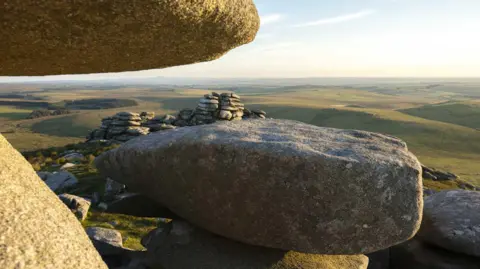
Ernest Victor (EV) Thompson's son Luke described how a chance encounter of bluebells outside a derelict miner's cottage on Bodmin Moor began his father's literary journey.
Luke Thompson said: "It was on Sharp Tor and my father was walking, probably walking the dogs up on the moor, and came across bluebells, something that didn't really belong exactly where it was.
"He was inspired to think of who planted it and what was their thinking and what was their story because it would have been, presumably, a mining cottage at some point that was on that spot.
"So, that kind of started a way of thinking that developed into Chase the Wind, which was the big first novel."
Chase the Wind, the first of the Retallick saga, was voted the best historical novel of 1977, with Thompson going on to write about 40 historical novels, most of them set in Cornwall.
After living in Sharptor, Thompson bought a house at the top of Mevagissey where his writing room had views of the sea and the clay pits near St Austell, which feature in a number of novels, including Ben Retallick, Polrudden and Ruddlemore.
"All of these things that he was seeing and that were immediately around him were the stories that he was sort of looking for," Thompson added.
Daphne du Maurier: Finding freedom on Cornwall's waters
 James Osmond/Getty Images
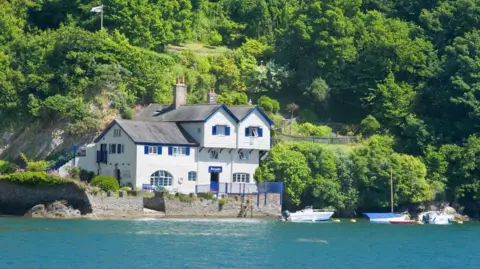
Daphne du Maurier described seeing the old boatyard at Bodinnick, near Fowey, for the first time at the age of 19 as: "Here was the freedom I desired, long sought for, not yet known."
In her autobiography, Taken from Myself When Young: The Shaping of a Writer, she wrote: "There was a smell in the air of tar and rope and rusted chain, a smell of tidal water.
"Down harbour, round the point, was the open sea.
"Here was the freedom I desired, long sought for, not yet known.
"Freedom to write, to walk, to wander, freedom to climb hills, to pull a boat, to be alone."
While Fowey featured in nearly all her work, Ann Willmore, who manages the du Maurier website, said "it was a total transformation moment because she suddenly saw the place that she wanted to be and the place as a piece to write".
 J Wilds/Keystone Features/Getty Images
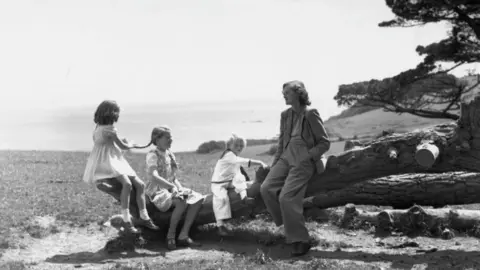
In her novel Rebecca, du Maurier reimagined Menabilly, the house near Fowey she lived in as the heroine's home, Manderley.
Willmore said: "She loved the house probably more than anything else for part of her life.
"She was an observer of people and things, so there's loads of weather and it's very real.
"She listened and watched and pulled everything into her books.
"I think that's why, even though she wrote them a long time ago, they're probably still relevant to people," Willmore added.
Cornwall today: Writers continue the legacy
 Adam Gibbard/Visit Cornwall
Today, Cornwall's landscape continues to act as a catalyst for writers, many of whom Luke Thompson has taught at Falmouth University.
His book Treasures of Cornwall is a literary anthology about the coastline, moorland and mines, which he grew up around.
Thompson said: "I think there's an appreciation and love of the landscape that you can have from being familiar with it and I think you look at it and write about it differently."
He said being surrounded by the sea was "sort of awe-inspiring and sort of peaceful, but also terrible" due to its power.
Like his father, Thompson has been inspired by Bodmin Moor: "As well as medieval and the mining of the 18th century onwards and the quarrying, you can probably see a wind farm, you can probably hear the A30, so you've got just everything.
"You've got thousands of years' worth of history just within arm's reach."
Across its cliffs, moors and harbours, Cornwall continues to inspire creativity just as powerfully as it did for Graham, Woolf, du Maurier and Thompson. Today, its landscapes remain one of Britain's richest literary well-springs.
Follow BBC Cornwall on X, Facebook and Instagram. Send your story ideas to spotlight@bbc.co.uk.
