UK's first legal drug consumption room registers almost 600 users

 PA Media
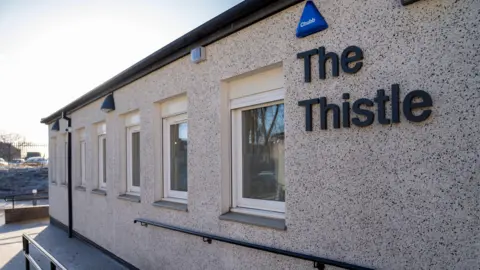
The UK's first safer drug consumption facility has registered 575 users in its first year.
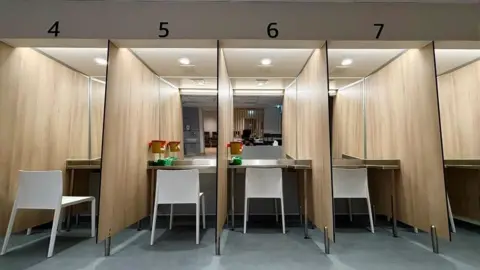
Since opening on 13 January 2025, The Thistle has been accessed 11,348 times and used for 7,827 injections of illegal drugs. Staff on site also managed 93 medical emergencies.
The facility on Hunter Street, Glasgow, allows people to inject heroin or cocaine while under medical supervision without being prosecuted.
The centre referred 612 people to other services, such as housing, in a bid to get them off drugs.
The Scottish government committed to making up to £2.3m available annually for The Thistle, which is overseen by Glasgow City Integration Joint Board.
Scottish drugs minister Maree Todd said the facility had already had a "profound impact".
"Through the ability of staff to respond quickly in the event of an overdose it has undoubtedly saved lives," she said.
"I would like to thank all staff and partners for their work in establishing the service, working with some of the most vulnerable people in our society to help save and improve lives, and their continuing efforts to support and engage with the local community."
Scotland has recorded the highest rate of drug deaths in Europe for the past seven years.
In 2024 there were 1,017 drug misuse deaths, down by 155 on the previous 12 months.
Users of The Thistle are mostly men, with 448 male and 127 female registered in the past year.
Following complaints from neighbours in Calton, in Glasgow's east end, about an increase in discarded drug paraphernalia, needle bins were installed at "key sites" around the Thistle.
A Glasgow City Council spokeswoman said they now had outreach staff out daily to report back any discarded litter.
Councillor Allan Casey, city convener for addictions, described the first year as "remarkable".
He added: "People are engaging with the service and trusting it as a safe space."
Casey acknowledged there was still much to to do.
But he said: "What we are seeing from the first-year data is the real impact of a compassionate, evidence-based approach to this public health emergency and reinforces why progressive policies matter and why Glasgow continues to lead the way in tackling complex challenges with practical solutions."
Rising numbers 'a positive sign'
Since The Thistle opened, cocaine has accounted for about a third of substances injected, but officials said there was anecdotal evidence of a shift to smoking or inhalation of drugs, particularly cocaine.
In September Glasgow's health board warned drug users against inhaling crack cocaine following a series of suspected drug incidents.
It is currently not legal for Glasgow City Health and Social Care Partnership tooperate a smoking room, but it is planning talks with the Scottish government over amending regulations to define The Thistle as an "exempt service".
Dr Saket Priyadarshi, associate medical director and senior medical officer for Glasgow Alcohol and Drug Recovery Services, thanked colleagues delivering the service "safely and effectively on a daily basis".
"The rising numbers in recent months is a positive sign and is promising for the year ahead, as well as our plans to progress a smoking/inhalation space in the facility," he added.
A drug consumption room was first proposed in 2016 following an HIV outbreak in the city.
The UK government initially refused to provide a waiver to the Misuse of Drugs Act, which would ensure users would not be criminalised.
It was only when Scotland's senior law officer Lord Advocate Dorothy Bain KC said it would not be in the public interest to prosecute service users that the path was cleared for The Thistle to open last year.
Safe consumption rooms have existed in some parts of Europe since the 1970s, with legally sanctioned ones coming into place in the 1980s.
Edinburgh City Council is currently looking to open a similar facility in the Scottish capital.
A bill that would have given people with drug and alcohol addictions the legal right to treatment has been rejected by the Scottish Parliament in October.
