Warning as lead and arsenic wash up on beach

 BBC
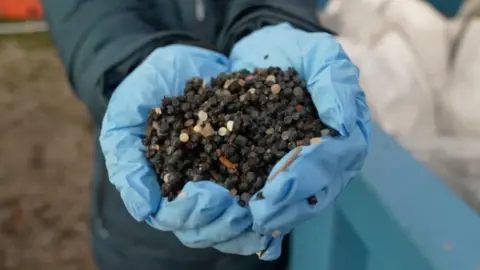
BBCHeavy metals, including lead, arsenic and cadmium, have been found on plastic pellets which washed up in their millions along the Sussex and Kent coast.
Scientists at King's College London university tested 200 bio-beads, gathered from Camber Sands in East Sussex, and found they contained a number of heavy metals which could be toxic to wildlife.
The beads are likely to have come from a pollution spill which happened over a month ago from a Southern Water wastewater treatment works in Eastbourne.
Southern Water has apologised for the spill and said it was "unable to comment on third party testing".
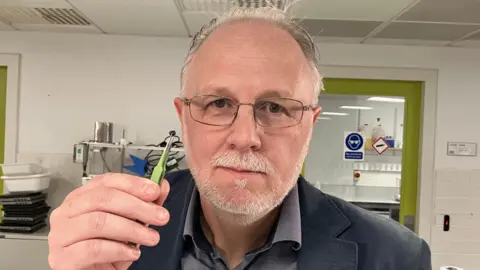
Prof Andreas Baas, an expert in microplastics in coastal environments, and his team at King's College London university tested the plastic beads for heavy metals using an X-ray fluorescence scanner.
They found the bio-beads contained antimony, barium, lead, rubidium, strontium, cadmium, thorium and arsenic.
Although the levels do not reach that for hazardous plastic waste, Prof Baas said the findings were worrying for wildlife.
'Potentially toxic'
Prof Baas said if birds ate the pellets, or consumed fish which had eaten them, the heavy metals could have an impact on the animal's nervous system.
He said previous studies had shown that "some of these metals can be released from the beads through the acidic environment in the gut and then they might have potentially toxic impacts on the birds".
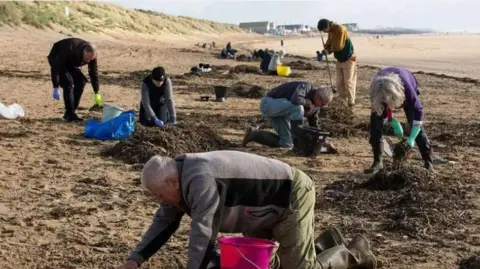
Since the bio-bead spill was discovered at the beginning of November, volunteers and Southern Water employees had been carrying out a large clear-up operation.
Sussex Wildlife Trust has also been trying to find ways to remove thousands of beads which have found their way on to Rye Harbour Nature Reserve.
The reserve is a protected habitat, home to many rare plants and animals.
The trust said the size, shape and buoyancy of the plastic beads meant birds and fish could mistake them for food.
 Getty Images
Henri Brocklebank, the trust's director of conservation, said Prof Baas' findings amplified "the need to get these beads out of the natural environment" and to "fast track the removal of them from our waste water treatment works, not just in Sussex, but nationally".
Prof Baas also highlighted concern for plants which come into contact with the beads.
He said if the beads got blown into sand dunes and started to deteriorate they could "release these heavy metals into the soil matrix, where they can be taken up by plant roots and then they can have potentially toxic effects on the plants themselves".
Electronic waste regulation change
Southern Water has previously said the bio-beads in its Eastbourne treatment works were "non-toxic, non-hazardous and chemically stable".
In the past many of the plastic beads used in biological aerated filter wastewater sites, like the one at Eastbourne, were made from recycled electronics including TVs and computers.
However, in 2003 the practice changed when an EU directive placed limits on the amount of heavy metals products could contain.
Prof Baas said the same heavy metal contamination discovered in the beads taken from Camber Sands had been found in previous studies where the beads were composed of recycled electronic waste.
He said the bio-beads were certainly "not just pristine plastic and should not be ingested by animals".
The Eastbourne wastewater treatment site was built in the late 1990s and it is not clear if the beads that spilt from the works at the end of October pre-date the 2003 regulation change.
Prof Baas has sent his findings to the Environment Agency (EA) which says it is carrying out its own investigation into the spill.
Southern Water said it had "independent experts carrying out an investigation", in addition to the EA's investigation.
Follow BBC Sussex on Facebook, on X, and on Instagram. Send your story ideas to southeasttoday@bbc.co.uk or WhatsApp us on 08081 002250.
