Native bluebells given a 'fighting chance'

 Shirley Boyt
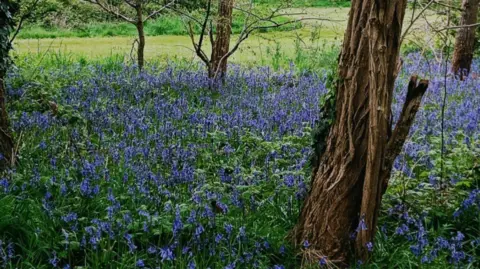
Nature lovers are set to remove invasive Spanish bluebells in a bid to protect the native English species in an ancient woodland.
The Friends of Town Lane group has been given permission from Wokingham Borough Council to dig up the larger Spanish bluebells from the edge of Bulmershe Park in Wokingham, Berkshire.
Leader Shirley Boyt said the goal was to give British bluebells "a fighting chance".
The much-loved violet-blue flowers appear in April and May, carpeting woodland floors before leaves fully develop on the trees above.
The Spanish bluebell, Hyacinthoides hispanica, was introduced into Britain and Ireland by the Victorians as a garden plant and can be found today alongside the native bluebell in woodlands as well as on road verges and in gardens.
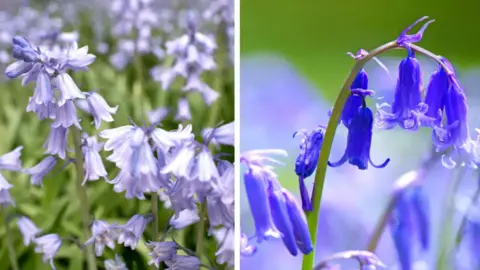
They have upright stems, no scent, and coloured pollen inside.
The British variety, Hyacinthoides non-scripta, has narrow leaves, deep violet-blue (sometimes white), narrow, tubular-bell flowers, with tips that curl back, flowers on one side of the stem, distinctly drooping stems and a sweet scent.
 Getty Images
Boyt said there were concerns that the native bluebells would eventually "disappear" as pollinators land first on the Spanish bluebells, then on the native ones, and they hybridise.
She said: "Some of the bluebell woodlands are about 400 even 500 years old.
"They have taken a very long time to establish themselves as those lovely carpets of bluebells.
"We can see around the edges of many of those woods that the change is happening."
It is illegal to pick, disturb or transplant bluebells in the UK.
The group's members were given permission by the authorities as they have the expertise needed to tell the difference between the two species.
They have already started the process of digging up the "invasive species" in the four-acre woodland of Bulmershe Park.
Boyt said it was an "ongoing process that depends greatly on the number of volunteers".
The group is trying to remove the Spanish bluebells from the edge of the woodland to create a "fire break" gap.
"We're never going to stop them, we realise that because obviously bees and other pollinators don't deter between them.
"We're just trying to protect it for generations to come because the carpets of bluebells we see this time of year are absolutely beautiful and we are so lucky."
